
Authored by Steve Watson via Modernity.news,
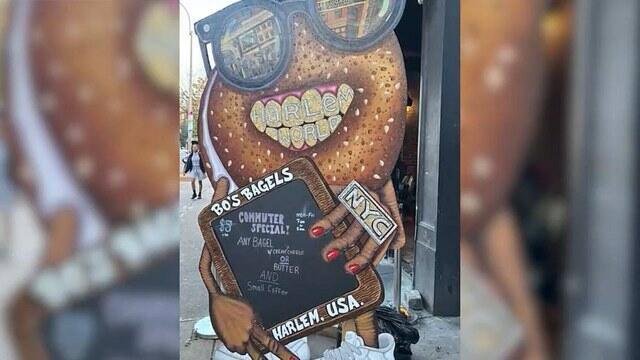
A Harlem bagel shop that has served its neighborhood for nearly a decade was forced to pull a cartoon mascot from the sidewalk after an influencer declared the smiling, sunglasses-wearing bagel a "blackface bagel."
Yes, really. Bagels are now racist.
Threats and harassment followed. The offense was a piece of local street art.
Bo's Bagels on West 116th Street, opened in 2017 by New York native Andrew Martinez and co-owner Ashley Dikos after they could not find decent bagels in the area, displayed a life-sized cardboard cutout that doubled as a chalkboard sign.
Designed by Harlem-based artist Tom Sanford, the mascot featured golden grills reading "Harlem World," a large gold ring marked "NYC," and the cheerful expression of a cartoon character.
Critics treated the grills, ring, and browned cartoon skin as evidence of a racist caricature.
The sequence began with Harlem photographer Carl Broady, who posted on Instagram that the sign was a "disrespectful caricature of black people."
He wrote that "the sign's exaggerated features, bulging lips and teeth, and darkened skin tone [...] recall the racist caricatures historically used to degrade Black people."
The post gained traction. TikTok creator Anastazia X, who has roughly 4,000 followers and produces content under Black Star Reviews while involved with Harlem Votes, visited the shop and amplified the claim.
In her video she called the cutout a "blackface bagel" and said "it's not funny," while describing other art inside as "a little askew." She also stated the shop was white-owned and that an email she sent had been ignored. The video spread, drawing comments that framed the grills and overall look as stereotypical.
Martinez, who has lived in Harlem for nearly 20 years, told the New York Post the situation "got completely out of hand by a bunch of people who know nothing about us. And the rage was coming in from people who just wanted to call us racist."
He said callers contacted his Black employees with the message "you need to leave there because your owners hate you," which he rejected as untrue. Other influencers arrived to film additional videos.
The owners removed the cutout from the sidewalk and placed it out of sight. Martinez noted that local customers already know the shop's record: "This is actually almost weird to us because Harlemites love us. They know what we do. We donate to schools. We give food away to the homeless shelters."
Sanford, who has lived in Harlem since the mid-1990s and whose other work includes life-sized Knicks player cutouts displayed near City Hall during the team's recent championship run, rejected the blackface framing.
"I did not intend it to be necessarily African American, but I did want it to be of Harlem," he told NBC New York. He added, "Personally, I do not see uptown streetwear culture in a negative light at all," and described the grills and related elements as "overwhelmingly positive cultural contributions that came from the streets of my neighborhood and crossed over into the mainstream."
He said he wanted "nothing more than to celebrate that culture," linking the design to hip-hop and neighborhood street style rather than historical minstrel imagery.
Co-owner Ashley Dikos, who has run the shop with Martinez for nearly a decade, described the piece the same way: "That art to me was celebratory, positive. He's smiling, it's a bagel, it's a cartoon. It just wasn't ever supposed to be controversial." She later observed that "being a business owner is not for the faint of heart."
Neighborhood reactions were not uniform. One longtime Harlem resident told the Post he saw "stereotypical imagery" in the gold chains and overall presentation, comparing it to older caricatures.
Another resident, Genisha Metcalf, said plainly "that's not blackface" and that labeling the sign racist went too far.
Local accounts on X later questioned the rush to condemnation, noting the shop's employment of Black staff and its support for neighborhood causes, and asked why energy was directed at a cardboard mascot rather than other issues in the area.
Anastazia X later told the Post she was "sorry that employees and the owner have been harassed as a result of the video" and that "that was not my intention and I don't condone or support any behavior of that kind."
The episode fits a familiar pattern in which ordinary commercial expression - here a smiling bagel character referencing the very neighborhood street culture the artist and owners live in - becomes the next target once the online machinery identifies an angle.
When a cartoon bagel with grills and a ring can generate this response and force a small business to alter its storefront, the standard for offense has expanded beyond comprehension.