In Ireland, where I grew up, the mountains roll low along the horizon,
a shadow of their former selves. They are treeless, or planted with industrial conifer plantations, less likely with each year to ever recover their former glory, thanks to the now-acidified soil. The megafauna which found refuge there centuries ago – including wolves and bears – has long been killed off.
Today, I look out of my window, and a green mountain shoots up proudly, peaking into jagged limestone. The tallest mountain in Ireland is just over one thousand metres. The one I see just out of my kitchen window as I make my morning tea, bleary-eyed, is taller than that. Venture a bit further east, and you’ll find some above two and a half thousand metres. Cantabrian brown bears roam somewhere up there, sometimes venturing down into our village in autumn in search of fruit. Wolves ghost around this landscape, too.
There is much more to mountains than their romanticisation as sites of self-realisation by urban excursioners and Western nature writers. Their natural topography tends to harbour immense diversity – ecological, cultural and otherwise. They are not a backdrop to human activity, or a ‘landscape’ to visit; they are the protagonists, the very formers of experience. For some cultures, they are ancient gods, and it is easy to see why. They are also dark spaces when it comes to surveillance and the state.
There is a local joke here that speaks to a pride in resistance to conquest through the centuries: Asturias es España, y lo demás tierra conquistada. ‘Asturias is Spain, the rest is just conquered territory’. There is also some historical truth to it, given the history of struggle against the Romans and the Moors. These mountains are wild places; unconquerable, resilient, hard to govern. The people who have lived here over millennia tend towards the same.
Mountain tenacity is a pattern repeated worldwide. When the late James Scott wrote The Art of Not Being Governed, he drew from the experiences of 100 million residents of the high-altitude Zomia region in southeast Asia – geographically the size of Europe – historically lying beyond the control of lowland governments. Maligned as primitive or ‘backwards’, these mountain communities were instead fugitives from Progress – avoiding the taxes, conscription, epidemics, inequality and exploitation that come with modern government.
Perhaps a similar history could be written of these northern Spanish mountain communities. It would speak of the conceyu, a form of assembly or municipal self-rule used to govern and administer communal pasture and resources such as collective mills and ovens up until the 19th century. Or it could move to the 20th century, where, in 1934, Asturian mountain villages and mining towns were the epicentre of an armed working-class rebellion, a prelude to the Spanish Revolution and Civil War. Remote hamlets and caves provided refuge to fugitive rebels (huidos) under threat of execution.
My wife and I came to ‘Green Spain’ naïve of much of this history, instead seeking a climate refuge. The imposing barrier of mountains separating the northern autonomous communities (Galicia, Asturias, Cantabria and the Basque Country) from the rest of the Iberian Peninsula creates a uniquely damp and warm climate. Apart from the literal move into an unfamiliar high-altitude landscape, my life here is the culmination of a metaphorical journey to the Mountain: a decade and a half of dreaming. A rural stone cottage and a small garden, just large enough to provide the basics. A lemon tree, laden with fruit. An apple tree. John Seymour would be proud.
Imagine the dismay, then, when we were faced with apocalyptic conditions in just our second summer – skies darkened for days by wildfires, as summer temperatures soared to unprecedented levels and the mountain landscape turned from green to yellow. Drought caused springs, which had run uninterrupted for centuries, to dry up. The fire service’s helicopter scraped whatever water it could out of the local river to try to contain vast strings of fire across the valleys.
Eventually, even the holm oaks clinging to the karst mountain, normally so resilient and used to water scarcity, began to die en masse. In a twist of irony, their dead carcasses caused the landscape to become even more vulnerable to wildfires, and the downward spiral continues. It might seem trite or repetitive, but there is no real escape these days from the damage wrought by civilisation.
There is no real escape these days from the damage wrought by civilisation
I am not the only newcomer trying to get to grips with this landscape. The Asian hornet (Vespa velutina, known simply as la velutina here) has also gained a foothold over the last decade, since arriving, as the story goes, incognito in a shipment of pottery from China. The hornets aggressively hunt local insects and have disrupted honey production at lower altitudes. I have had to put my dream of keeping bees on hold. By late summer, when the enormous hornet hives have matured and they are gorging on fermenting, fallen fruit, you can walk through the landscape and wonder if there are any other insects left. Climate disaster – with its milder winters and scorching summers – enables the hornets to spread. The problems of modernity multiply, feeding upon each other.
To confront this plague, our local council organises an annual selective trapping campaign in spring. The aim is to tackle the problem at source by capturing the queens before they have the chance to found a new colony. The council provides a trap – resembling a plastic coffee cup, with a lid that ensnares the hornet but from which other insects can easily escape – and a sweet, fermenting liquid to fill it. This liquid attracts the queen, at which point she exhausts herself in attempting to escape, and eventually drowns.
My minor role is to check the three traps hanging in my garden on a weekly basis, empty them, and count the number of queens. This sounds straightforward, but often, just on the day you have to count, there is a live hornet inside, riled up and desperate to escape. In this case, you can wait for it to weaken and drown, or encourage its demise by swilling the contents of the trap around, trapping the hornet below the liquid’s surface. Either way, with up to 30 queens per trap, the result is a fermenting mass of death.
I fish out the dead queens with a fork, counting them one by one. Again, easier said than done. What follows is a string of corpses, each entangled with the one beside it, creating a sticky, decomposing mess.
In the last eight weeks, I have counted 361 queens. The meagre three traps might sound irrelevant in the face of the growing continental scale of the problem, and perhaps they are. However, a mature hornet nest in autumn can have 6,000 individuals, so potentially over two million fewer hornets will be patrolling our local landscape come autumn.
I often feel guilty about participating in this gruesome ritual of death, as virtuous as it might seem in the grander scheme of ecological balance. The hornets have no natural predators here, I tell myself. Humans created this mess; now we need to figure out what to do. Yet the velutina is doing only what it knows how to do; what millions of years of evolution have told it to be correct. Nature is dynamic, and species move and disrupt, including our own.
Perhaps both sides of this deathly dance – myself and the queen – are indicator species of sorts, fighting it out in this new territory. But what do we indicate? Unbalance? Adaptation? Invasion? A new start?
Se acabó la España Verde.
‘Green Spain is finished.’ That is the verdict of my neighbour, a man in his sixties who has lived here all his life, as he watches his orchard already gasp for breath in early June. Green Spain is yellowing.
There are contradictions in moving to seemingly dying mountain communities at a time like this. It isn’t only the climate that is shifting. Older generations – those who learned to survive in this landscape, with sophisticated kitchen gardens and transhumance agriculture – are dying or being shipped off to care homes with each passing day. They are being replaced. But with what? Day-trippers? Tourists? Blow-ins like me? As the villages empty out, rich Madrileños and others from further south in Spain, not to mention the guiris (Northern European foreigners), buy properties to use as holiday homes or rentals. The villages are increasingly gripped by that all-too-modern affliction – gentrification. A few climate migrants move in permanently, yet the generational chain is weakened, and village life is hollowed.
I can’t help thinking of the gulf between this and our acute need for more people like my 88-year-old neighbour, Joaquín. People who have never used a computer or been on a plane. Who can make scythe handles and build houses. Who plant seedlings and harvest timber according to the phases of the moon. Is there an alternative future for depopulating mountain villages, beyond gentrification and becoming playthings for urban elites?
There are green shoots of regeneration amidst the decline. New meanings and rituals challenge the chauvinism of the urban, which has been so dominant for decades. Some villages have undertaken deep processes of self-study and ethnography, including taking up the old festivals and giving them new life; others have invented brand new festival forms, recognising the need for evolution and change.
New meanings and rituals challenge the chauvinism of the urban, which has been so dominant for decades
For two years now, my wife has worked in one local heritage organisation, La Ponte (The Bridge, in Asturiano), a rural research centre and ecomuseo similarly facilitating learning about the old ways. Ecomuseos are grassroots projects that, as in the term ‘ecology’, appropriate the prefix ‘eco-’ from oikos, the ancient Greek for ‘dwelling’ or ‘household’. The small team at La Ponte has been working, for instance, to bring generations together to remember place names at risk of being forgotten, songs no longer being passed on, and craft techniques on the verge of extinction. Their museum is not a static collection of objects, decontextualised and on display indoors. Instead, a slow trickle of visitors immerse themselves in the valley, chatting on cobbled streets with locals, visiting Paleolithic cave art and exploring the vibrant mysteries of 1000-year-old pre-Romanesque sacred art. The people and territory are the museum, and it becomes clear that learning from the past, for the sake of the future, can happen at all times, in all places.
There is a radical underpinning to this, in the desire to revalorise rural life in the face of the urban machine, to make local knowledge relevant in the context of global challenges, and to learn how to survive here, in this one mountain valley. Most of all, these initiatives spin the threads that might hold tradition and knowledge long enough to survive in some new form.
These themes all came back to me recently, when I found myself on a high-speed train, hurtling across vast arid plains at 250km per hour. Across from me, travelling from the south of Spain to Leon in the north-west, were two elderly couples. At one point, one of the women, in a low voice, began singing an old Leonese folk song to pass the time. As we whizzed along, the incongruity felt like an omen. I was reminded of a refrain from Alastair McIntosh’s Soil and Soul:
The Circle is broken and I cannot raise a tune
The faeries have left and they will not return
When the faeries danced on the land the Circle was whole
And then you could raise a tune
IMAGES
William Bock
Photographs
From the Dinnseanchas Project
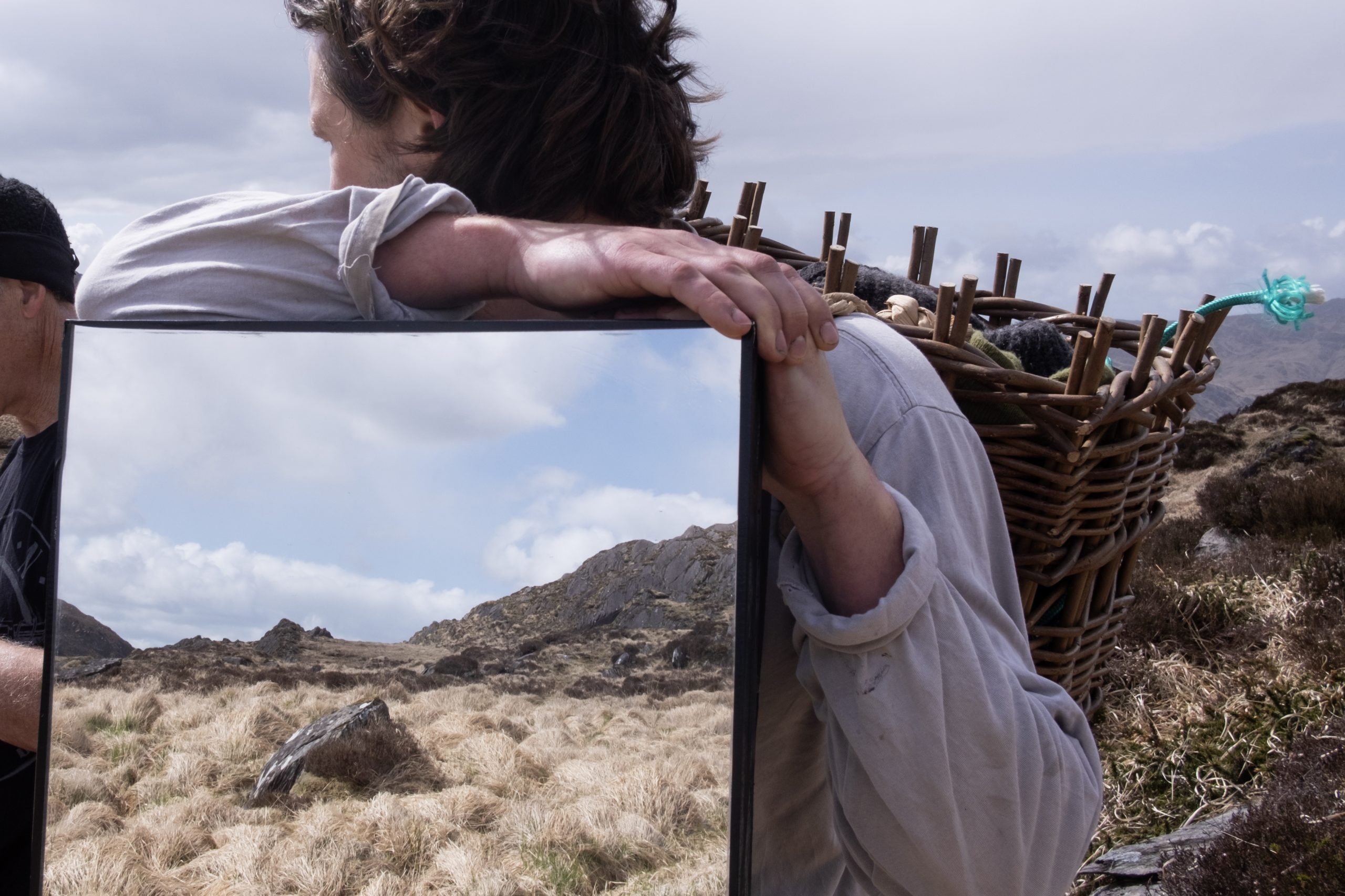
The Dinnseanchas (lore of place) project weaves voices of farmers, artists and communities reflecting on land, language and belonging in Ireland’s coastal uplands.
I was one of the seven commissioned artists in the Dinnseanchas Project working on the western uplands of Ireland. In West Cork, I met with the communities who have lived through dramatic changes in their lifetime, the Borlin Valley being one of the last places in Ireland to get electricity. Their stories of resilience, slow cultural and ecological loss alongside a deep connection with the land were remarkable. I created a series of artworks in response to his time with them including an audio visual installation inside a farm jeep, a series of published writings, short film works and a workshop series.
William Bock is a multidisciplinary artist based in Ireland producing innovative projects for and about diverse communities and the environments they inhabit. His practice delves into the complex experiences of living between cultures, landscapes and identities, using a combination of collaborative filmmaking, photography, field recording, performance and installation. (Issues 18, 22)
Dark Mountain: Issue 30
Our 2026 Autumn last issue is a full-colour hardback on the theme of endings, created by writers and artists at the heart of the project.
Read more