When I was writing about the Fuhle, I came across a small detail: in 1895, the first tram line in Hamburg built for electric operation from the start ran along Fuhlsbüttler Straße. I knew that Hamburg once had trams, but I never knew much about them. Berlin and Munich still have tram networks, so why is Hamburg the largest city in Germany without one?
Digging deeper, I realised the network was much bigger than I thought. In 1954, Hamburg’s trams carried about 251 million passengers. To put that into perspective, all Hochbahn buses together carried 261 million passengers in 2025, and the U-Bahn 291 million. The network was so big that, almost 50 years after the last tram ran in 1978, its traces are still around us.
So I went looking for them. I wanted to put these traces together like pieces of a map, so that when you walk past one of them, you can picture the tram network that once connected the whole city.
A Short History of Hamburg’s Tram (1866–1978)
Hamburg’s tram story starts with horses. In 1866, the first horse-drawn tram started running from the city centre to Wandsbek, which back then was still a separate town.
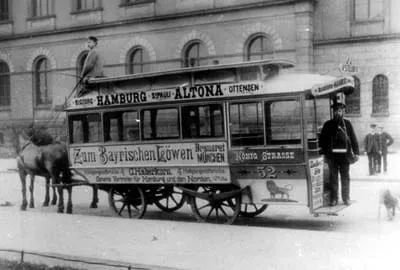
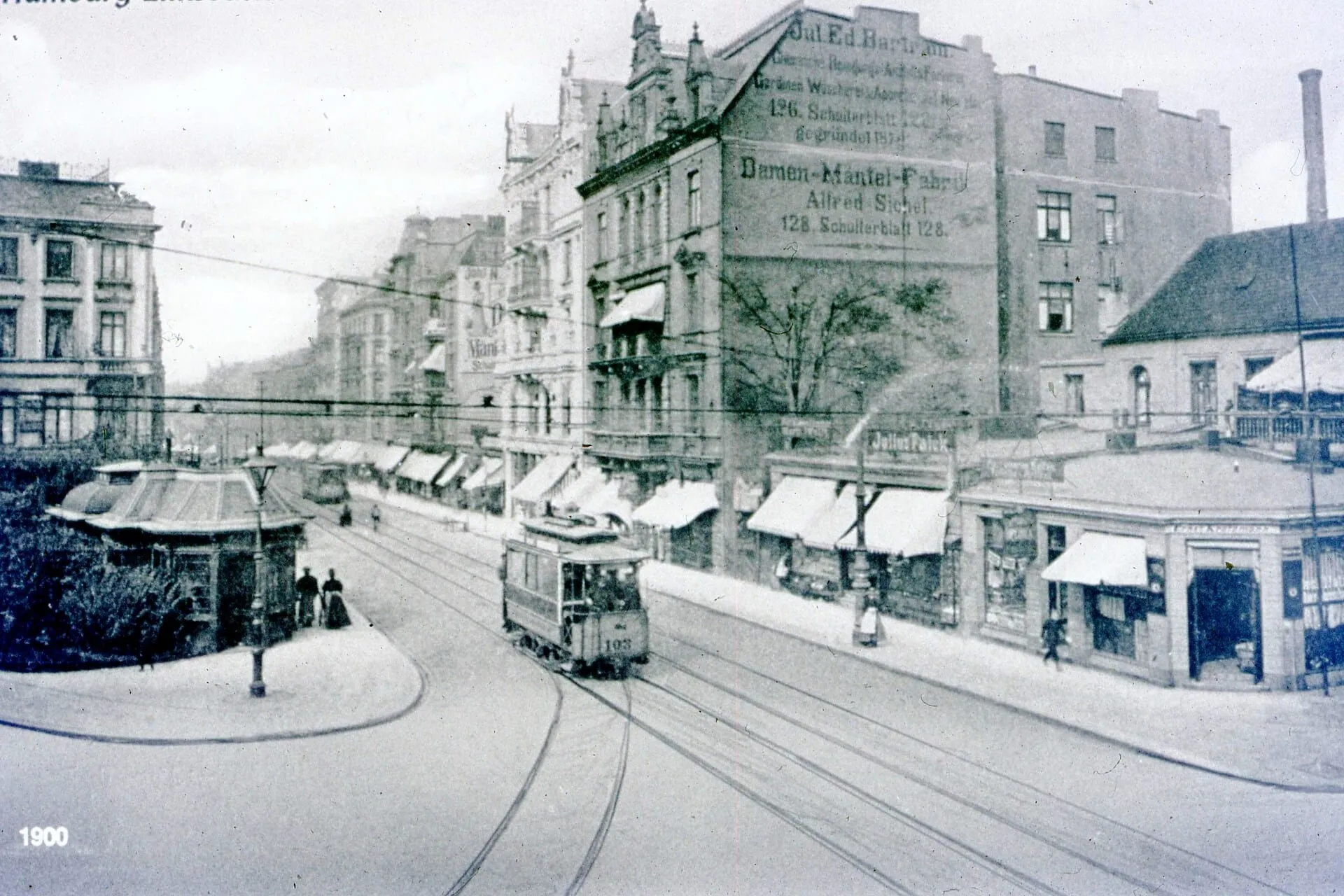
In 1894, the first electric tram started running around the old town. The overhead wire was hung from masts on wide streets and fixed to house walls with cast-iron rosettes on narrow ones. Altona, still a separate city then, had its own tram company, with its own design of richly decorated cast-iron masts. Over the following decades, the network grew from Harburg in the south to Schnelsen in the north.
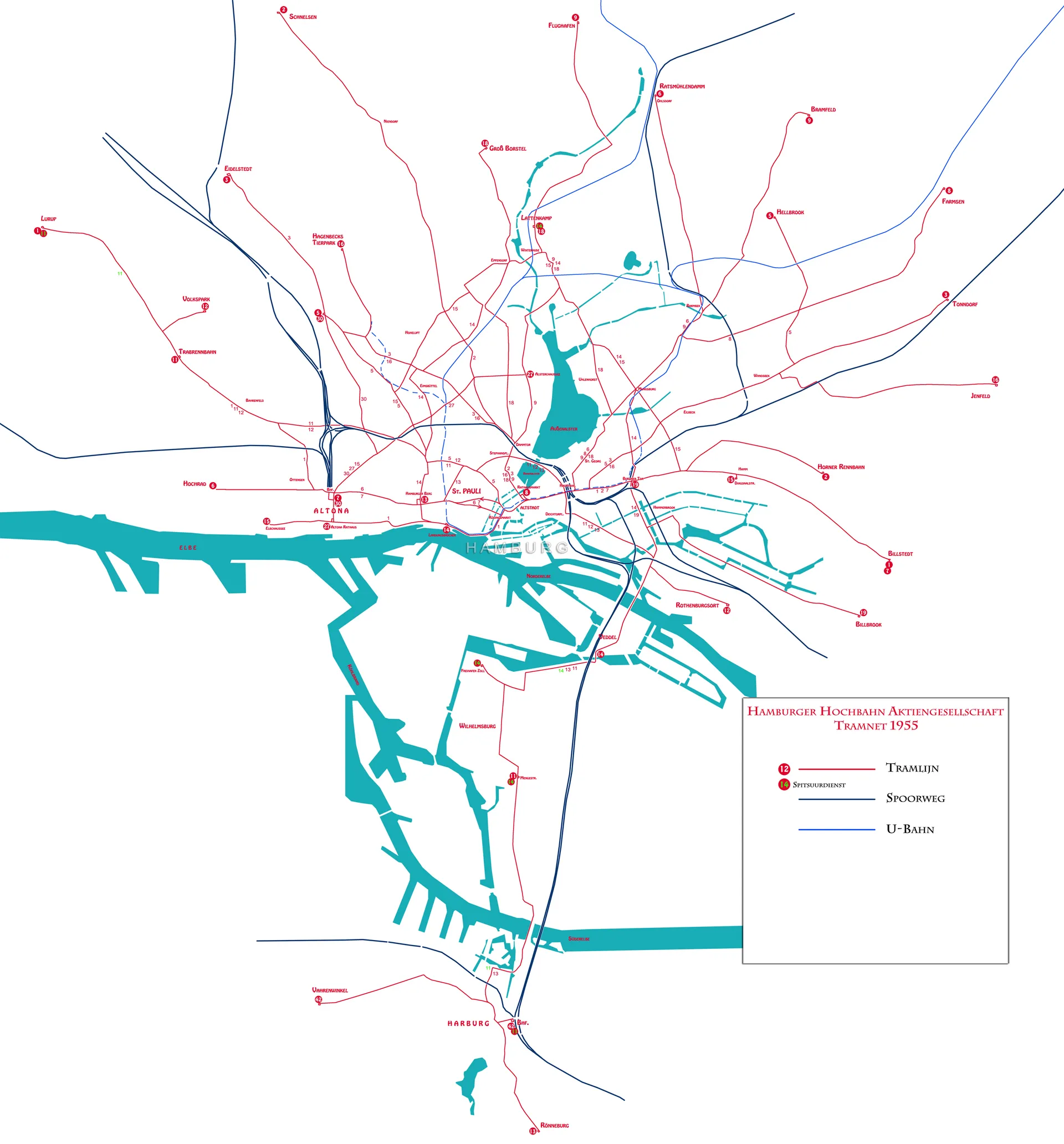
The bombing of 1943 destroyed large parts of it, and some routes never came back. In 1958, the SPD and FDP Senate decided to expand the U-Bahn and phase out the tram. Hamburg was planning for cars, and buses were seen as the modern alternative. Line after line closed, and the rails were often just paved over. On 1 October 1978, the last tram ran from Rathausmarkt to Schnelsen while crowds lined the street to say goodbye.
To see how big the network was, I rebuilt it on today’s map. There was no single source with all the lines, so I combined old network maps from Wikipedia with the work of people who have spent years on this topic, like Horst Buchholz, who wrote a chronicle of every line on his website horstbu.de, and fredriks.de, which has collected the old routes and traces of the tram for more than two decades. The result is a map of the old tram network along with the stations on top of today’s city.
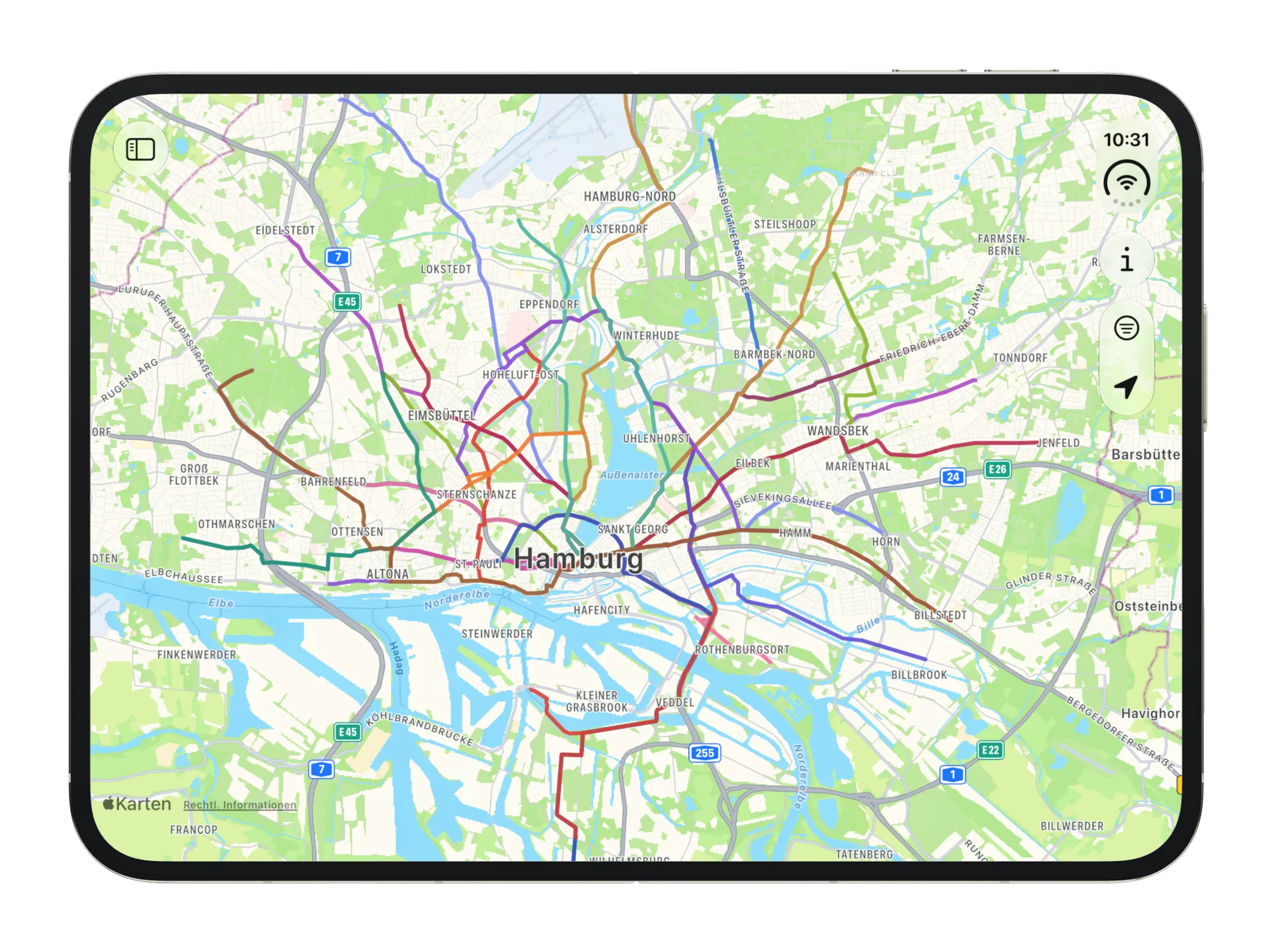
Seeing all the lines together shows how far the tram reached: from Eidelstedt and Lurup in the west to Jenfeld and Billstedt in the east, south towards Harburg, and, of course, along the Fuhle.
Hidden Traces
The tram has been gone for almost 50 years, but once you know what to look for, you find it on walls, poles, pavements and buildings all over the city.
Rosettes
In narrow streets, there was no space for masts, so the overhead wire was anchored directly to the houses. For this, cast-iron rosettes were fixed to the façades: round, decorated wall plates that held the wire above the street. They were cheaper than masts, and the decoration made them look like part of the building rather than a piece of technical equipment.
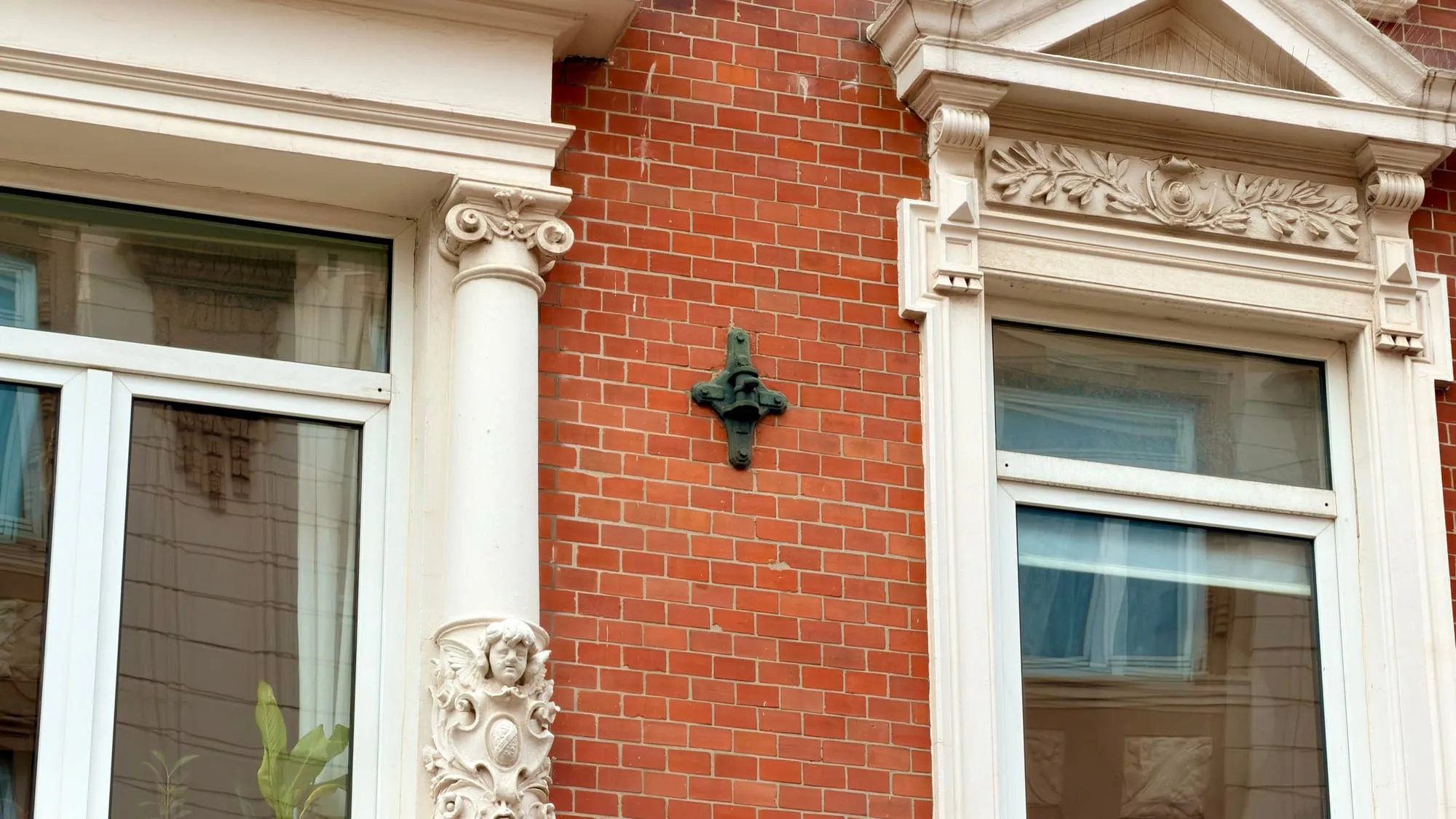
While cycling around the city to hunt for rosettes, I quickly realised they are harder to spot than I expected. Some are plain and black, and once you know where to look, they are easy to find. You can find many of them along Ottenser Hauptstraße. Others are painted in the same colour as the façade and blend into its decoration, so you can pass them many times without noticing.
On Hein-Hoyer-Straße in St. Pauli, you can probably see the widest range on a single street, from very plain ones to really fancy ones. I still wonder why. Were the simple ones put up first and replaced over time, or did some building owners pay extra for a nicer design? What we do know is that Hamburg had several tram companies, five different rosette designs are documented, and later rosettes became simpler, until in the end a plain wall hook was enough.
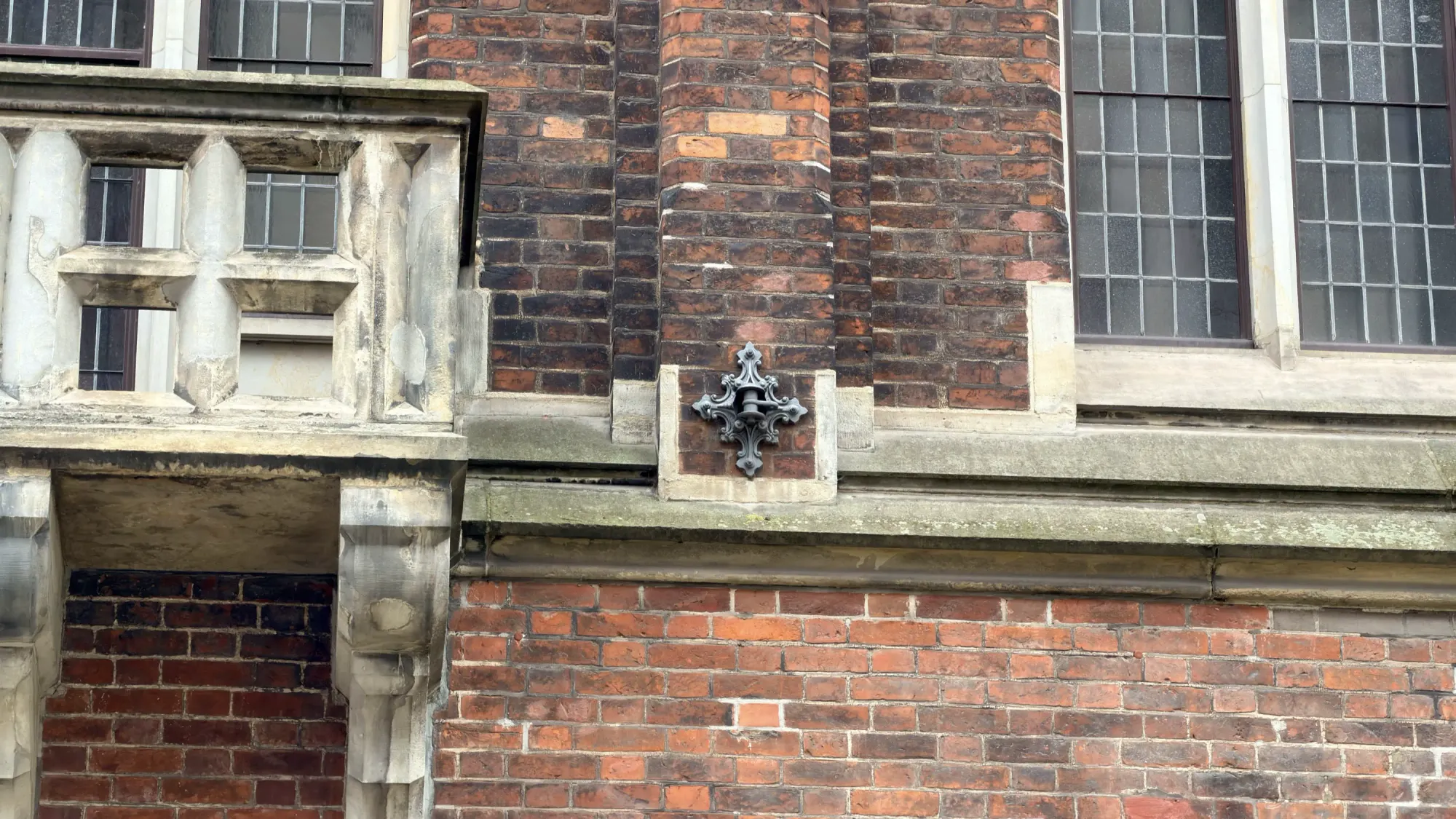
In the old town, there’s one at the corner of Börsenbrücke and Trostbrücke, on the red brick building of the Patriotic Society. The building stands where Hamburg’s old City Hall was, until it was blown up during the Great Fire of 1842 to stop the flames from spreading. A few steps away, on Rathausmarkt, you can even see three pink/white rosettes on a single façade, right above the French café Bouillon.
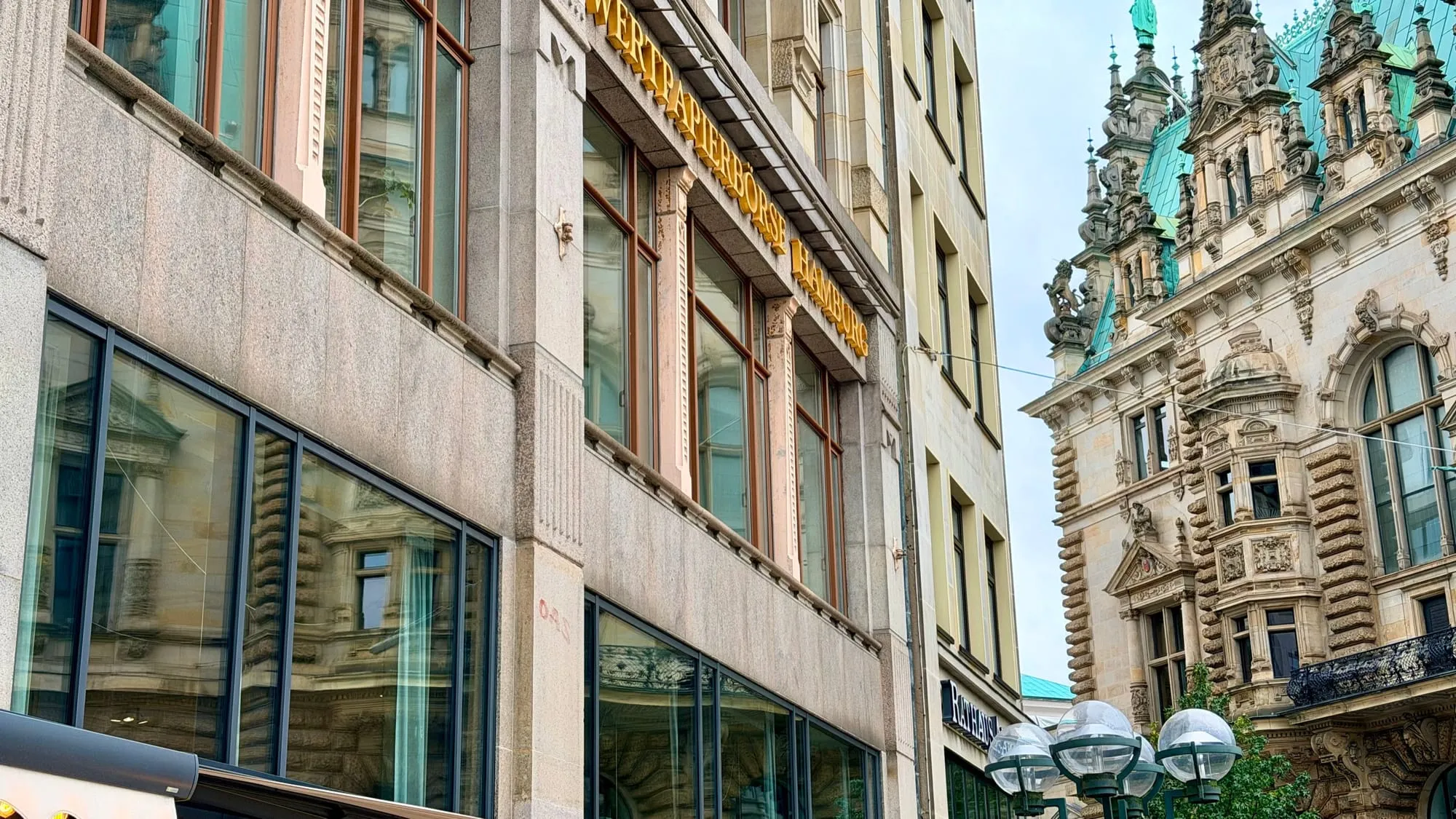
The rosettes are not listed as monuments. Whether they stay is up to the building owners, and when a house is renovated, they can quietly disappear. A few of the ones I went looking for were already gone.
Masts
On wider streets, the wire hung from masts instead. When the trams were gone, many of these masts were simply kept and used for street lighting. The easiest way to recognise them is the lamps: instead of sitting on top of a pole, they hang on wires stretched across the road, exactly where the tram wire used to be.
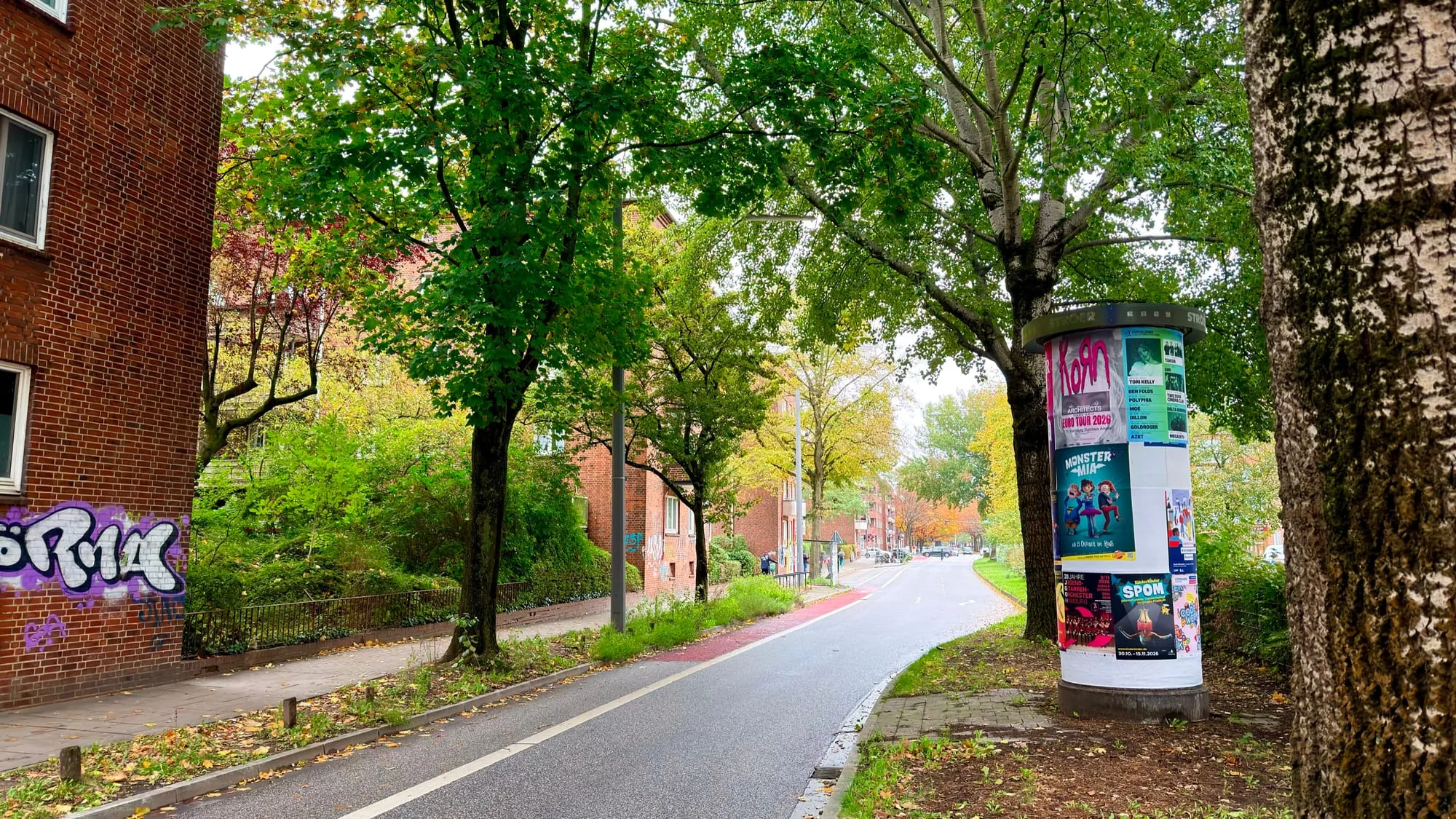
Luruper Chaussee is a good place to see this, with a long row of old masts still carrying the lights. In the east, you can follow the former Line 8 along Straßburger Straße and the first part of Friedrich-Ebert-Damm by its masts. Further along Friedrich-Ebert-Damm, the city even put up new masts in the same design as the old ones, so not every tram mast you see there is actually from the tram era. Sometimes it is just a single mast left on its own, like the one in front of Horner Landstraße 194.
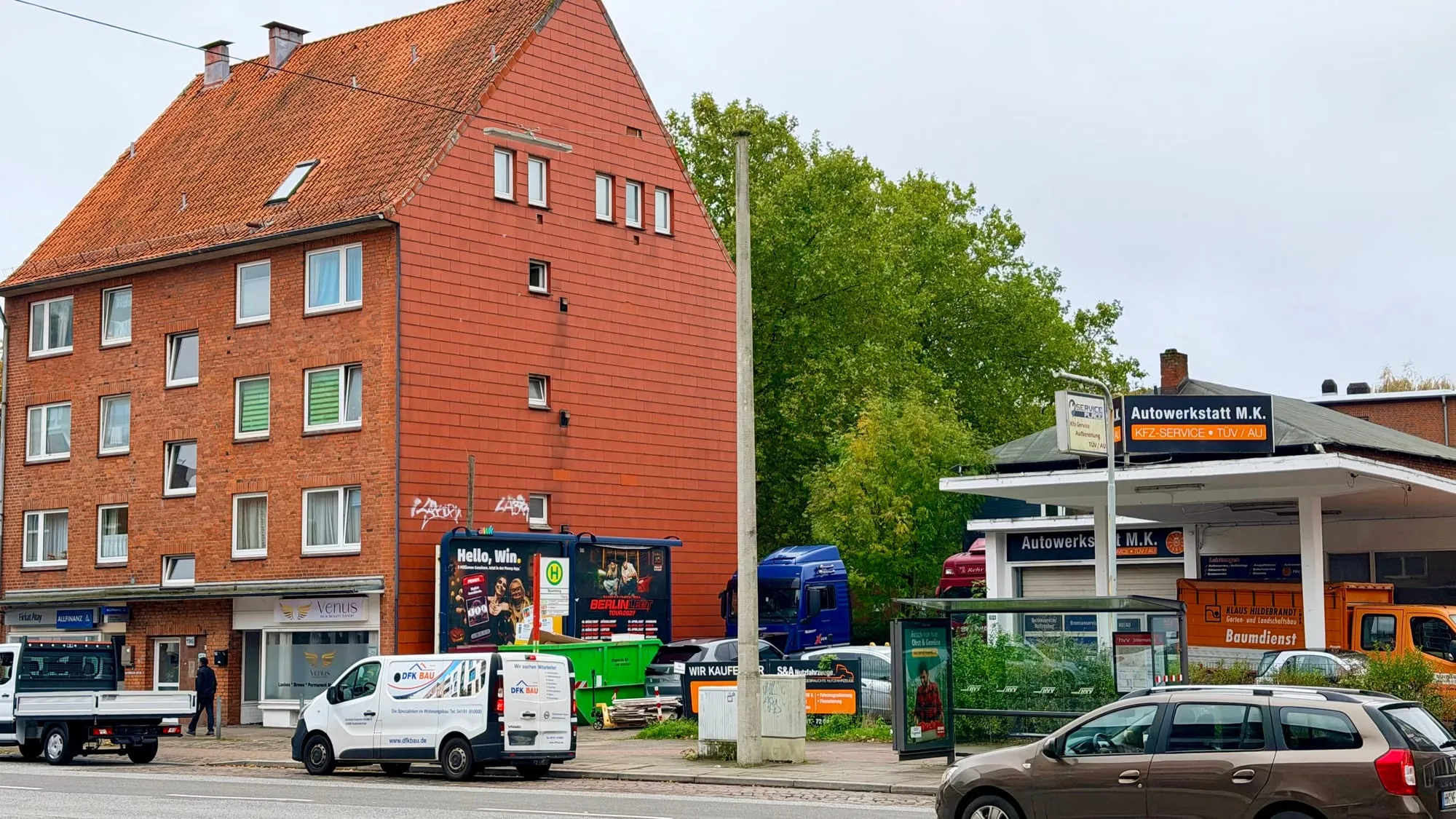
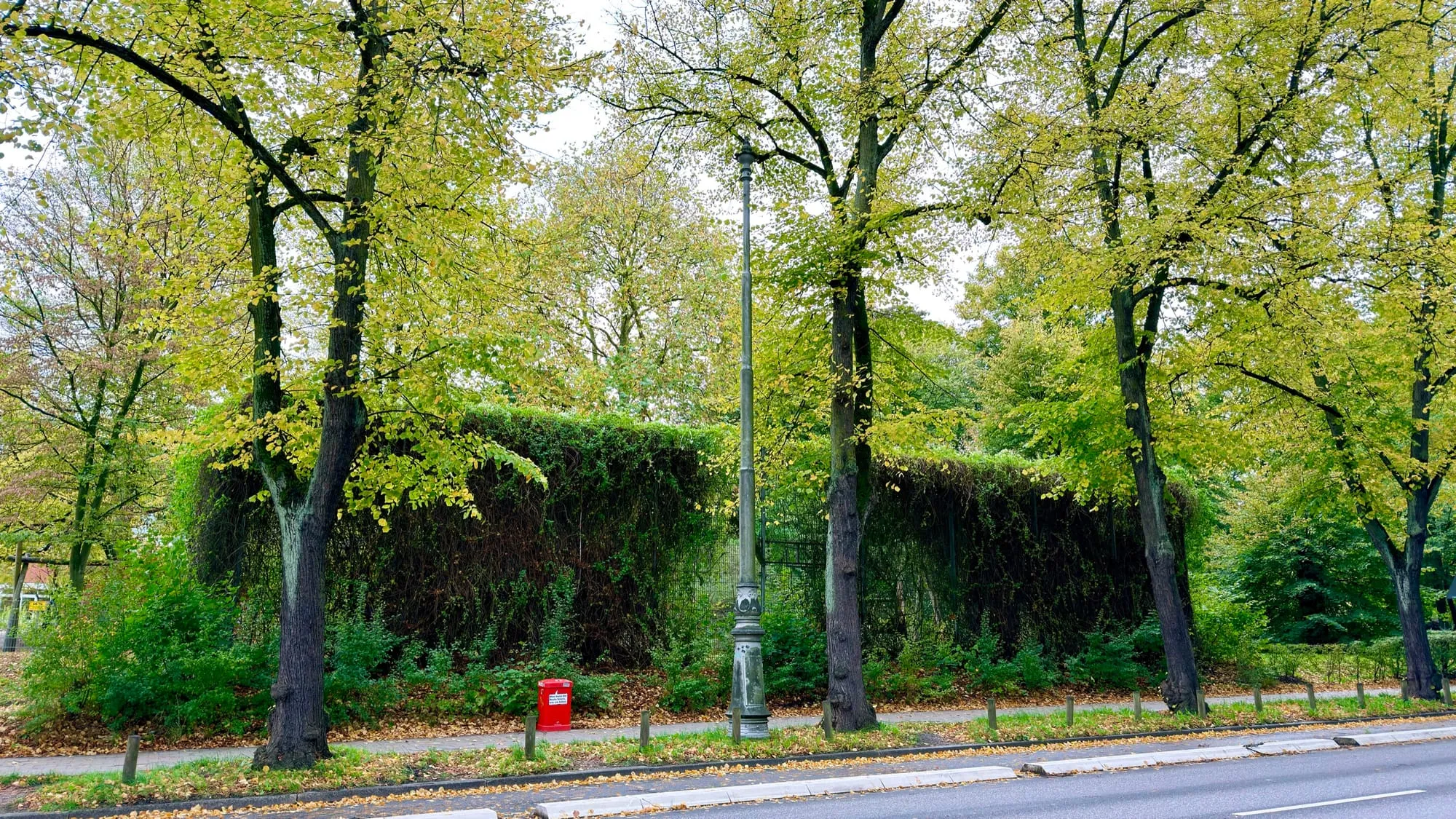
The most beautiful ones are on Königstraße in Altona. Opposite Lessers Passage, five richly decorated cast-iron masts from 1896 stand between the street trees. They belonged to Altona’s own tram company, they are the last of their kind in Hamburg, and unlike the rosettes, they are protected monuments.
Rails
When a line closed, the rails were usually not taken out. To save money, they were just covered with asphalt, and many of them are still under Hamburg’s streets. Every now and then, road works bring them back to the surface, as happened on Rathausstraße next to City Hall in 2023 and on Max-Brauer-Allee in 2024.
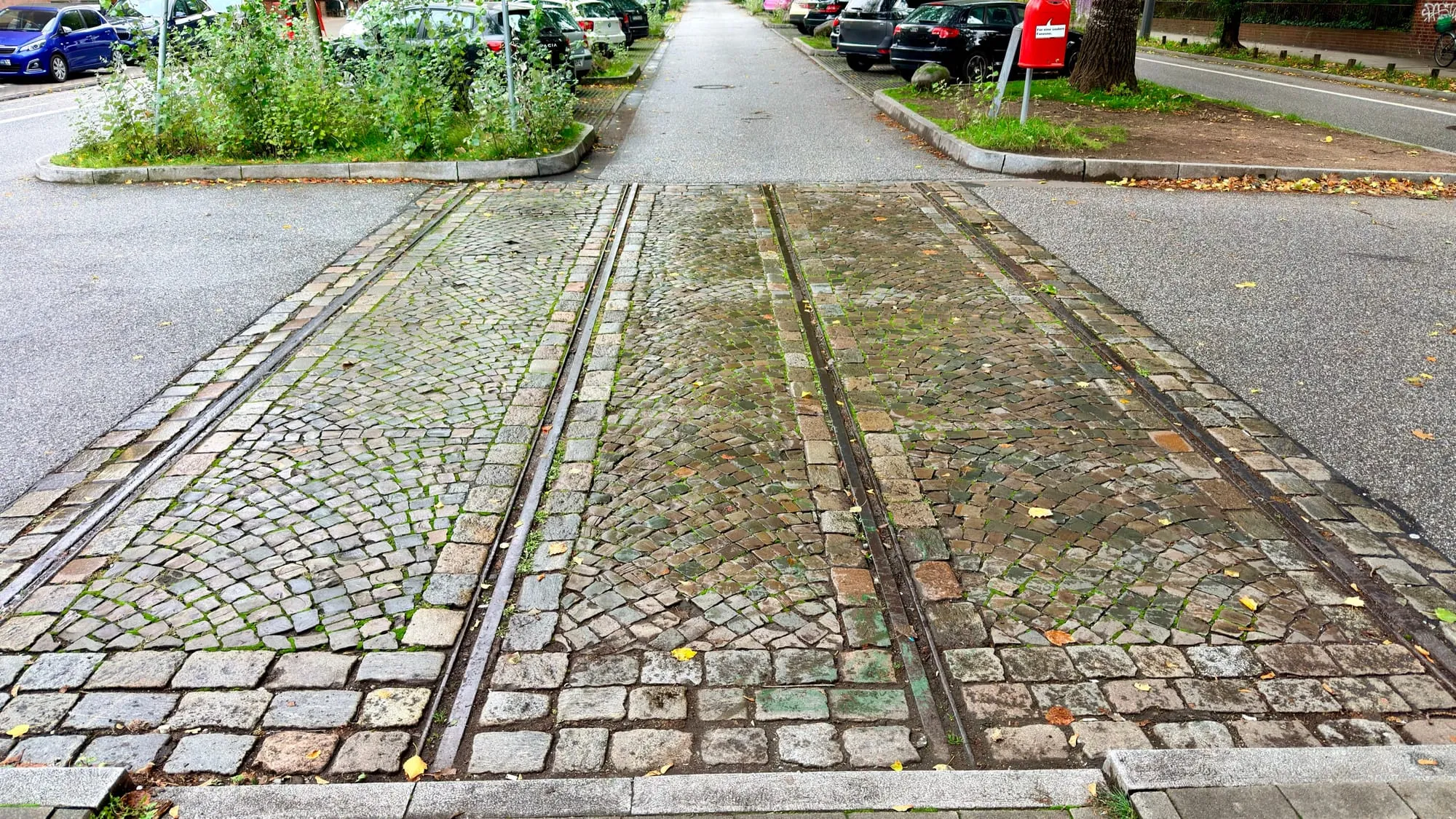
In a few places, you can see real rails without any digging. On Straßburger Straße in Dulsberg, a stretch of track is still visible, and in front of Gymnasium Hochrad in Othmarschen, a few metres of rails filled with bitumen lie in the pedestrian crossing.
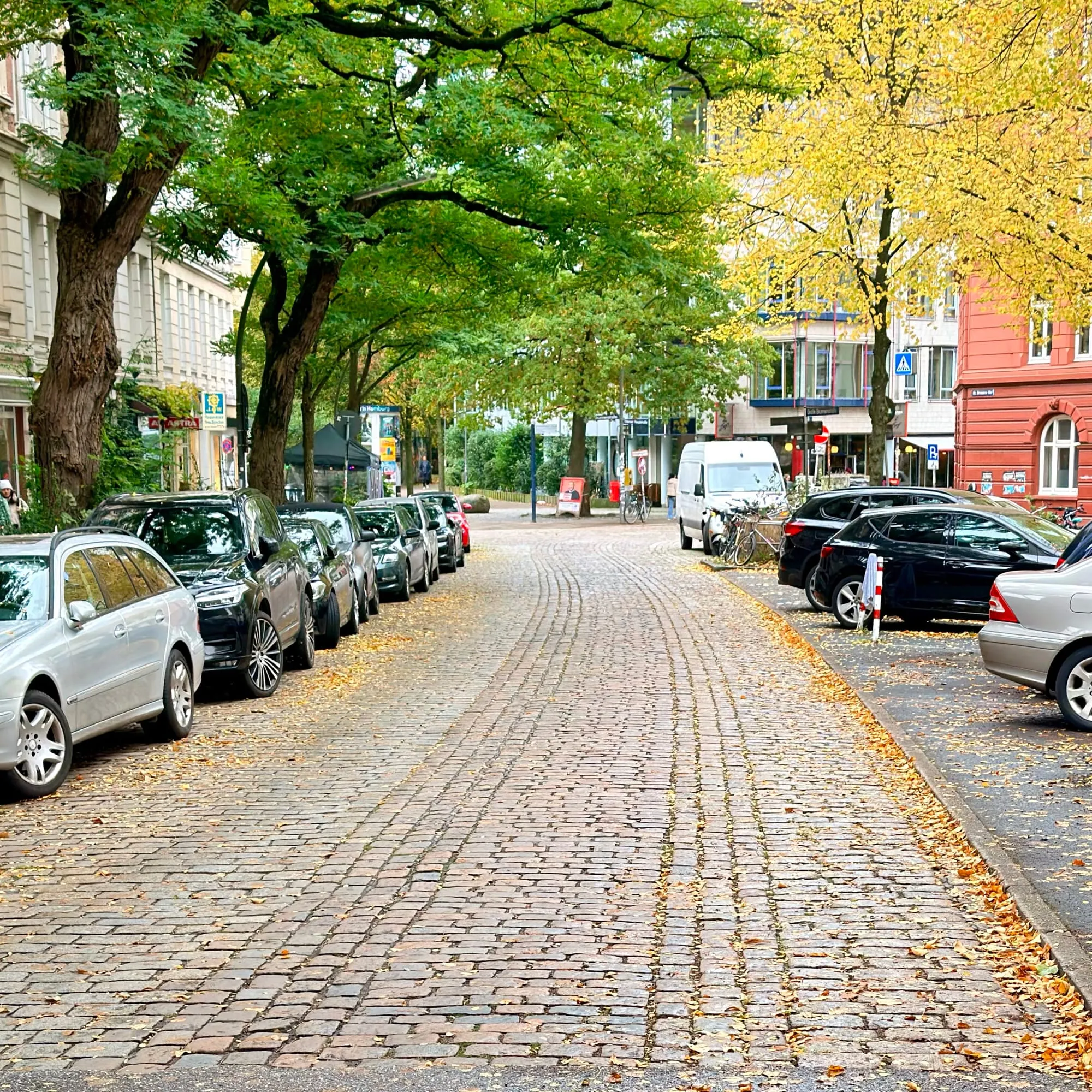
Even where the rails are gone, the cobblestones sometimes remember them. On Bei der Reitbahn in Ottensen, the stones that replaced the tracks were laid in a slightly different pattern, so you can still follow the curve of the old line in the street.
I find it fascinating to follow these lines, because it makes me imagine how these streets would look with a tram running through them: probably busier with people, and with fewer cars.
Bus Lanes
When I first came to Hamburg for an internship, I often took bus line 5, and I was surprised that it drove in its own lanes in the middle of the street. Only when I learnt about the tram did it start to make sense.
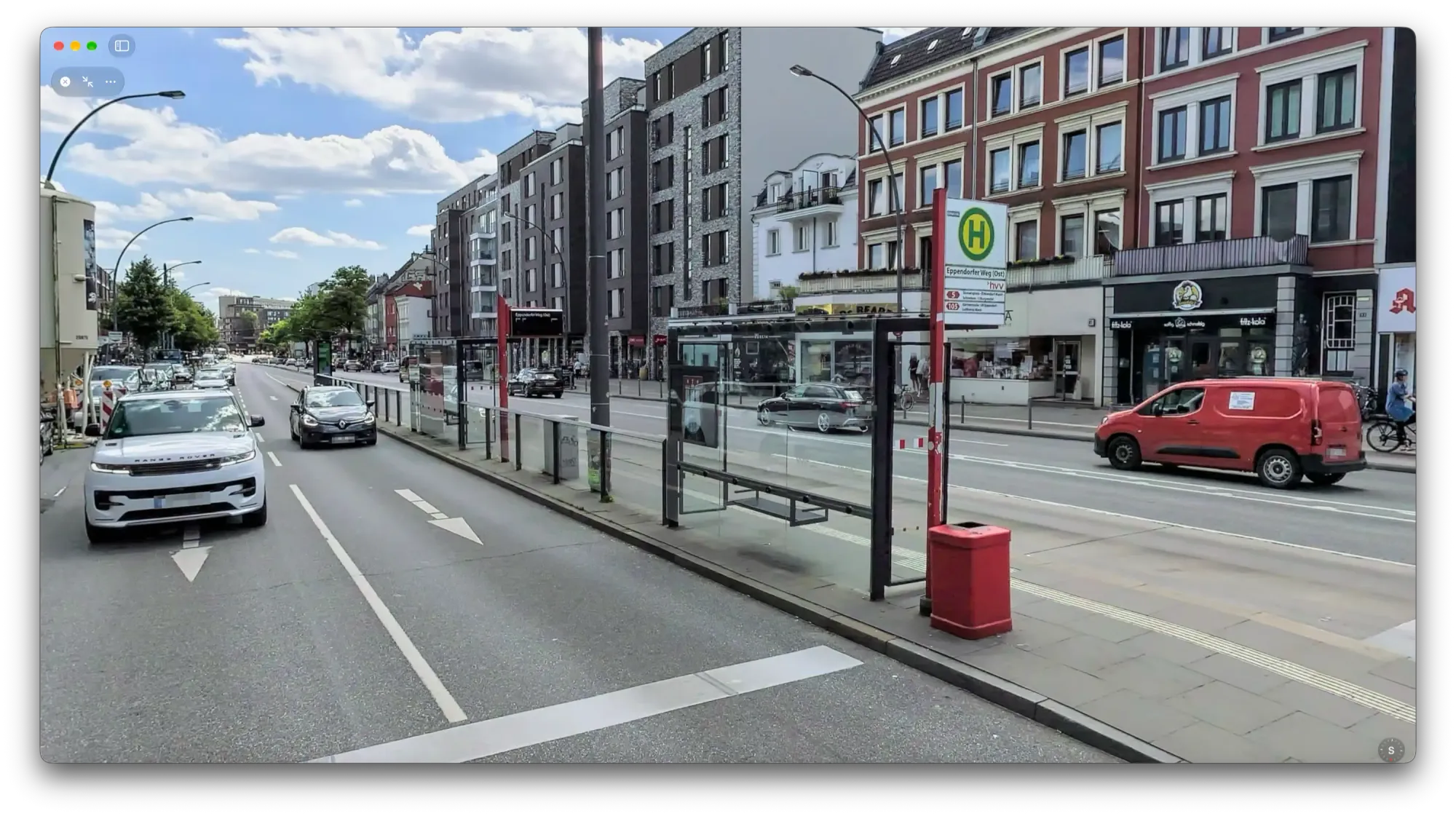
After Line 2 closed in 1978, the tracks between Grindelberg, Hoheluftchaussee and Lokstedter Steindamm were removed, and bus lanes were laid in the old track bed in the middle of the road. So along this stretch, the 5 follows the path of Hamburg’s last tram. At some junctions, the bus lanes also follow the wide curves of the old tracks, which were designed for trams, not buses.
Stations and Depots
The oldest trace of all is in Wandsbek. The depot on Wendemuthstraße was built in 1866 for the very first horse tram, with stables for the horses. Today, it is a bus depot.
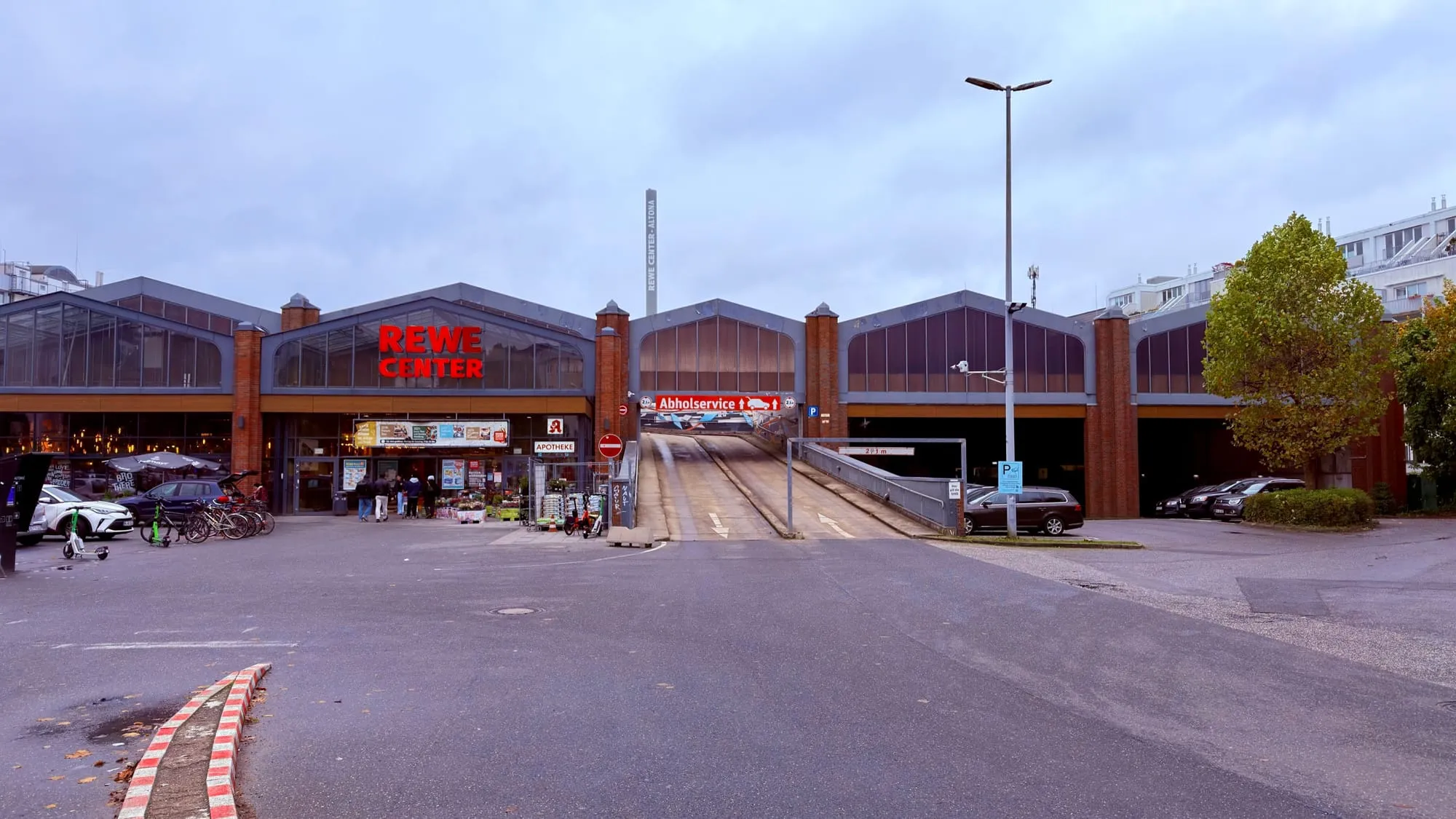
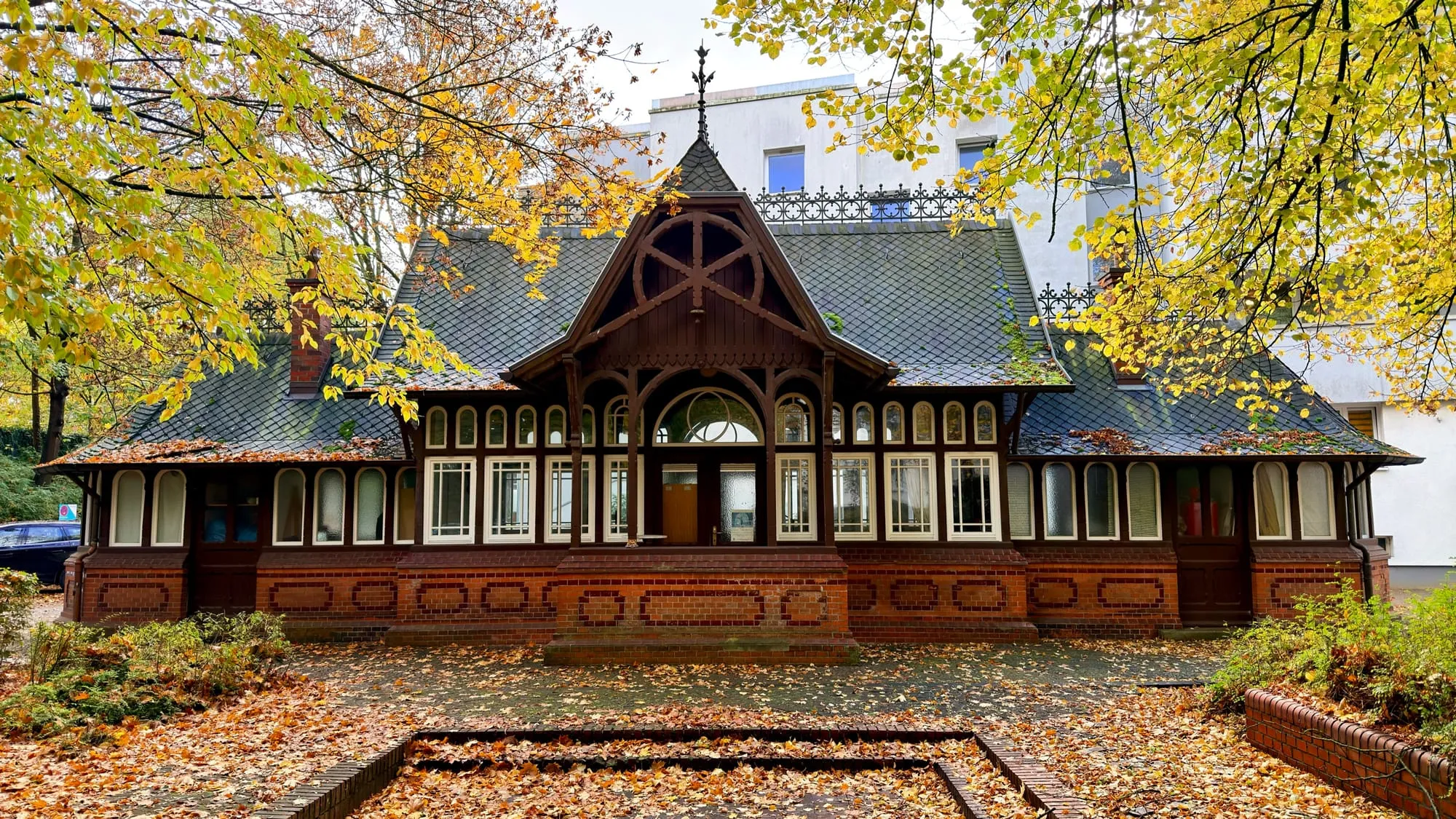
Many of the later depots found new lives as shops. The depot in Lokstedt is now a hardware store, the one at Krohnskamp in Winterhude a supermarket, and the old depot on Max-Brauer-Allee in Altona is a supermarket too. Near Ohlsdorf Cemetery, the small terminus building where the trams once turned is now a private art studio.
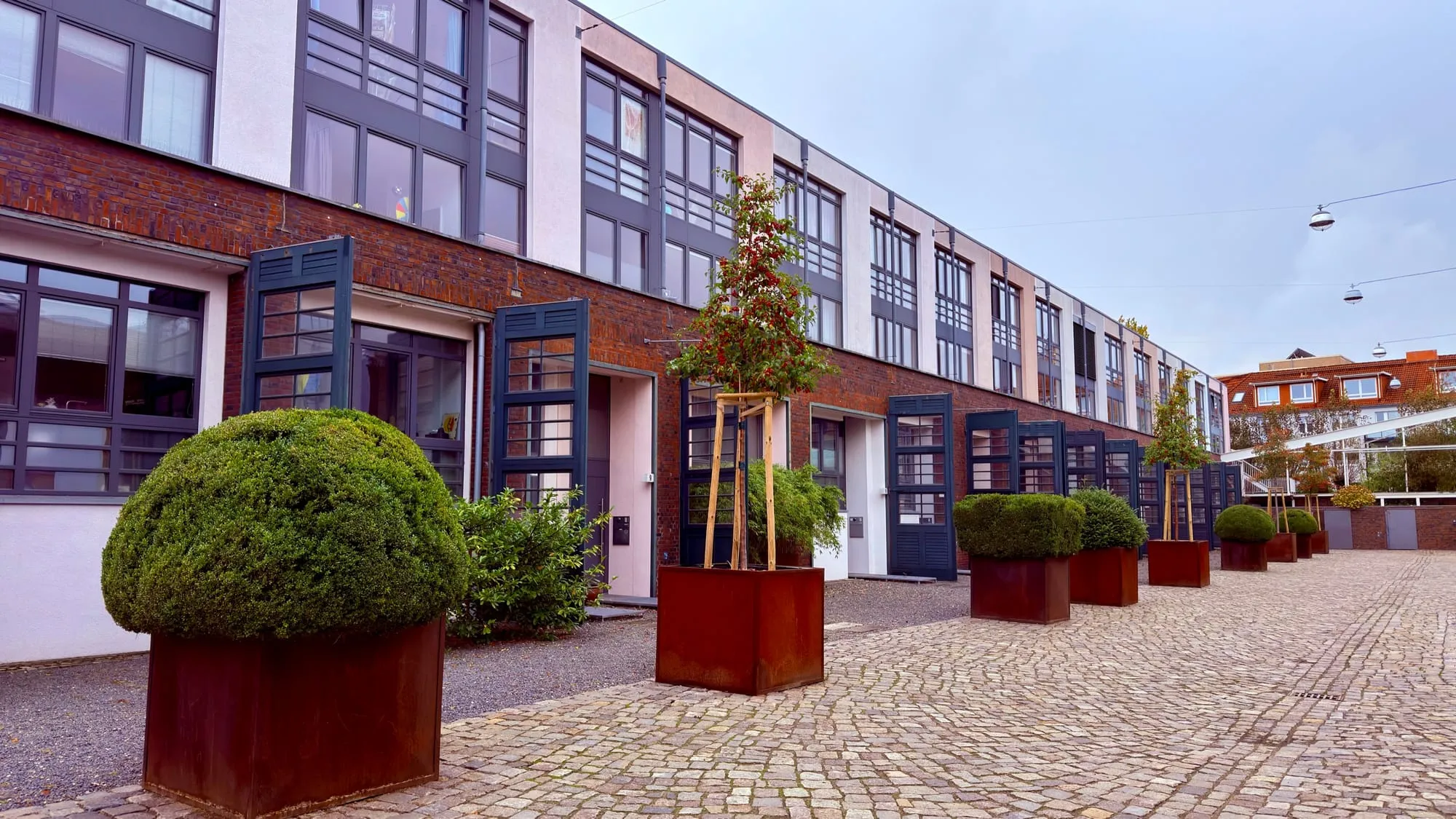
The biggest site was the Falkenried works in Hoheluft, where most of Hamburg’s trams were built. The workshops closed in 1999, and the area was turned into a residential neighbourhood that kept parts of the old industrial halls. Two of its streets are called Straßenbahnring and Straßenbahnstieg.
Tram Cars
Some of the trams themselves have survived too, often in unexpected places. One stands at the hardware store in Lokstedt, another in front of the supermarket at Krohnskamp. If you want to see Hamburg trams in action, the museum at Schönberger Strand near Kiel has the largest collection, and some of them still run on its museum line.
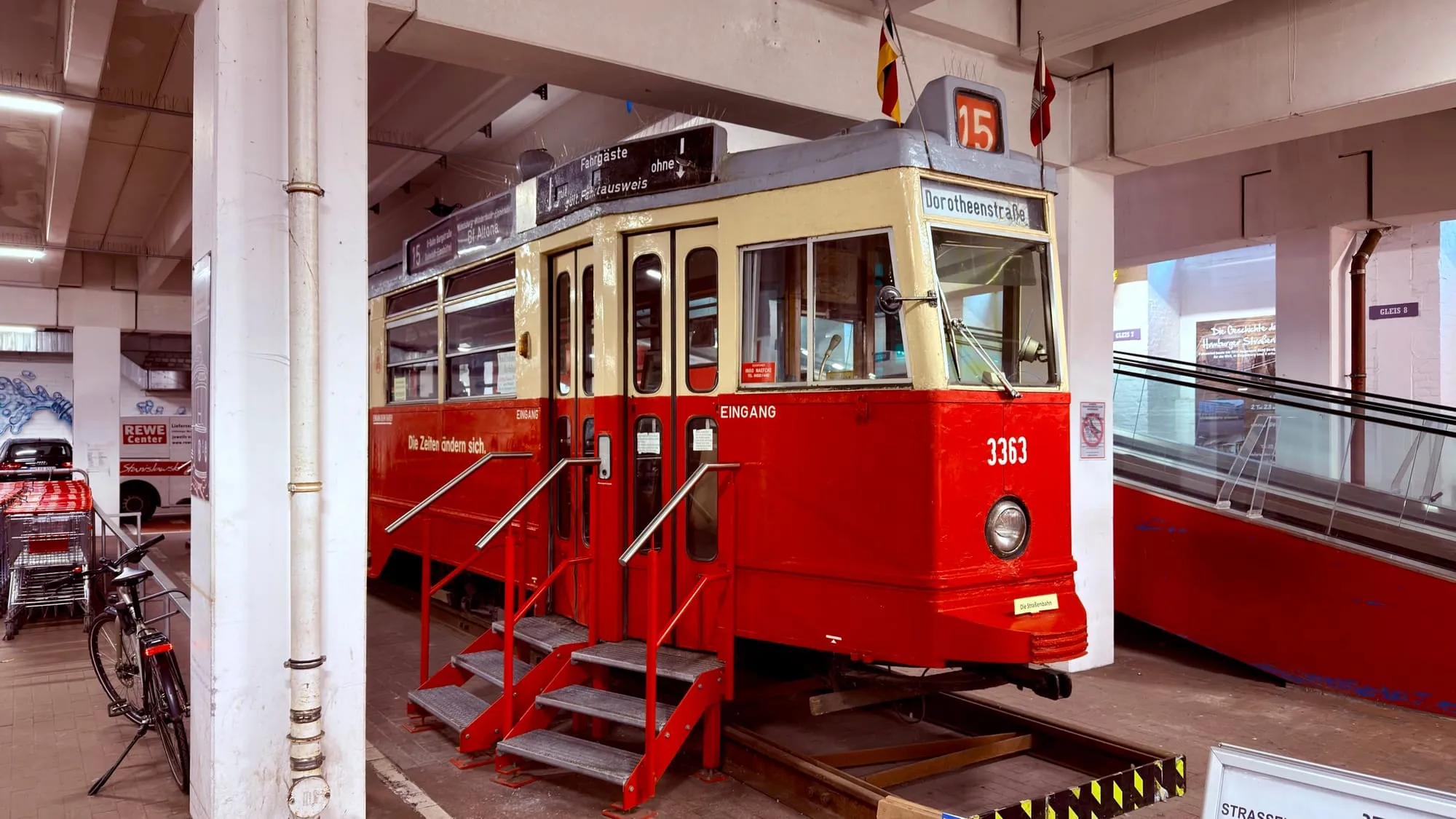
A few travelled much further. Hamburg trams ended up in museums in Denmark and even in the USA: car 2710, built at Falkenried in 1921, now stands in the Seashore Trolley Museum in Maine.
Will the Tram Come Back?
Since 1978, the tram has almost returned twice, and both times politics decided its fate. In 1989, the SPD and the Greens started planning a modern Stadtbahn, but after they lost the 2001 election, the new CDU-led government stopped it. In 2008, the CDU and the Greens brought the idea back, until the Greens left the coalition in 2010 and the plans were put on hold again. A few months later, the SPD won the election with a promise to stop the Stadtbahn, and in 2011 it was officially cancelled.
Today, Hamburg is building the U5 instead, a new U-Bahn line from Lurup to Osdorf, planned to be finished by 2040 at an estimated cost of up to 16,5 billion euros. That keeps the tram in the debate: a recent study suggests a tram network could cover much of the same route for around 1,5 billion euros, while the Hochbahn argues a tram could never carry as many passengers.
Personally, I have a love-hate relationship with trams. I really like them as a form of public transport, especially compared to buses. On the other hand, the wires and the noise feel like a kind of pollution of their own. I can still hear the trams in Lisbon; they were so loud. Buses are slowly becoming electric, but I still don’t find riding a bus a delightful experience.
While writing this, I was curious whether trams have moved on, and it turns out they have. In Nanjing, battery-powered trams run without overhead wires on most of their lines, and Birmingham chose battery trams so it wouldn’t have to fix cables to its historic Town Hall, a modern answer to the same problem Hamburg once solved with rosettes.
If Hamburg ever brings the tram back, I hope it will be a quiet one without wires, maybe even floating silently like a maglev train. Until then, I’ll keep looking up at the rosettes and down at the cobblestones, imagining the network that once ran through the city.
Enjoyed this post?
Subscribe to Alsterrunde for more observations, discoveries, and stories from around Hamburg, delivered whenever there's something worth sharing.