Almost a decade ago, I released a hackintosh guide on running macOS 10.14 through a VM with an x86 host. A "Hackintosh" is the feat of running macOS on non-Apple hardware, and has a history dating back to the late 1980s. At the time KVM and PCI passthrough were relatively new technologies, and this guide provided near-native performance with GPU acceleration.
A few years passed by, and we saw Apple release the first ARM-based Mac in 2021, the M1 MacBook Air. The timing was impeccable, Intel was unable to create competitive processors (due to being stuck on the 14nm node), and Apple had powerful and efficient ARM chips already being shipped in their iPhones. The long battery life, the fanless design, the instant wake, what's not to like? The benefits of switching to ARM were clear, however to most, this was thought to be the final chapter in the hackintosh community. x86 versions of macOS would soon be discontinued, and the hackintosh community would slowly fade away. That day has come and the latest version of macOS 27 (Golden Gate) released this year is no longer compatible with x86...
Just a few days ago, I decided to create an iOS app for the first time. It required XCode 26 for development, so I used my spare ThinkPad T490 as my development machine and installed macOS 26 using a posted guide. The installation was smooth and painless. XCode 26 has integrations with Claude Code and OpenAI Codex, and this was my first foray into AI-assisted coding. After some initial tinkering with x86 workarounds, I was pleased that I had a functional iOS app within a day, without touching a single line of code!
So how does this all tie in? Well, this is exactly what the Hackintosh community could hardly envision five years ago: the rise of AI. Waiting patiently and gently until now, the hackintosh and the hackios community has seen an absolute explosion in development, activity, and success in the past few weeks! As one person aptly wrote, this is the power of Claude Code with Ghidra on steroids. Just to list a few recent developments, we have:
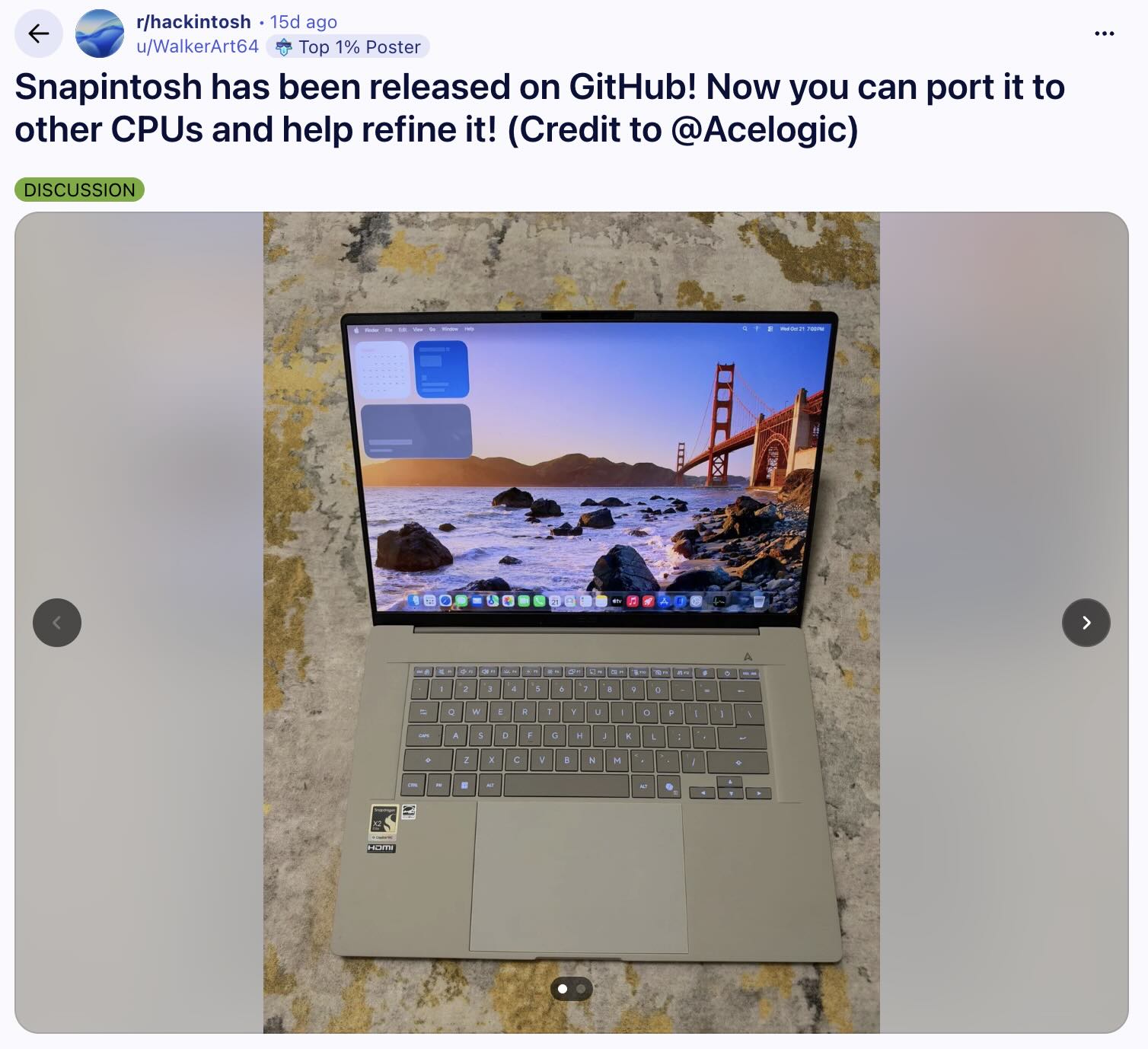
macOS 27 running on the Snapdragon Laptop:
macOS 27.2 Beta on an ARM SBC RK3588 with Mali drivers:
iOS 17 running on the Nintendo Switch OLED:
Support for 50-series Nvidia GPUs with nullmoth:
I'm barely scratching the surface, with further developments in AirDrop, accelerated video decode, and even running translated macOS 27 on x86. As much as we lament the cost of AI, there are some glimmers of hope: you just might be able to have your hardware and own it too.