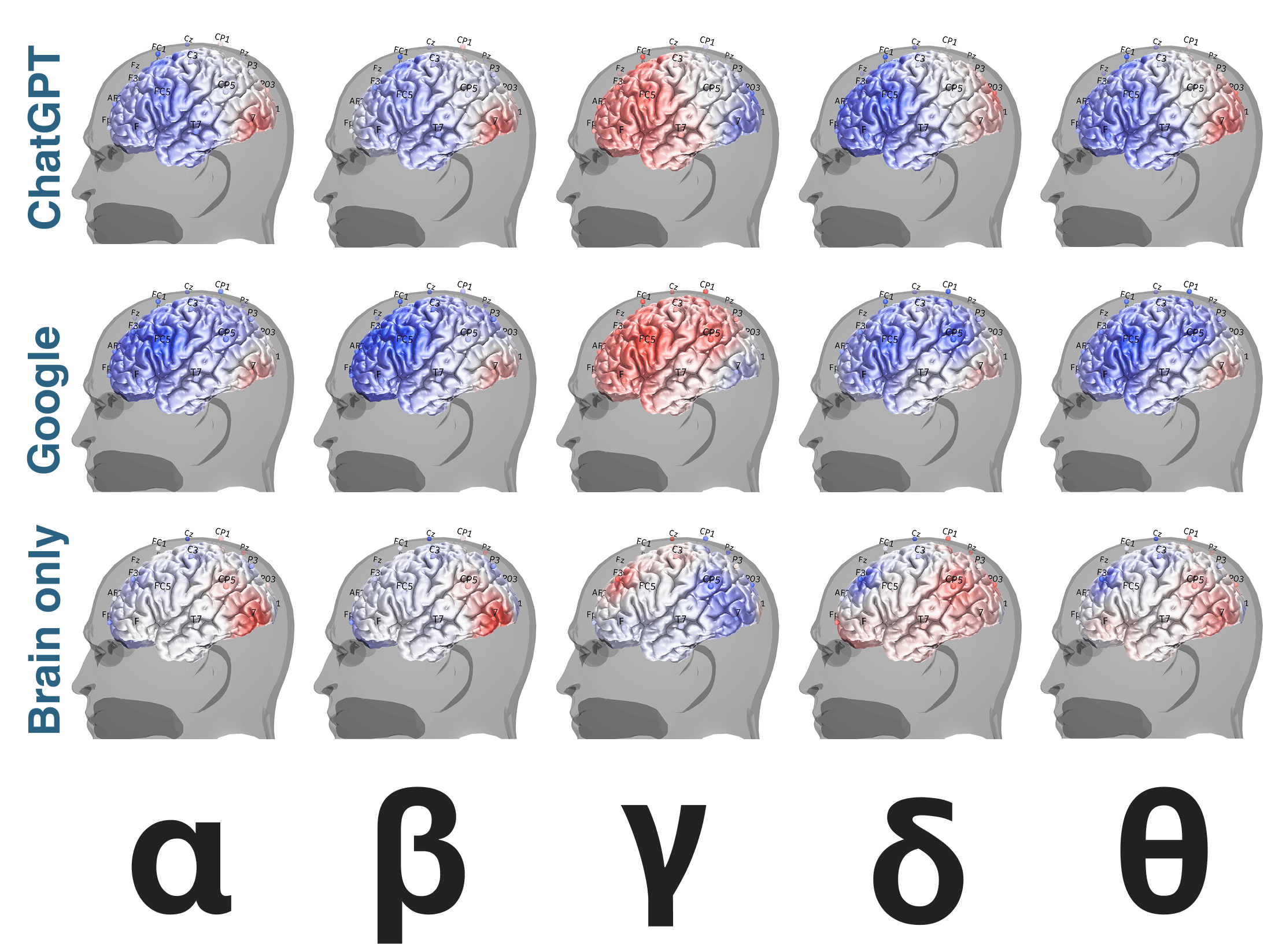

With today's wide adoption of LLM products like ChatGPT from OpenAI, humans and businesses engage and use LLMs on a daily basis. Like any other tool, it carries its own set of advantages and limitations. This study focuses on finding out the cognitive cost of using an LLM in the educational context of writing an essay.
We assigned participants to three groups: LLM group, Search Engine group, Brain-only group, where each participant used a designated tool (or no tool in the latter) to write an essay. We conducted 3 sessions with the same group assignment for each participant. In the 4th session we asked LLM group participants to use no tools (we refer to them as LLM-to-Brain), and the Brain-only group participants were asked to use LLM (Brain-to-LLM). We recruited a total of 54 participants for Sessions 1, 2, 3, and 18 participants among them completed session 4.
We used electroencephalography (EEG) to record participants' brain activity in order to assess their cognitive engagement and cognitive load, and to gain a deeper understanding of neural activations during the essay writing task. We performed NLP analysis, and we interviewed each participant after each session. We performed scoring with the help from the human teachers and an AI judge (a specially built AI agent).
We discovered a consistent homogeneity across the Named Entities Recognition (NERs), n-grams, ontology of topics within each group. EEG analysis presented robust evidence that LLM, Search Engine and Brain-only groups had significantly different neural connectivity patterns, reflecting divergent cognitive strategies. Brain connectivity systematically scaled down with the amount of external support: the Brain‑only group exhibited the strongest, widest‑ranging networks, Search Engine group showed intermediate engagement, and LLM assistance elicited the weakest overall coupling. In session 4, LLM-to-Brain participants showed weaker neural connectivity and under-engagement of alpha and beta networks; and the Brain-to-LLM participants demonstrated higher memory recall, and re‑engagement of widespread occipito-parietal and prefrontal nodes, likely supporting the visual processing, similar to the one frequently perceived in the Search Engine group. The reported ownership of LLM group's essays in the interviews was low. The Search Engine group had strong ownership, but lesser than the Brain-only group. The LLM group also fell behind in their ability to quote from the essays they wrote just minutes prior.
As the educational impact of LLM use only begins to settle with the general population, in this study we demonstrate the pressing matter of a likely decrease in learning skills based on the results of our study. The use of LLM had a measurable impact on participants, and while the benefits were initially apparent, as we demonstrated over the course of 4 months, the LLM group's participants performed worse than their counterparts in the Brain-only group at all levels: neural, linguistic, scoring.
We hope this study serves as a preliminary guide to understanding the cognitive and practical impacts of AI on learning environments.
Distributed under CC BY-NC-SA 4.0
© Copyright 2025: Nataliya Kosmyna, Eugene Hauptmann