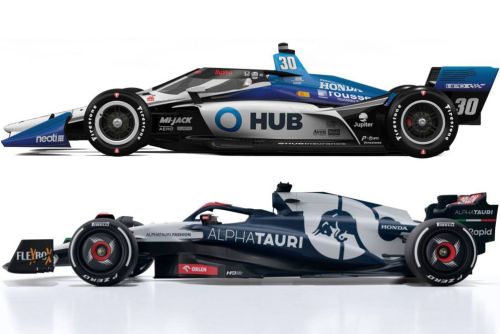
 IndyCar is often seen as the American counterpart to Formula 1, but the reality is that there are more differences than similarities. When comparing an IndyCar to a Formula 1 car, they are both formula cars with a monocoque, wings, four tires, and a hybrid turbo engine, but the differences between the two cars are significant.
Formula 1 is a constructors' championship, and the cars developed by the teams push technical limits, whereas IndyCar is more of a drivers' championship, competing not only on traditional road and street courses, but also on ovals. While the key term for a Formula 1 car is 'on the limit', for IndyCar, it's more about 'robustness'. We’ve listed the biggest differences below.
The Differences Between IndyCar and Formula 1 in Specifications
Downforce
 Perhaps the biggest difference between IndyCar and Formula 1 lies in the downforce generated by the car. The current generation of IndyCars is designed with a focus on generating most of the downforce from the underside of the car. This design reduces the need for large wings or various extra winglets to generate additional downforce, which would create more dirty air behind a car and make it harder for cars to race closely together. IndyCar also wants to position itself more as a drivers' series, and the less downforce a car generates, the harder it is to handle, making it more reliant on the driver’s skills and talent.
Formula 1 cars generate significantly more downforce, making them quicker in fast corners. Although the current generation of Formula 1 cars generates more downforce from the underside of the car, they still produce a lot of dirty air. This makes it harder for cars to run close to each other. The amount of downforce generated in Formula 1 is one of the key factors that make them faster than IndyCars.
Engines
 Both IndyCar and Formula 1 use turbo engines, but the differences are again significant. Since 2024, like Formula 1, IndyCar also uses a hybrid component. However, its use is limited per lap and resets with each new lap. While the electric motor gives the driver approximately 150 extra horsepower at the push of a button, in Formula 1, it’s slightly more: around 160 hp.
The power produced by an IndyCar combustion engine depends on the type of track being raced on (with less power used on ovals than on other tracks), but the maximum is around 700 hp. This is less than the power of an average Formula 1 combustion engine, which produces between 800 and 850 hp. This is because IndyCar engines are restricted to last longer: the RPM must not exceed 12,000 (compared to about 15,000 in Formula 1), and while turbo boost in Formula 1 is unlimited (usually between 3,5 and 4 bar / 51 and 58 PSI).
In IndyCar, the turbo boost limit is based on the type of track:
Tires
 When comparing the Firestone tires used in IndyCar to the Pirelli tires in Formula 1, it’s clear that the Pirelli tires are much faster. Formula 1 tires are more advanced and much softer than IndyCar tires, giving Formula 1 drivers significantly more grip. The Firestone tires in IndyCar are much harder and suffer less wear. A key aspect of the development of these tires was to ensure the tire construction is as strong as possible. Especially on ovals, a puncture can have serious consequences for a driver, making reliability more critical than speed in the tire development process.
During a race weekend, IndyCar drivers can choose between two tire compounds: the standard tire and the red, alternate tire, which is softer and therefore faster but also wears out more quickly. Formula 1 has adopted this principle and even expanded it with a third type of tire per race weekend. The use of different tire compounds shows how much influence the tire's softness has on lap times: a tire with a softer compound can be up to a second faster than the standard tire.
Weight
 An IndyCar is heavier than a Formula 1 car: while a Formula 1 car weighs 1759 pounds / 798 kg including the driver, an IndyCar weighs 1700 pounds / 771 kg on road and street courses, excluding the driver. Adding a driver brings the total weight to over 1875 pouns / 850 kg. This weight comes primarily from the more robust construction of the car, which is necessary to ensure safety at the high speeds reached on ovals.
As a result, an IndyCar is much more durable than a Formula 1 car. Additionally, the aeroscreen adds a significant amount of weight.
In Formula 1, teams build most parts themselves, pushing weight limits as much as possible so they can place that weight more efficiently. In the IndyCar Series, this is different: almost all parts are manufactured by Dallara, which focuses on extra strength rather than reducing weight.
Brakes
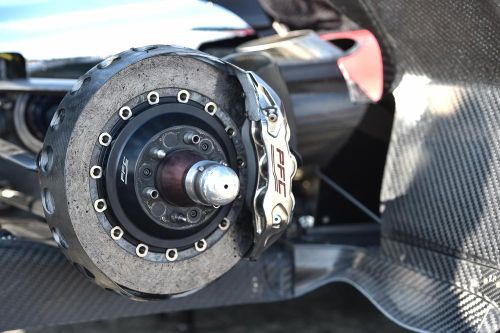 Both IndyCar and Formula 1 use carbon fiber brake discs and pads, but the similarities end there. The brakes in Formula 1 are built much more on the limit, requiring multiple sets per car over a race weekend. In IndyCar, a set of brakes can last a third of the season (5-6 races), but this durability comes at the cost of effectiveness. A Formula 1 car can brake much later before a corner than an IndyCar.
Development
Formula 1 is a constructors' championship, so the emphasis is much more on the constructors than in IndyCar. These constructors build their own cars and have much more flexibility within the Formula 1 regulations to develop their cars. A team can gain several seconds in speed from the beginning to the end of a development cycle during a season.
 IndyCar is known as a spec-racing series. This is true for the aerodynamic— and therefore visible—components, but teams can still develop the car underneath. The vast majority of the development budget goes into the car’s dampers. Most other parts that teams are free to develop have little impact on the car's performance, such as water and oil lines and the gas pedals. With these limited development opportunities, an IndyCar team will find little extra speed, but the differences between IndyCar teams are small, and a fraction of a second can make all the difference!
Learn more about IndyCar car development
The Difference in Lap Times Between an IndyCar and a Formula 1 Car
It should come as no surprise that a Formula 1 car would win the race if it were to compete under the same conditions against an IndyCar on a traditional circuit. Especially on tracks with many fast corners—where a lot of downforce is required— a heavier IndyCar with relatively little downforce would fall significantly behind.
In the past twenty-five years, it has only happened six times that IndyCar and Formula 1 have raced on the same track in the same year. Here are the lap times based on the qualifying time that was good for pole position: