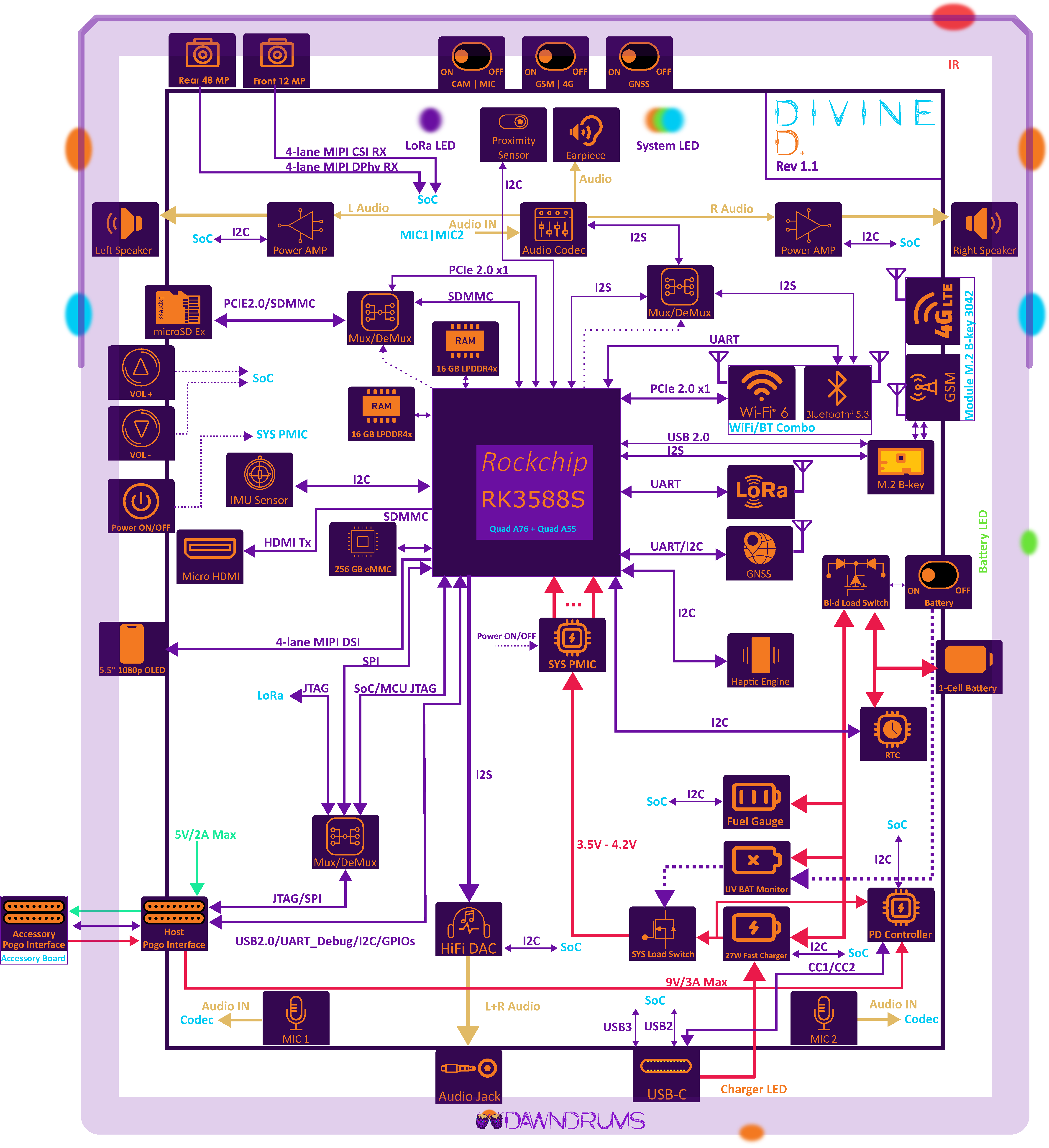

Hardware Architecture
Divine D. continues its rapid evolution toward a stable, community-powered, open mobile system.
This article highlights all the new blocks, updated subsystems, and design decisions that distinguish Rev. 1.1 from Rev. 1.0. SecondPCB is deprecated and its features are now merged with mainPCB.
Overview of Rev. 1.1 Improvements
Rev. 1.1 introduces several key subsystems that significantly improve connectivity, power management, audio routing, and expandability. These upgrades reflect community feedback and engineering validation.
It also takes into consideration the design fixes and changes from the system evaluation of Rev 1.0
1. microSD Express (Spec 7.x)
This represents a significant advancement in storage technology for open-source systems. The microSD Express now interfaces with PCIe 2.0 Gen 2 x1, enabling data transfer rates of up to 500 MB/s. One of the standout improvements is the markedly increased IOPS compared to legacy microSD and eMMC 5.1, enhancing overall system performance.
Following the SD specifications of 7.x, the hardware allows for multiplexing between legacy microSD (SDMMC) and microSD Express. Since the RK3588S does not natively support SDexpress, the operating system is required to manage an external de/multiplexer. This setup enables dynamic switching between interfaces based on user or system requirements, optimizing flexibility and efficiency.
2. Micro HDMI Display Output
An HDMI connector has been added to facilitate the connection of an external display, enabling high-definition video output. This upgrade supports an impressive image resolution of up to 7680x4320, or 8K at 60Hz, allowing users to enjoy ultra-clear visuals with exceptional detail and fluid motion. Whether for presentations, gaming, or media consumption, this enhancement significantly expands the multimedia capabilities of the device, making it ideal for a wide range of applications.
3. LoRa Subsystem
One of the biggest additions in Rev. 1.1 is the integration of a LoRa transceiver, connected via UART
Why this matters
LoRa opens immersive experimentation possibilities:
- Ultra-low-power long-range messaging
- Off-grid peer-to-peer communication
- Community mesh networks
- IoT gateway scenarios
This gives Divine D. one of the most flexible wireless stacks seen in an open smartphone.
4. New Load and Battery Power Switches
Rev. 1.1 introduces two new load switches situated between the Power Management Integrated Circuit (PMIC) and the charger, as well as between the battery and the charger. This addition significantly enhances the power path efficiency, providing improved control over the overall system power management.
By optimizing the routes for power distribution, these switches facilitate better energy regulation and reduce the risk of power-related issues. Users can expect more reliable performance and greater flexibility in power management, improving the overall user experience and extending the longevity of the device.
5. Haptic Engine Added
A dedicated Haptic Engine block (motor + driver) now appears in Rev. 1.1.
Connected via I²C, it enables:
- Vibrations
- UI feedback
- Alerts
- Custom waveform control
6. Under-Voltage Battery Monitor
To enhance the battery management system, we have integrated a battery voltage monitor that efficiently manages dead battery mode without requiring any interaction from the host system. This improvement was driven by several tests conducted on Rev. 1.0, which revealed that the charger failed to isolate the battery when its voltage dropped below 3V.
In such scenarios, the system encountered boot loops as it attempted to charge the battery while the load remained excessively high, particularly during the boot process. With the new UV (Under Voltage) battery monitor in place, the system's load switch automatically opens the circuit to disconnect the load until the battery voltage rises above a predefined threshold of 3.5V.
Additionally, the monitor incorporates a delay mechanism and hysteresis to ensure reliable operation, preventing unnecessary cycling and enhancing the overall efficiency of the charging process. These enhancements significantly improve the reliability and longevity of the device under varying battery conditions.
7. Battery Switch
The battery can now be fully disconnected from the load via a bi-directional load switch. When this disconnection occurs, users still have the option to power on the system simply by connecting the charger. This allows also to override the UV battery monitor, allowing for operation even when the battery is disconnected or deeply discharged.
8. New LEDs
New LED indicators were added:
- RGB System LED (PMIC ON, User, Boot)
- Charger LED (charging state)
- Battery LED (UV battery monitor state)
- LoRa status LED (LoRa connectivity state)
- Drumhead LEDs (User)
- Infrared LED (User)
These help during early firmware and software bring-up and user feedback.
9. Expanded Accessory Side Pogo Interface
An 18-pin magnetic pogo interface implements:
- UART/Debug
- USB2
- GPIOs
- SPI
- Muxed JTAG SWD for the SoC, Soc's MCU and LoRa
- Bi-directional power path
This strengthens Divine D. as an experiment-friendly open hardware platform.
10. M.2 B-key GSM and 4G module
The mini-PCIe connector has been deprecated and replaced with an M.2 B-key connector to optimize space on the assembly and accommodate a smaller connected module. This change allows for the integration of an M.2 3042 module, enhancing both compactness and functionality.
11. Design fixes
Based on the previous tests and runs, some design fixes and improvements have been added to the existing sub-systems. Most notable changes have been implemented on:
- HiFi DAC
- GNSS
- DDR voltage rail on the PMIC
- Component footprints
- SPI Nor is deprecated
| Subsystem | Added or Updated |
|---|---|
| microSD Express (Spec 7.x) | Added microsSD express interface |
| Micro HDMI Display Output | HDMI 2.1 connector with 8k @ 60Hz |
| LoRa Module | New long-range communication subsystem |
| Power Switches | New power domain isolation/control |
| Haptic Engine | Added motor + driver via I²C |
| UV Battery Monitor | Added under-voltage monitoring for the battery |
| Battery Switch | A slide switch to disconnect the battery |
| Indicator and IR LEDs | New indicator LEDs and IR LED |
| Pogo Accessory Interface | Interface to accessory with GPIO/SPI/UART/I2C/JTAG mapping |
| M.2 B-key GSM and 4G Interface | Interface to connect an M.2 B-key for GSM and 4G |
| Design fixes | Fixes from the last system evaluation |
