Adding to the growing mountain of commentators joining us in calling BS on the booming data center industry magically pulling dozens of gigawatts of energy per year out of thin air...
... and as a reminder, the DOE recently forecast that data centers would need 100GW of new peak capacity by 2030 - the equivalent of about 100 new nuclear power plants - the FT has published a report highlighting the growing chasm between dreams and (artificial) reality.
Already accounting for about 51 GW of demand today, data centers look to add as much as 72 GW over just the next three years according to Morgan Stanley. There's about 25 GW of new energy generation ready to come online in that same timeframe, mostly in the form of natural gas turbines, but this will leave a gaping hole 47 GW wide. It follows similar estimates from across the industry.
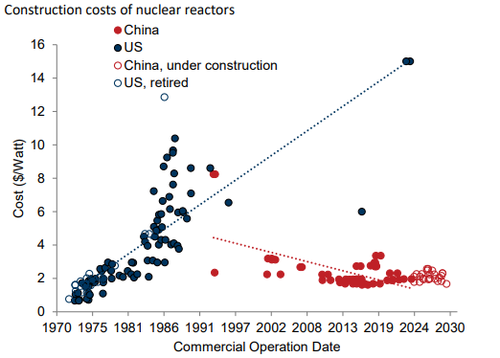
An AP1000 from Cameco’s Westinghouse can provide just over 1.1 GW, which means from the perspective of nuclear energy, big tech is asking for over 17 new large reactors within the next 36 months. So, just some context: in the past few decades, the US has built only two, and they weren't exactly cheap.

Oh, and as of this moment, the US isn't building any, while China has 29 in process.

Needless to say, the US is horribly behind with construction proficiency of any type of energy generation infrastructure. OpenAI’s letter to the US government claimed they and their big tech peers need 100 GW per year of new power, while lamenting the US only added 51 GW in 2024 compared to China adding 429 GW. This is partly due to China’s skilled and proficient construction force.
But what happened to the army of nuclear construction workers trained for the reactors we built recently in Georgia, you ask? They quit nuclear to go build data centers... the same data centers which now have no power. As the chart from Goldman below indicates, the US is now short 300,000 engineers (and as much as 500,000) to meet US power demands by 2030.

With the average time for connecting new demand to grids like PJM now exceeding eight years, where is all the power going to come from in the short term?
Why don't we just take a supersonic jet engine and screw it into the ground? Thankfully, there's a company for that.
Boom Supersonic has unveiled their Superpower Natural Gas Turbine, capable of producing 42 MW of electricity each. The company was originally designing a supersonic jet turbine for use on next-gen airliners, but they quickly recognized the disturbing demand for new energy generation capacity and are now seizing their moment.
Furthermore, Boom turbines have the benefit of not requiring water cooling systems due to their advanced materials used in the turbine’s construction and specially designed air cooling systems. Given the strong opposition to water usage by environmental groups and smaller towns, this gives Boom a major leg up in dry areas.

Their capacity for producing the supersonic turbines is expected to reach roughly 100 per year by 2030, which is about 4 GW of new gas turbine energy. So no, it won't plug the demand gap through 2030 - and it certainly won't plug the massive gap with China - but at least it's a step in the right direction. As for the bigger picture, either more gas turbine producers will need to step up over these next few critical years, or data centers are going to start stacking up as nothing more than order dots on GE Vernova’s backlog.
Meanwhile Boom's core business - the pursuit of a 21st century Concorde - continues.
Loading recommendations...