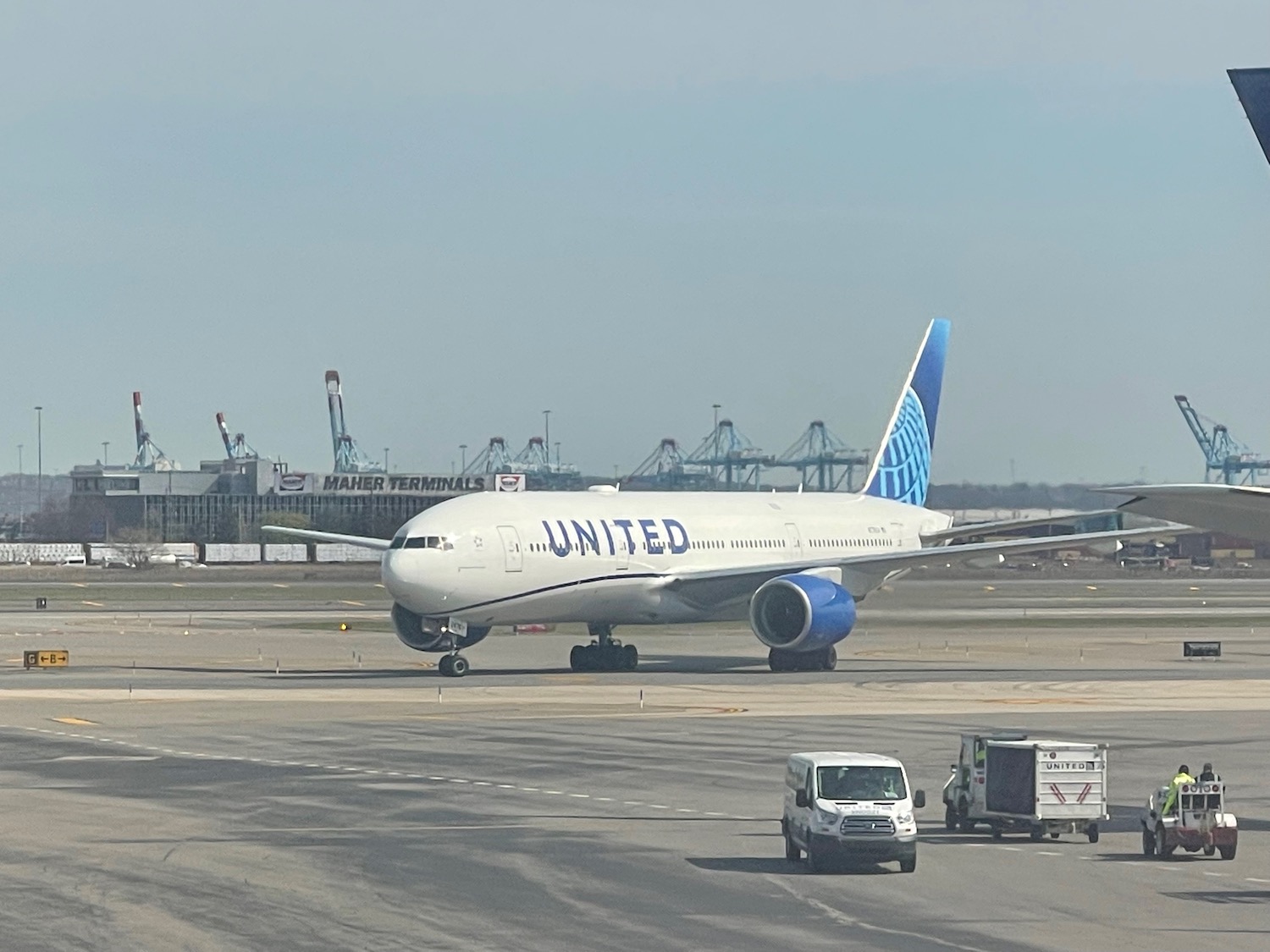
A United Airlines 777-200 incident at Dulles and a quiet schedule shift raise a bigger question about a widebody that increasingly looks like it has no long-term home in United’s fleet.
A United Airlines Boeing 777 departing Washington Dulles (IAD) for Tokyo Haneda (HND) suffered an engine failure shortly after takeoff on December 13, 2025, shedding debris that ignited a brush fire near the airport. The aircraft returned safely, passengers were unharmed, and United emphasized that safety protocols worked exactly as intended:
“Shortly after takeoff, United flight 803 returned to Washington Dulles and landed safely to address the loss of power in one engine. There were no reported injuries. We’ve temporarily closed a United Club lounge at Dulles to help assist our customers and work to get them to their destinations. United is grateful to our crews and to the teams at Washington Dulles for their quick work to help ensure the safety of everyone involved.”
All of that may be true…and still miss the bigger story.
Because this incident comes as United is quietly pulling its remaining high-density domestic Boeing 777-200s from the schedule, it raises an obvious question. What exactly is the future of the 777-200 (-ER and non-ER) at United Airlines? Will the 787 Dreamliner fully replace it?
The Dulles Engine Failure Was Serious Even If It Ended Well
The aircraft involved was operating a routine departure from IAD when it experienced an engine malfunction that scattered debris beyond the airport perimeter. Fire crews responded to a brush fire, flights were disrupted, and the FAA opened an investigation.
United deserves credit for how the situation was handled operationally. The aircraft returned safely, and this was not a repeat of the United 328 Denver incident from 2021. Still, engine failures on aging widebodies attract scrutiny for a reason: they are rare, expensive, and underscore fleet-planning realities airlines cannot ignore.
United Is Quietly Removing Domestic High-Density 777s
Separately, FlyerTalk users have been tracking United’s quiet removal of domestic Boeing 777-200 flights from the schedule. These are the infamous high-density aircraft configured with large economy cabins, minimal premium seating, and no true long-term role beyond domestic trunk routes.
For years, United used these aircraft to maximize capacity on Hawaii and hub-to-hub flying, where gauge mattered more than passenger experience.
As these aircraft age, that logic no longer holds. These aircraft are expensive to operate, inefficient by modern standards, and mismatched with United’s current premium-heavy strategy. Pulling them from domestic service is not a temporary tweak, even if driven specifically by supply chain challenges with Pratt & Whitney engines. It looks structural.
The 777-200 Problem Is Not Safety. It Is Economics.
The Boeing 777-200 is not an unsafe airplane. As far as I can tell, that is not the issue even after the incident over Dulles over the weekend.
The issue is that United’s 777-200 fleet is old, maintenance-intensive, and increasingly difficult to justify economically. This is particularly true for the Pratt & Whitney PW4000-powered subfleet, where parts availability and long-term support have become growing challenges. But even the GE 777-200s are getting old.
United has not broadly retired all of its Pratt & Whitney-powered 777-200s. However, United has begun placing at least some of its oldest 777-200s into long-term storage in California’s Mojave Desert, including its very first Boeing 777, which recently marked 30 years of service. That move is widely viewed as symbolic of the aircraft’s shrinking role at the airline, even though United has not formally declared the entire subfleet permanently retired.
At the same time, United is investing heavily in:
- Boeing 787s for long-haul flying
- Airbus A321neos for domestic and transcontinental routes
- Premium-heavy cabins and more efficient narrowbodies
There is no obvious niche left for a 25-plus-year-old widebody that feels like flying on a budget carrier (hopefully the 757-200s are not far behind, but that’s another issue).
Why Incidents Like This Accelerate Fleet Decisions
Airlines rarely retire aircraft because of a single incident. But incidents like the IAD incident reinforce internal arguments that already exist.
Every disruption forces planners to ask whether the aircraft is still worth the complexity it brings to the network. Every unscheduled maintenance event tightens the math. Every FAA inquiry reminds management that aging fleets carry reputational risk, even when handled correctly.
The timing here is not coincidental.
What Comes Next For United’s 777-200 Fleet
The writing has been on the wall for years, but I think the UA803 incident crystallizes it.
Rather than an abrupt retirement, expect a slow drawdown:
- Continued removal from domestic schedules
- Reduced overall utilization
- More aircraft placed into storage as leases expire
- No meaningful interior refreshes or long-term investment
I still like that non-ER aircraft in the dorm-style 8-across business class, but it really is like stepping 20 years back in time. Even the longhaul-conifugred 772s just feel old onboard with their smaller overhead bins and horrible fluorescent lighting.
CONCLUSION
The Dulles engine failure was handled professionally, and it does not mean the Boeing 777-200 is unsafe, whether we are talking about GE or Pratt-Whitney engine variant. But it does highlight why this aircraft no longer fits United’s future.
Between rising maintenance costs, declining efficiency, and a network strategy focused on newer aircraft and premium revenue, the 777-200 is running out of runway at United.
The quiet schedule changes say more than this freak incident over Dulles does.

Get Daily Updates
Join our mailing list for a daily summary of posts! We never sell your info.