There are people who demand beauty, calm, and harmony in music – a demand that is perfectly understandable. I am talking about classical music, leaving other “musics” aside just now.
I often hear people say, “When I go to a concert, I like to have the music wash over me. It relaxes me, takes my cares away. It settles me down.” They speak of music almost as if it were a sedative.
Dissonance, on the other hand, is often disturbing. It prickles and piques, rather than soothes. Harmony is a crucial part of music, obviously. But disharmony, a.k.a. dissonance, is too. It has been embedded in music from the beginning.
The works of Bach are loaded with dissonance. Typically, he uses it to create tension and then gives us the resolution – the return to harmony.
For many generations, there has been a joke, which goes something like this: An old musician is lying in bed, ill. His daughter wants to get him out of bed. She goes to a nearby piano and plays an unresolved chord, over and over. Unable to take it anymore, the old man rises from bed, staggers to the piano, and resolves the chord.
Mozart wrote a string quartet dubbed “Dissonance.” He begins with an A-flat–major chord, which he builds note by note – until he lays an A natural on top of it. Dissonance. There is no tool of which Mozart would not avail himself.
So, dissonance, or disharmony, we have always had with us. But there came a time, in the twentieth century, when dissonance prevailed, to the exclusion, even the derision, of other tools. Dissonance was not so much a tool as the whole box.
Ned Rorem spoke of “the serial killers.” Rorem, an American born in 1923, was a composer thought of as “old-fashioned,” in that he continued the tradition of beauty, especially in art songs (of which he wrote about five hundred).
Maybe we could pause to state a simple truth: Beauty is in the eye, or the ear, of the beholder, or hearer.
What did Rorem mean by “serial killers”? He was referring to the practitioners of serialism, which includes the twelve-tone method, which was pioneered by Arnold Schoenberg, that Vienna-born genius (1874–1951).
Schoenberg started out in the Romantic tradition, writing such works as Verklärte Nacht, a lush and beautiful piece for strings. He also wrote many fine art songs. If he had continued in that vein, he would have been the latest in the line of great Lieder composers, in my opinion: a successor to Schubert, Schumann, Wolf, et al. But Schoenberg felt “air from another planet.”
That is a line from “Entrückung” (Rapture), by Stefan George: “I feel air from another planet.” Schoenberg incorporated this poem, and another by the same poet, into his String Quartet No. 2. He has a soprano sing them. Never before had a voice been introduced into a string quartet. And Schoenberg launched a long, long period of atonality. Composers all over embraced the new language.
Most of us, I think, welcome new languages. Vive la diversité. But the “composition establishment,” to the extent it existed, was not content with diversity: a diversity of languages and styles. This establishment insisted on the “new” to the exclusion of the “old.” It was censorious, illiberal, and mean.
In 2005, the Salzburg Festival highlighted the “forbidden composers”: composers forbidden by the Nazis for their “degenerate art” (Entartete Kunst). Among the forbidden were Franz Schreker, Erich Wolfgang Korngold, and Alexander Zemlinsky (Schoenberg’s brother-in-law).
Before an audience, I did a Q&A with Michael Haas, a music scholar. After the Nazis, he said, some of the forbidden composers faced “a second dictatorship”: that of an establishment that scorned anything smacking of the Romantic or tonal.
There were composers who nonetheless went their own ways. Two Americans, Aaron Copland and Samuel Barber, got famous for the tonal, “accessible” music they wrote: Copland’s Appalachian Spring, for example, and Barber’s Adagio for Strings. But each of those men also wrote “modern,” or modernist, music – including twelve-tone music. Because they wanted to or because they felt they had to? I would like to ask them.
In 1999, the San Francisco Symphony, conducted by Michael Tilson Thomas, put out an album called Copland the Populist. It comprised Appalachian Spring, Rodeo, and Billy the Kid. It could also have included Lincoln Portrait, El Salón México, and Fanfare for the Common Man.
What’s an example of Copland the un-populist? His Piano Sonata (commissioned by, and dedicated to, Clifford Odets, the playwright). Also his Piano Quartet. Are these works un-beautiful, in addition to being un-populist? Certainly not. Modernism need not exclude beauty.
In an interview with me, Lorin Maazel spoke of “tonal-sounding atonality.” (Maazel was a conductor who also did some composing.) He was referring, in particular, to the Violin Concerto of Alban Berg, one of Schoenberg’s illustrious students.
On the eve of his hundredth birthday, in 2008, I interviewed Elliott Carter, the American composer who practically embodied modernism. It was his view that the “old music” could not speak to modern man the way twentieth-century music could. By “old music,” he did not mean Renaissance or Baroque composers, but music all the way through Wagner.
I asked Carter what he thought of “neo-Romantics” such as Samuel Barber. “Well, some of us felt that the kind of music Sam wrote had already been done, only done better than anybody could do it now,” he said. “Therefore there was no reason to do it now.” With a grin, Carter added, “What Sam did was deplorable, but his music, in any case, is rather good.”

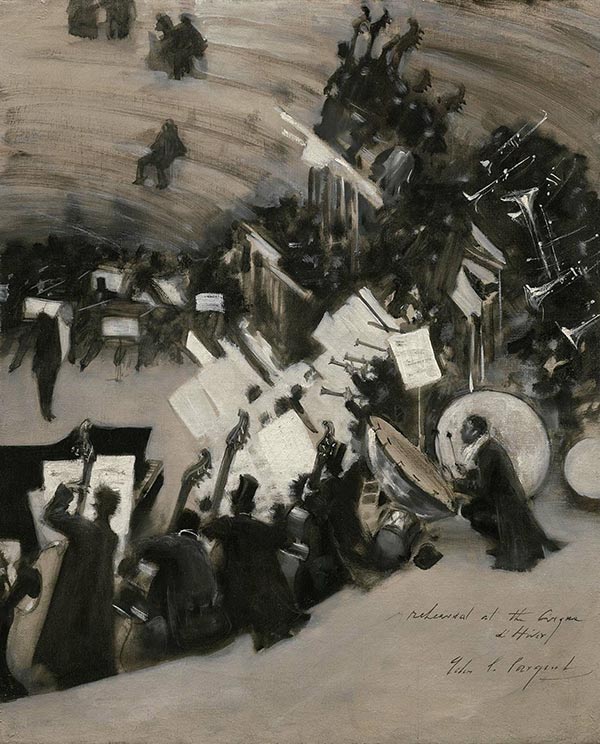
John Singer Sargent, Rehearsal of the Pasdeloup Orchestra at the Cirque d’Hiver, oil on canvas, c. 1880.
In 1952, Lee Hoiby won a Fulbright scholarship, allowing him to study at the Santa Cecilia Academy in Rome. But the authorities at Santa Cecilia – chiefly, the composer Goffredo Petrassi – would not let him in. They said he had to abandon his “nineteenth-century” notions and adopt modern practices. Hoiby, stubborn, refused. He often said, “I wanted to grow heirloom roses, but they allowed you nothing but cactuses.”
Another line of his was, “I felt the hot breath of the composition police on my neck every time I wrote a major third.”
Hoiby, an American born in 1926, paid a price for his nonconformity: a price in commissions, prizes, and fame. But it was a price he gladly paid. He had to write the music that was in him, and, fortunately, enough people liked it (including Leontyne Price, the great soprano, who championed his songs).
“It was Schubert who taught me to write songs,” Hoiby once told me. He had teachers in the flesh – Barber among them – but teachers he never met in the flesh, too. Another such teacher was Richard Strauss. “He was the one, in Capriccio, who gave me the courage to write simple lyricism.” (Capriccio is a Strauss opera.)
You know who else encouraged Hoiby, unbeknownst to her? Joni Mitchell, the singer-songwriter. She proved, said Hoiby, that “there is still juice in the tree of melody.” There always will be, for those who want it.
Eventually, the compositional world loosened up – became more liberal, less censorious. When was that? It’s hard to put a date on it, but sometime before the end of the twentieth century. In 2002, Ned Rorem told me:
I always felt like the Prodigal Son’s brother. I had never gone astray. People for many, many years did music of a particular kind because they thought they should – music of incredible complexity. Everyone wanted Elliott Carter, Pierre Boulez. For nearly a generation, my music was “vulgar,” but that was the music that was in me. Now one can write anything one wants to.
Lee Hoiby was tickled pink when a younger composer referred to him as a “maverick.” For decades, Hoiby had been knocked as a square and a relic. But the younger composer perceived him as a maverick, kicking against the zeitgeist.
There was a loosening, to be sure, but the composition police still had some kick in them. In 2009, a composer who was then in his thirties sent me an email:
Critics are awful to me. I am writing the only music I know how to write. It’s an unconscious reaction to the music I love most. Despite what critics say, my music is actually not without modernist influence in places. But why is my music routinely described as “safe” while modernist composers – who do exactly what they think they’re supposed to do as modern composers, and who often confess to me that certain overtly tonal parts of my music are “daring” – are always described as “edgy,” “bold,” and, yes, “daring”? Well, I can’t play the new-music game.
Different composers have different leanings, different impulses, in them. They feel the air of their own planets. They should, indeed, write “the music that is in them.” If your music is cerebral and thorny, fine. If it is simple and lyrical, fine. “If it sounds good, it is good.” That was the dictum of Duke Ellington.
Music has a variety of “jobs,” as the other arts do. It can calm, soothe, and delight. It can also provoke, disturb, bite. No one expects the other arts to be beautiful and soothing, only. (Think of theater!) But some people have that expectation of music.
Composers, like other artists, need all the expressive tools they can get. There is a lot to express: love, consolation, joy, holiness – all those positive things. But also confusion, anxiety, anger, despair, sarcasm, malice….
Ah, malice. The second movement of William Walton’s Symphony No. 1 is marked “Scherzo: Presto con malizia.” The composer was reacting to a love affair gone awry. He follows that movement with one marked “Andante con malinconia” (with melancholy).
And did I mention sarcasm? Prokofiev wrote a set of piano pieces called Sarcasms. They are, too (sarcastic). In his career, Prokofiev used practically every tool in the compositional toolbox. Take Cinderella, one of his two great ballets (the other being Romeo and Juliet).
Cinderella ends with the “Amoroso,” as the prince and his up-from-the-ashes princess prepare to live happily ever after. This is some of the sweetest and best love music ever composed. Prokofiev meets the moment.
But earlier in the opera, when the clock strikes midnight and Cinderella has to leave in a hurry? Prokofiev creates a great, clangorous cacophony, reflecting urgency and panic. This meets the moment too.
Generally speaking, music without beauty would be like an ocean without water – but think of the salt as well, and the creepy things of the deep.