【Key Research Achievements】
- Demonstration that natural bacteria isolated from amphibian and reptile intestines achieve complete tumor elimination with single administration
- Combines direct bacterial killing of cancer cells with immune system activation for comprehensive tumor destruction
- Outperforms existing chemotherapy and immunotherapy with no adverse effects on normal tissues
- Expected applications across diverse solid tumor types, opening new avenues for cancer treatment
【Research Overview】
A research team of Prof. Eijiro Miyako at the Japan Advanced Institute of Science and Technology (JAIST) has discovered that the bacterium Ewingella americana, isolated from the intestines of Japanese tree frogs (Dryophytes japonicus), possesses remarkably potent anticancer activity. This groundbreaking research has been published in the international journal Gut Microbes.
While the relationship between gut microbiota and cancer has attracted considerable attention in recent years, most approaches have focused on indirect methods such as microbiome modulation or fecal microbiota transplantation. In contrast, this study takes a completely different approach: isolating, culturing, and directly administering individual bacterial strains intravenously to attack tumors--- representing an innovative therapeutic strategy.
The research team isolated a total of 45 bacterial strains from the intestines of Japanese tree frogs, Japanese fire belly newts (Cynops pyrrhogaster), and Japanese grass lizards (Takydromus tachydromoides). Through systematic screening, nine strains demonstrated antitumor effects, with E. americana exhibiting the most exceptional therapeutic efficacy.
【Research Details】
Remarkable Therapeutic Efficacy
In a mouse colorectal cancer model, a single intravenous administration of E. americana achieved complete tumor elimination with a 100% complete response (CR) rate. This dramatically surpasses the therapeutic efficacy of current standard treatments, including immune checkpoint inhibitors (anti-PD-L1 antibody) and liposomal doxorubicin (chemotherapy agent) (Figure 1).
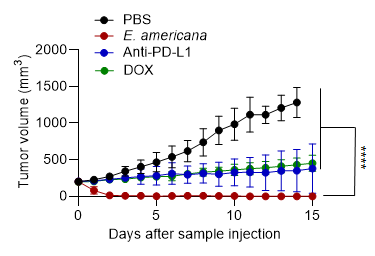
| Figure 1. Anticancer efficacy: Ewingella americana versus conventional therapies. Tumor response: single i.v. dose of E. americana (200 µL, 5 × 10⁹ CFU/mL); four doses of doxorubicin or anti-PD-L1 (200 µL, 2.5 mg/kg per dose); PBS as control. Data: mean ± SEM (n = 5). ****, p < 0.0001 (Student's two-sided t-test). |
Dual-Action Anticancer Mechanism
E. americana attacks cancer through two complementary mechanisms (Figure 2):
- Direct Cytotoxic Effect: As a facultative anaerobic bacterium, E. americana selectively accumulates in the hypoxic tumor microenvironment and directly destroys cancer cells. Bacterial counts within tumors increase approximately 3,000-fold within 24 hours post-administration, efficiently attacking tumor tissue.
- Immune Activation Effect: The bacterial presence powerfully stimulates the immune system, recruiting T cells, B cells, and neutrophils to the tumor site. Pro-inflammatory cytokines (TNF-α, IFN-γ) produced by these immune cells further amplify immune responses and induce cancer cell apoptosis.

Figure 2. Mechanisms underlying Ewingella americana antitumor effects.
Tumor-Specific Accumulation Mechanism
E. americana selectively accumulates in tumor tissues with zero colonization in normal organs. This remarkable tumor specificity arises from multiple synergistic mechanisms:
- Hypoxic Environment: The characteristic hypoxia of tumor tissues promotes anaerobic bacterial proliferation
- Immunosuppressive Environment: CD47 protein expressed by cancer cells creates local immunosuppression, forming a permissive niche for bacterial survival
- Abnormal Vascular Structure: Tumor vessels are leaky, facilitating bacterial extravasation
- Metabolic Abnormalities: Tumor-specific metabolites support selective bacterial growth
Excellent Safety Profile
Comprehensive safety evaluation revealed that E. americana demonstrates:
- Rapid blood clearance (half-life ~1.2 hours, completely undetectable at 24 hours)
- Zero bacterial colonization in normal organs including liver, spleen, lung, kidney, and heart
- Only transient mild inflammatory responses, normalizing within 72 hours
- No chronic toxicity during 60-day extended observation
【Future Directions】
This research has established proof-of-concept for a novel cancer therapy using natural bacteria. Future research and development will focus on:
- Expansion to Other Cancer Types: Efficacy validation in breast cancer, pancreatic cancer, melanoma, and other malignancies
- Optimization of Administration Methods: Development of safer and more effective delivery approaches including dose fractionation and intratumoral injection
- Combination Therapy Development: Investigation of synergistic effects with existing immunotherapy and chemotherapy
This research demonstrates that unexplored biodiversity represents a treasure trove for novel medical technology development and holds promise for providing new therapeutic options for patients with refractory cancers.
【Glossary】
Facultative Anaerobic Bacteria: Bacteria capable of growing in both oxygen-rich and oxygen-depleted environments, enabling selective proliferation in hypoxic tumor regions.
Complete Response (CR): Complete tumor elimination confirmed by diagnostic examination following treatment.
Immune Checkpoint Inhibitor: Drugs that release cancer cell-mediated immune suppression, enabling T cells to attack cancer cells.
CD47: A cell surface protein that emits "don't eat me" signals; cancer cells overexpress this to evade immune attack.
【Publication Information】
| Title: | Discovery and characterization of antitumor gut microbiota from amphibians and reptiles: Ewingella americana as a novel therapeutic agent with dual cytotoxic and immunomodulatory properties |
| Authors: | Seigo Iwata, Nagi Yamashita, Kensuke Asukabe, Matomo Sakari, Eijiro Miyako* |
| Journal: | Gut Microbes |
| DOI: | 10.1080/19490976.2025.2599562 |
【Research Funding】
This research was supported by:
- Japan Society for the Promotion of Science (JSPS) KAKENHI Grant-in-Aid for Scientific Research (A) (Grant No. 23H00551)
- JSPS KAKENHI Grant-in-Aid for Challenging Research (Pioneering) (Grant No. 22K18440)
- JSPS Program for Forming Japan's Peak Research Universities(J-PEAKS) (Grant No. JPJS00420230006)
- Japan Science and Technology Agency (JST) Program for Co-creating Startup Ecosystem (Grant No. JPMJSF2318)
- JST SPRING (Grant No. JPMJSP2102)
December 15, 2025