In order to solve robotics' data problem, we're building a preschool for robots.
The areas of deep learning that have seen the fastest progress in the past decade are those where data is abundant: language models and image generators can train on the entire internet; game-playing models like AlphaGo can generate data by playing against themselves. These datasets don't exist for robotics, so we need to create them from scratch.
At Pantograph, we're creating systems that are capable of unsupervised data gathering in the real world. Our models build representations of the world as they go, gradually learning about the world around them and about how they can influence it. Like language models, they are trained on enough diverse data to be able to generalize to new, unseen tasks. Like AlphaGo, our models learn from experience, continuously improving as they interact with the world.
Exploration in the Real World
What would the ideal real-world robotics dataset look like? Scale is important, as is diversity. The internet has an abundance of videos, so the most important real-world data to collect is about things that are difficult to infer from video. We need data about the properties of materials: texture, viscosity, density, what it feels like to bend something, to rub something against something else.
This first phase of data collection will look something like a robot preschool: thousands of small, inexpensive robots, touching everything they can get their hands on, tossing things around, finding the exact balancing point of two wooden blocks, bending, rubbing, scraping, building up a model of the world around them. This data will be the foundation upon which we will train increasingly capable models.
The robots will not only learn about the world around them, but also about themselves. The resulting models will be native to the robot's hardware, better able to exploit its capabilities and idiosyncrasies than any human operator.
Hardware Demo
Today, we're releasing an early preview of our hardware. It's designed from the ground up for what we think of as the robot preschool — this first phase of data collection, exploration, and long-horizon tasks.
Data scale matters, so minimizing cost matters. This makes our robot's small size an asset: it's cheaper to build, easier to scale, and faster to replace. Being small and low to the ground also makes it safer to be around as it learns - failures are less damaging, and human supervisors can easily pick it up and move it around. This is true for toddlers just as much as robots: being little makes being uncoordinated a lot less dangerous.
Real-world exploration also presents a specific hardware challenge: durability. Early models won't be especially coordinated: they'll bump into things, hit the ground, each other, themselves. The hardware has to survive that. We decided to design our hardware in-house because every detail matters when building a system that's robust and reliable at scale. Our team started with component-level testing — at this point, we've amassed over 10,000 hours of in-house stress and endurance data validating our most critical parts.
Our robot is small, strong, and exceptionally durable. It has treads instead of wheels, which make it more stable, terrain-capable, and motor efficient. It's an "origami" robot wherever possible: we lean heavily on 2D profile-based manufacturing — die cutting, laser cutting and bent sheet metal construction so that the design is materially efficient and easy to manufacture at scale.
Strength
Despite its size, our robot is quite strong. Fully extended, its arms each have a continuous payload of about 1kg, and it's capable of moving much heavier objects, as shown in the clips below.
Two robots together can move a couch, a person, and an IKEA bookshelf (~130kg):
Dexterity
Fine manipulation is the most difficult robotic capability, and we've designed our grippers to be simple while still capable of complex manipulation tasks. The following clips show our grippers connecting zip ties, inserting a USB cable into a port, and building a structure out of wooden blocks:
Tool Use
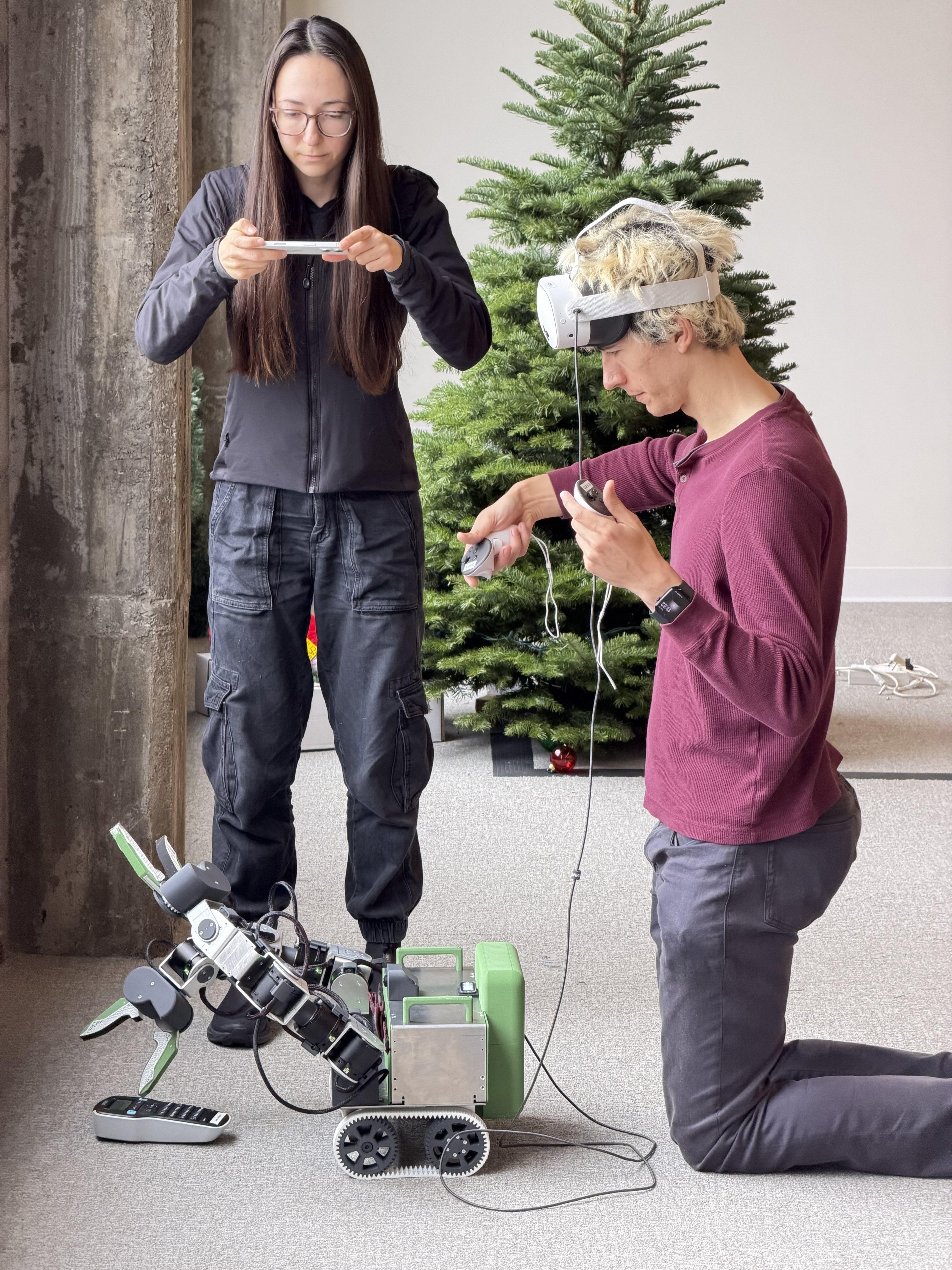
The world around us was mostly designed for humans, and it's important that a general-purpose robot be able to interact with tools designed for human hands. The compliance of our robot's grippers makes it better able to manipulate such tools. The following clips show our robot using scissors to cut a piece of paper, an electric screw driver to insert a fastener, and a label maker to print a message:
Teleoperation Setup
The demos above were collected via a simple teleoperation setup, pictured below:

Getting This Right Matters
A pantograph is a mechanical linkage that scales and replicates motion: trace a shape with one end, and the other reproduces it larger or smaller. We named our company Pantograph because we believe robotics should do the same for human agency: amplify what people can do, extend our reach, and multiply our capacity to shape the world around us.
Generally intelligent robots will reshape how work gets done and what people are capable of building. This technology touches the foundations of how society is organized: labor, economics, what it means to make something. That weight is something we feel.
We want robotics to amplify what it is possible for humans to do. We're targeting low hardware costs not just because it lets us train at scale, but because we want to expand who gets to build and what becomes possible to build. More labs, more workshops, more ambitious projects that today are impractical. This is a future that should be widely shared.
We structured Pantograph as a Public Benefit Corporation because we take seriously both the promise and the responsibility of what we're building. The PBC structure encodes that commitment into how we're governed, ensuring that as we scale, we remain accountable to something beyond short-term returns.
What's Next
We're in the process of massively scaling up data collection with our hardware. We own the entire stack, from hardware and firmware to our training infrastructure and learning algorithms. In all of these areas, there is much work to do.
On the hardware side, we're scaling to thousands of robots over the coming months. We'll be iterating on our designs for reliability, manufacturability, and capability, and keeping the robots running continuously. We're deepening our relationships with suppliers who can scale with us. Beyond this generation, we're interested in building hardware that meets a wider range of needs and exploring new form factors.
On the research side, there are many unanswered questions: what's the right task distribution? What's the right way to incorporate pretraining? How can we steer the resulting models? These algorithms have never been scaled up before, and there is a lot of room for new ideas.
If the prospect of designing hardware and algorithms that can learn continuously in the real world sounds exciting to you, we're hiring!