Travel agents are the go-to example of an industry killed by the internet. And the numbers are brutal: US agents fell from 132,000 to 74,000, retail locations from 34,000 to 13,000, total jobs down 70% by 2021. But that collapse took a decade. The ones who survived did it by going upmarket. I keep thinking about this when I look at what's coming for software engineering - except this time, I don't think we get ten years.
The history
Interestingly, while researching this article there are some significant other factors at play. US airlines dramatically cut commissions in 1995 - which accounted for 60% of the average US travel agent's revenue prior to this.
While it's hard to say how much of this commission cut was due to increasing digitisation of the booking services vs other factors, I feel this really does have parallels to the software engineering market, which had a huge boon with covid-era ZIRP causing arguably far too much capital to be allocated to software engineering and then a gradual but seemingly relentless pullback in job positions post that.
In many ways the commission cut led the travel agent industry to be in the worst possible position for the advent of the internet with serious almost overnight cashflow worries. I have no doubt this led the industry to be poorly prepared for the arguably much larger threat of OTAs - margins really started eroding but overall travel volumes continued to increase, masking the structural shift going on.
I do feel this is happening with software engineering positions and contracts right now. Many chats I have with people seem to blame the economy or other external factors for the big slowdown in openings. While there is some truth in this - there has been a ~$150bn decline in US VC funding - I also hear a lot of managers and CTOs saying they are not needing to hire for additional software engineering positions and often aren't rehiring when employees leave.
Things got a bit better, then got a lot worse
Interestingly, employment in the US travel agent sector started to increase in the late 90s - due to record travel volumes. It was a classic 'make it up in volume' play, where margins started eroding because of the commission cut. Anecdotally I've heard of a lot of this happening in the custom software engineering market - with significant discounting going on to try and maintain/increase headline revenue numbers albeit at a (much) reduced margin.
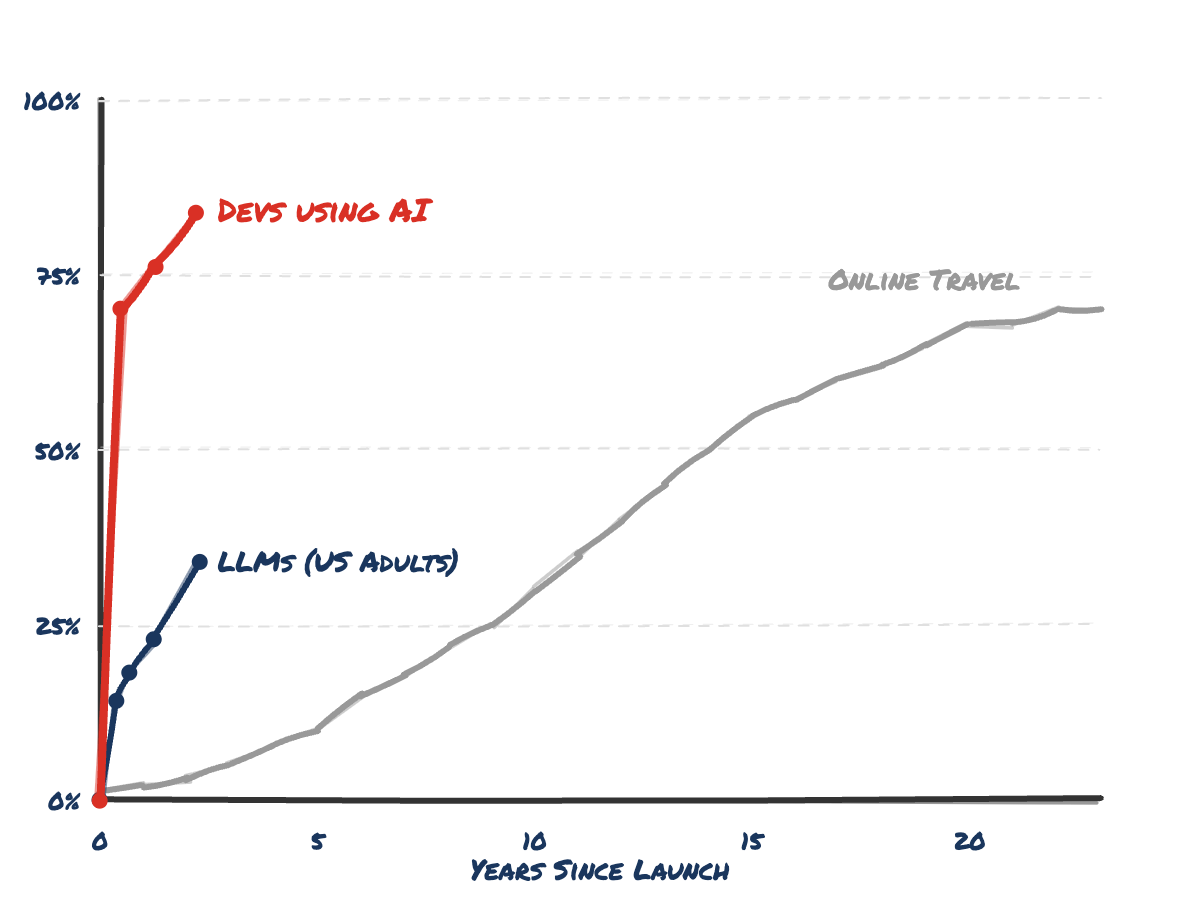
It's important to keep in mind in 1999 less than 5% of travel was booked online - which seems incredibly alien to us now.
LLMs have got far more market share in far less time. This is the key reason I think the changes are going to be far more rapid. We're at ~2.5 years since the release of GPT-4 (the first model that could really attempt to code on any serious level) and LLM usage is >40% of the entire US population.
 Even more astoundingly, according to the Stack Overflow developer survey LLM adoption in software engineering went from 0% in 2022 to 84% (!) in 2025.
Who survived
Interestingly, while the market contracted rapidly with OTAs seeing very rapid growth over the early 2000s, there were some markets that saw major growth.
Corporate "TMCs" (travel management companies) saw huge growth - the companies in charge of mass-booking employee travel on behalf of companies.
So did certain niche parts of the market - cruises especially (still 75% offline). Luxury travel exploded - Virtuoso up 211% - arguably because they are accessing inventory that isn't available to anyone.
So it wasn't all bad news. There was certainly some resilience in the travel industry where there was more complexity, typically requiring multiple products packaged together with higher commissions on some products outweighing the wafer thin (or non-existent) commissions on airfare.
Who didn't
Generalist travel agents got completely wiped out. Retail travel agency establishments fell 59% between 1997 and 2013; from nearly 23,000 to under 10,000. If your job was to type customer requirements into Sabre, within a few years you were competing directly with a website that could do it faster and cheaper. The most commoditised work went first: simple point-to-point flights moved online almost immediately, and by 2002 agents who depended on airline ticketing had zero commission and no differentiation.
Between 2000 and 2020, somewhere between 58,000 and 64,000 agents exited the profession entirely. There was no retraining program. Most didn't "move upmarket".
I think this is a very telling tale for software engineering. If your job is to translate requirements into code manually - and that's it - you're the generalist travel agent.
I'm still speaking to far too many software engineers who are dismissive of agentic tooling, or who treat it as a novelty rather than the thing that's coming for their job. If you're fighting it rather than leaning in, unless you're lucky enough to be in a specific niche, I suspect the market is going to look extremely ropey over the next five years.
That's not to say that software engineering is "done" - far from it. Some of the best engineers I know have leveraged it to improve quality while increasing productivity. For example - building better test suites, better observability and also prototype multiple directions to see what works best. Or they've hugely improved the quality of the UI/UX for MVPs if they lean backend.
Software engineering doesn't have 10 years
As the stats above show, adoption is extremely rapid. The other curve that is happening from my last post which blew me away is the improvement in agent success rates from METR.

Opus 4.5 has really startled me - it genuinely can do complex software engineering tasks which I'd expect a proficient developer to take hours in minutes with very few defects.
The real question is what happens over 2026. Are we going to see 'superhuman' agents that far surpass human abilities (either in speed, quality or some other dimension we haven't even thought about)? I don't know. But I'm not waiting around to find out.
What does 'upmarket' look like?
The real value now lies in domain knowledge: understanding how systems connect, knowing which data exists where, and grasping what the business actually needs. I've had outrageously good results taking my knowledge of internal and external data sources and getting LLM agents to synthesise it all together. That kind of work isn't going away: if anything, improvements in agentic coding mean you can do what would have required a team of 10 in what seems like a few afternoons.
The other move is to broaden. If you're a backend engineer who's always avoided frontend, now's the time - agents can bridge the gap while you learn. If you're frontend-only, lean into backend, devops, infrastructure. The engineers I see thriving are the ones who can own an entire problem end-to-end, not just their slice of it. The generalist travel agents got wiped out, but the generalist engineers - the ones who can move across the stack - are more valuable than ever.
Travel agents had ten years to figure this out. Most didn't. Developers are three years in, and the curve is steeper.