Authored by Andrew Korybko via Substack,
This refers to keeping the targeted state’s power structure in place but after some (at times significant) changes that advance the meddling state’s interests.
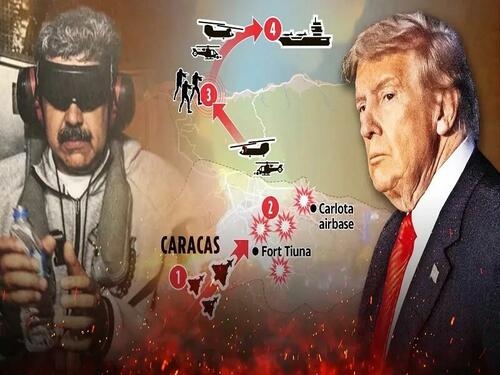
Some critics of the US’ “special military operation” in Venezuela claim that it didn’t succeed despite President Nicolas Maduro’s capture since the “Chavismo deep state” that he presided over remains in place.
This refers to the explicitly ideological elements of his country’s permanent military, intelligence, and diplomatic bureaucracies but can be expanded to include governors and trade unions among other groups.
The point is that removing Maduro from the political equation didn’t result in regime change.

That’s true, but the premise that US wanted to achieve such a goal is debatable since Trump 2.0 is comprised of figures who’ve criticized previous regime change operations for destabilizing their regions and leading to unpredictable consequences that ultimately harmed US interests.
It’s therefore plausible that they never intended to forcibly carry out regime change in Venezuela due to concerns that a civil war might follow, which could engender a large-scale migrant crisis and destroy energy infrastructure.
Rather, the immediate goal can be described as regime tweaking, which refers to keeping the targeted state’s power structure in place but after some (at times significant) changes that advance the meddling state’s interests.
In the Venezuelan context, the US forcibly removed Maduro so that he’d be replaced by his Vice President Delcy Rodriguez, who Trump publicly expects to “do what we want” (likely at Marco Rubio’s direction).
That’s arguably what he meant by “running the country” till its transition is complete.
Such a transition might not result in regime change after Trump ruled out Nobel Peace Prize winner Maria Corina Machado leading Venezuela since “She doesn’t have the support or the respect”.
He also didn’t mention “democracy” once during his press conference in a sign that he’s uninterested in a radical regime change from the Chavismo model to a Western one (at least at this time). This hints that he’s open to Rodriguez or some other Chavista who he thinks the US can work with succeeding Maduro.
They’d have to enjoy the support of the powerful armed forces and militias in order to prevent a civil war, which ipso facto entails preserving at least some of their privileges, especially economic-financial ones.
That said, the armed forces barely put up any resistance on Saturday so it’s possible that Defense Minister Vladimir Padrino Lopez and Interior Minister Diosdado already clinched a deal with the US, only to talk tough in front of the cameras afterwards like Rodriguez has for domestic political reasons.
If an election is held within 30 days like Article 233 of the Constitution calls for, then the Defense and Interior Ministries would have to help secure it, thus reinforcing the importance of their chiefs supporting the US’ envisaged transition in Venezuela.
The US doesn’t care how Venezuela is governed or who (at least nominally) rules it, just that US influence is restored, which could take the form of its oil only being sold to US-approved buyers and foreign rivals like China no longer having a foothold there.
Of course, de-ideologizing the Venezuelan “deep state” so that more easily manipulatable pro-Western figures replace the Chavistas would entrench the US’ newfound influence, but this can only be done gradually since moving too fast could spark a civil war and thus risk ultimately harming US interests.
Some of the Chavismo model’s socio-economic programs and neighborhood organizations might also have to be preserved to prevent this.
It’ll therefore be interesting to monitor how the transition unfolds.
Views expressed in this article are opinions of the author and do not necessarily reflect the views of ZeroHedge.
Loading recommendations...