

The Push to Make Semiconductors in Space Just Took a Serious Leap Forward
Space Forge plans to manufacture semiconductors from space—without the need for humans
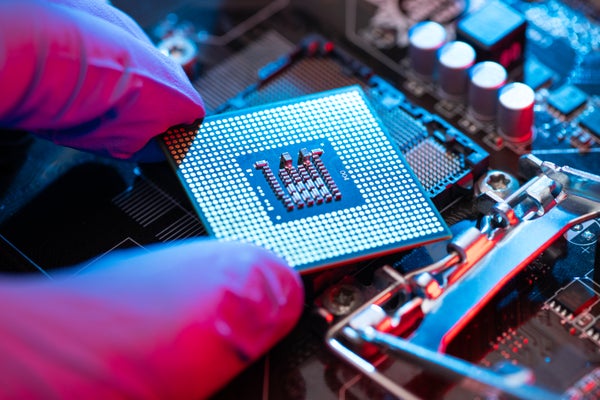
Narumon Bowonkitwanchai via Getty Images
Space Forge is on a mission to manufacture semiconductors in space—no humans required. And on Wednesday the U.K.-based aerospace startup announced that it had taken a major step toward that goal by creating plasma, or superheated gas, aboard a commercial satellite for the first time.
Semiconductors require extremely precise conditions to make, and both NASA and industry groups have argued that the microgravity environment of space is better for their manufacturing than that of Earth. The reasons why are varied, but part of it has to do with how silicon behaves in such an environment—it’s just easier to get the material to adhere to the structure needed to make a semiconductor.
Indeed, Space Forge’s feat builds off previous work done on the International Space Station, says Clayton Swope, deputy director of the Aerospace Security Project at the Center for Strategic and International Studies, a think tank.
On supporting science journalism
If you're enjoying this article, consider supporting our award-winning journalism by subscribing. By purchasing a subscription you are helping to ensure the future of impactful stories about the discoveries and ideas shaping our world today.
“The key difference here is that this was done uncrewed, without any people, on an entirely commercial spacecraft,” he says. “This demonstration shows that semiconductor crystal manufacturing can happen in space just using machines.”
“Keeping people alive in space is expensive,” Swope adds. “If machines can do that work instead, it brings down the cost of doing manufacturing in space.”
Space Forge CEO Joshua Western said in a press release that the company’s work proves that the right environment for semiconductor manufacturing “can be achieved on a dedicated, commercial satellite—opening the door to a completely new manufacturing frontier.” Space Forge launched its satellite, ForgeStar-1, in June. Its microwave-sized factory includes a furnace that the company showed reached temperatures of around 1,832 degrees Fahrenheit (1,000 degrees Celsius).
Other companies and research teams are getting in on the budding space manufacturing industry. In 2024 another startup, Varda Space Industries, demonstrated that it was possible to grow crystals of ritonavir, an antiviral drug, on an uncrewed commercial spacecraft and return them to Earth. And researchers at the Swiss Federal Institute of Technology Zurich recently 3D-printed human tissues in microgravity.
In-space manufacturing is in its “early days,” Libby Jackson, head of space at the Science Museum in England, told the BBC. But testing and proving technology like Space Forge’s “really opens the door for an economically viable product, where things can be made in space and return to Earth and have use and benefit to everybody on Earth.”
It’s Time to Stand Up for Science
If you enjoyed this article, I’d like to ask for your support. Scientific American has served as an advocate for science and industry for 180 years, and right now may be the most critical moment in that two-century history.
I’ve been a Scientific American subscriber since I was 12 years old, and it helped shape the way I look at the world. SciAm always educates and delights me, and inspires a sense of awe for our vast, beautiful universe. I hope it does that for you, too.
If you subscribe to Scientific American, you help ensure that our coverage is centered on meaningful research and discovery; that we have the resources to report on the decisions that threaten labs across the U.S.; and that we support both budding and working scientists at a time when the value of science itself too often goes unrecognized.
In return, you get essential news, captivating podcasts, brilliant infographics, can't-miss newsletters, must-watch videos, challenging games, and the science world's best writing and reporting. You can even gift someone a subscription.
There has never been a more important time for us to stand up and show why science matters. I hope you’ll support us in that mission.