When Virginia Faulkner arrived at Grand Central Station aboard the Commodore train from Chicago on August 1, 1951, the composer Dana Suesse was there to greet her. The two women hadn’t seen each other for almost three years. Dana had gone to Paris to study composition with Nadia Boulanger. Dana’s departure had triggered a depressive cycle in Virginia that had led to an extended stay at an asylum in Michigan where she’d undergone dozens of rounds of electroconvulsive therapy. The Virginia who stepped off the train was forty pounds thinner, and the spark in her eyes had dimmed to a reserved smolder.
Article continues after advertisement
Dana had a project in mind to restore Virginia’s self-confidence, but it didn’t involve their living together again. When they dined that evening, they were joined by Dana’s new protégé, the pianist Walter “Renz” Hoffman. Dana had returned to a heterosexual lifestyle. But sex was part of her plans—at least indirectly.
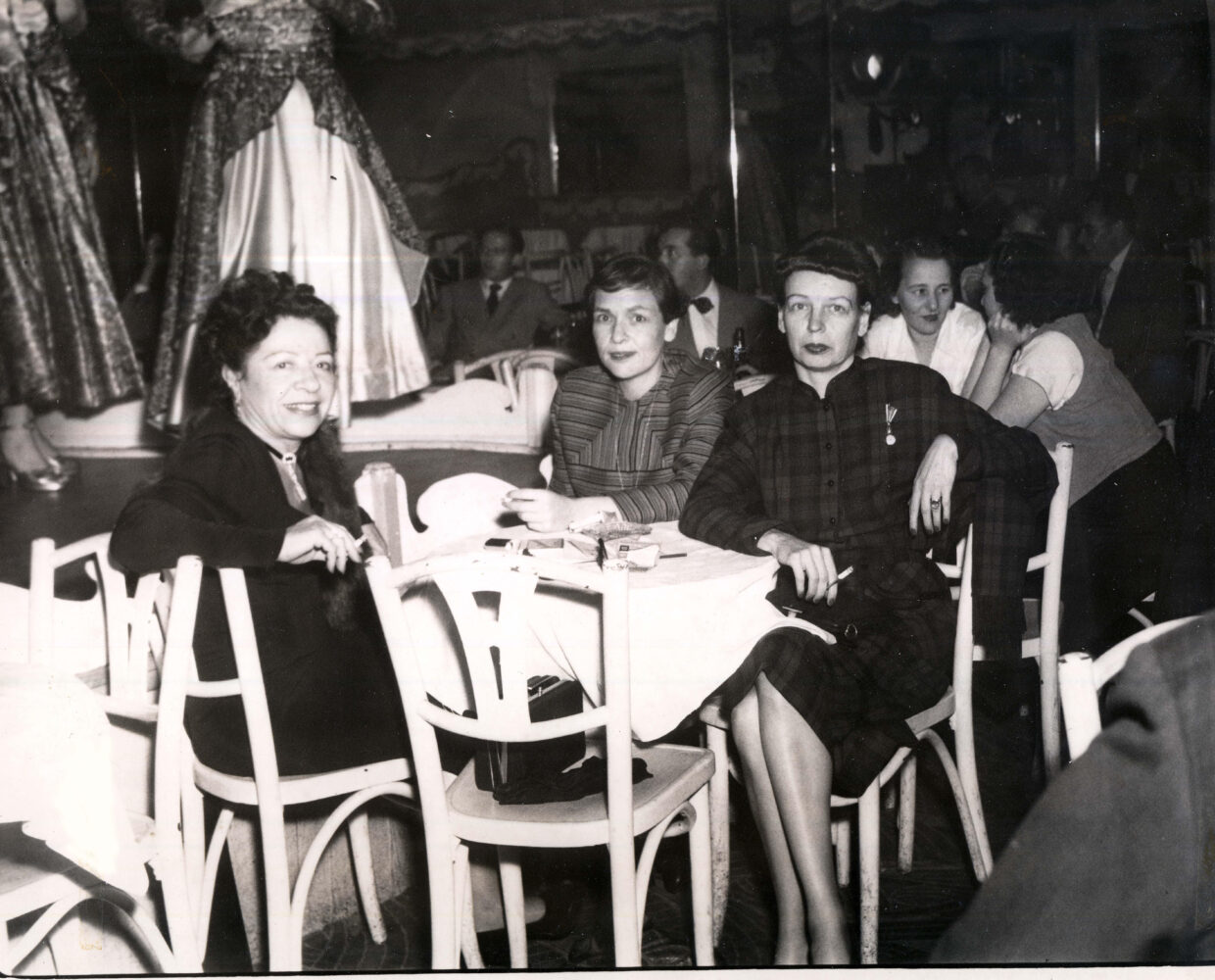
Virginia and Dana had both known Polly Adler, who had run houses of prostitution in Manhattan throughout the Jazz Age and well into the 1930s. Polly’s places were popular not only with johns but with members of New York’s culturati, who enjoyed visiting for conversations, cocktails, and occasional games of backgammon. After years of staying ahead of the law and navigating the complex alliances of the city’s underworld, Polly had closed shop and decided to try her hand at writing. By the time she met Virginia and Dana for lunch at Club 181, a drag club on Second Avenue run by the Mafia, she’d amassed a manuscript of over 150,000 words that her literary agent, Ann Watkins, had been shopping around publishers for months.
It wasn’t that Polly invented things; rather, she dealt with the truth selectively, leaving out details, inventing others, changing names, combining events.
Aside from obvious concerns about obscenity and libel, the primary objection of the editors who’d rejected it was more fundamental: it was dull. How could the story of New York’s most notorious madam, a woman who had the likes of Dutch Schultz, Wallace Beery, Robert Benchley, and Dorothy Parker as regulars throughout the Roaring Twenties be boring? But there it was. Dana’s idea—which she’d already discussed with Watkins and Gertrude Gottleib, who was both Dana and Polly’s personal lawyer—was to put Virginia to work on putting some of her trademark snap into the narrative.
Virginia had arrived in New York City nearly twenty years before, just days after her first novel, Friends and Romans, had been released to clamorous reviews. “Seldom has a novel been written with higher good humor or a more disarming wit,” wrote Time magazine’s reviewer. Town & Country magazine hired her, and her wisecrack-studded stories soon earned a loyal following. Her second book, The Barbarians, appeared less than a year later, winning praise for its wit, if not its substance. But Virginia’s reputation was already established: “Talk about a mental cocktail in a dry and thirsty land—Faulkner can furnish quips in deliriously fast succession and never repeat herself.”
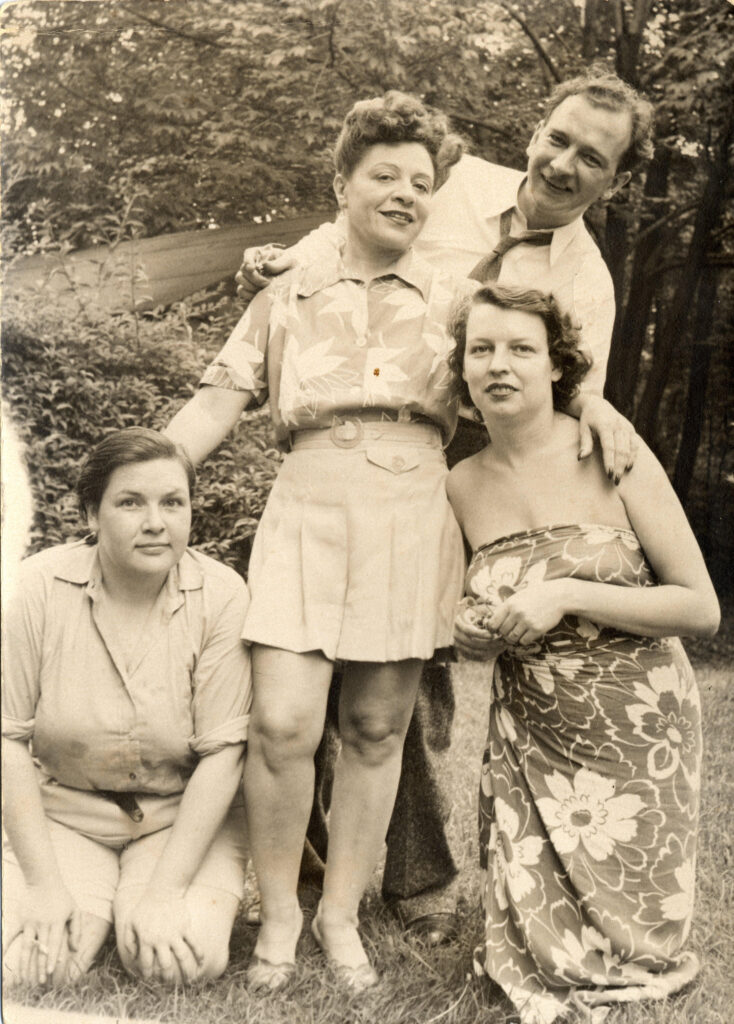
That reputation soon convinced MGM to bring her to Hollywood. If the studio hoped her bon mots and comebacks would liven a string of screwball comedies, it made the mistake of teaming her with Gottfried Reinhardt, son of the legendary theater director Max Reinhardt. Instead of sparkling scripts, the pair produced stories that never made it past an editorial conference. Her only screen credit in three years was for Bridal Suite, a forgettable comedy starring Robert Young and the French actress Annabella. Back in New York, Virginia found failure hard to shake. She wasted months on a revue called All in Fun that closed on its second night. Though she and Dana Suesse had happy years together through much of the 1940s, they couldn’t find a producer for a musical they wrote together, and the play that followed—It Takes Two—closed after a week. She managed to sell dozens of amusing but superficial stories to magazines like The Saturday Evening Post, but her hopes of writing “something a little kinder and truer” continued to be frustrated. When Dana, who, like Virginia, had been successful in writing pleasant but undistinguished nothings—in her case, songs for Billy Rose’s revues—decided to try taking on more serious music by studying with Boulanger, Virginia entered a deep downward spiral.
Virginia agreed to take a look at Polly’s manuscript and advise Ann Watkins if it could be repaired. Two years as a mental health patient had taught Virginia to be cautious. She understood her own strengths and weaknesses better—and she understood Polly’s. While Virginia was subject to cycles of ups and near-crippling downs, Polly only had ups. She could be relentless, petty, selfish, opportunistic, and selective in her memory. “Miss A. is a force of nature,” Virginia confided to Watkins. “Anyway, when she gets the conversational bit in her teeth, there’s nothing to do but take a seat and hang on.” The traits that had helped her survive in business were certain to test the patience of any collaborator, and Virginia was never known for her patience.
Virginia went through the book, taking notes, considering how to improve it. At some point, she decided not only that the book could be saved but also that she was the right person to save it. She moved out of her hotel, leased an apartment at Sutton Terrace, and sent Ann Watkins a memo outlining her proposal. Her major criticism was that the book needed cutting and rearranging. “Though this is easy enough to say, still so far as I know the only way it can be done is by the old blood, sweat, spit and polish process: there’s no quick way.” She outlined eight major points on which rework was required, from Polly’s treatment of her parents (something Virginia was more attuned to after many months of psychoanalysis) to inconsistencies in presentation. She did not address the veracity of Polly’s recollections, which would prove her biggest source of headaches.
Virginia followed up with another letter that did confront the matter of facts. “I would hesitate to say the proportion of true and manufactured—and in some cases it’s a sort of pastiche of the actual and the apocryphal—but there is plenty which is suppressed or distorted or just plain lied about.” It wasn’t that Polly invented things; rather, she dealt with the truth selectively, leaving out details, inventing others, changing names, combining events. Ironically, to deal with these difficulties, Virginia would have to both check facts and do some inventing of her own. “So long as it is authentic in feeling and spirit, I see nothing against supplying punch lines, rounding off anecdotes, and (where needed to support a point) making a whole goddam brick, even in the absence of straw.” Virginia had, she felt, “assimilated Polly’s point of view” and felt she could predict what would pass Polly’s test. She shared a few passages that she’d doctored with Polly, and proudly reported to Watkins, “by not so much as a flick of the eyelid did the author indicate that it was all news to her.”
Ann Watkins sent the material Virginia had worked on to John Selby, an editor at Rinehart. Rinehart had taken an option on the book, subject to major revisions—the job Virginia was offering to take on. He was impressed. “The difference between the version of Polly I read some months ago, and this last version, is enormous,” he wrote. He was in favor of moving forward. He did, however, suggest yet another way in which the book needed improvement: Virginia would need to add “enough of the period”—the 1920s and 1930s—to make Polly’s success as a madam plausible. “From time to time the story throughout ought to contain references” to larger events, things like the introduction of Prohibition and its repeal. Now, besides fact-checking, she would have to conduct her own historical research as well. But, he concluded, “It is good to know that Polly’s book is in your hands. I shudder to think what hash some people could make of it.”
Virginia had started to realize the magnitude of the task she was taking on. “Miss Adler’s little opus is really turning into a project and a headache,” she confided to Watkins. Selby’s suggestion about adding context sent Virginia to the 58th Street library, digging into books on topics ranging from America in the 1920s to the history of prostitution to Judge Samuel Seabury’s corruption investigations. Her list of sources came to over three dozen books and even more newspaper articles. On a copy of Selby’s letter that she kept with her working notes, Virginia later scribbled next to his comment about adding “enough of the period”: “Just took six weeks’ slavery is all!”
For all her grumbling, Virginia was starting to enjoy the work. “I’ve got plenty of background dope about the Twenties and some wonderful quotes,” she wrote. And even Polly was surprisingly helpful: “She really has knocked herself out to supply the dates which I requested” and even agreed to fix the year of her birth. Virginia felt confident enough to venture, “I bet this will be quite a book yet.”
Virginia had come to a decision. She would never be “kinder and truer” writer she aspired to be, but as A House is Not a Home had shown, she had the instincts, judgment, and tenacity to be a brilliant editor.
By March 1952, Virginia wrote that she’d finished the job. “Seems hard to believe, but with luck by this time next week I’ll no longer be a white slave,” she declared to Ann Watkins. She looked forward to being able “to sit down at the typewriter and write an entire page without once having to use the word whorehouse.” That day was still long off, however. There were more rounds of fact-checking. Answers to questions raised by Rinehart’s in-house legal counsel. Challenges about potential points of libel. References to Polly’s African American maid, “Showboat,” had to be changed over concerns she could sue. Finally, in January 1953, Watkins sent Virginia a proof with dozens of changes made by Rinehart editor John Lamont. Virginia returned the package to Watkins, saying Lamont’s edits were “mutton-fisted and bird-brained.”
Virginia hadn’t received a dime for her work. And the more she dealt with Polly, the more she wanted it that way. “To be frank,” she explained to Watkins, “it is just as well Polly has no financial claim on my services.” Polly’s demands could be interminable. In the last weeks before the book went to the printers, Virginia wrote, “It seemed to me she was unable to go to the bathroom without calling up long distance to consult about it.”
A House Is Not a Home came out in early June 1953. It was an immediate success. One of the first reviews to appear, by the New York Herald Tribune‘s book editor, John K. Hutchens, called the book “a seriously written and, in its fashion, highly moral tale.” John Barkham, the country’s leading syndicated reviewer, credited Polly for acquiring “as great a mastery over the English language as she once exercised over the baser instincts of men.” In the Saturday Review, Lee Rogow, who wrote that he was reliably informed that the book “was writ by hand by Miss Adler herself,” declared it “an extraordinary performance by a nonprofessional writer.”
Despite Rogow’s assertion, however, in late September, columnist Dorothy Kilgallen, who’d known both Polly and Virginia from her days as a beat reporter, announced that “Virginia Faulkner, a real writing pro, actually put the words together” for Polly’s book. Virginia was annoyed to see her association made public and suspected someone at Rinehart had talked to Kilgallen. Bennett Cerf repeated the claim in his Saturday Review column, but an article in Confidential magazine around the same time suggested that some veteran newsman like Quentin Reynolds, Jim Bishop, or Gene McHugh had written the book, “the best job of ghostwriting to come down the pike in many years.”
Virginia’s link to the book was questioned as late as 2006, when the University of Massachusetts Press reissued A House. In a footnote to her introduction, Rachel Rubin mentioned that in a 1961 letter to the playwright S. N. Behrman, Virginia wrote that she’d ghostwritten the book. Rubin dismissed her statement, however: “There is no documentary evidence of this.” Nor was there until Debby Applegate, researching Madam, her 2021 biography of Polly, found the full record of the correspondence among Virginia, Polly, Ann Watkins, and John Selby in Watkins’ papers at Columbia University.
Applegate followed a lead that one of Virginia’s notebooks from her work on A House was in the hands of a private collector in Lincoln. The notebook includes not just copies of letters in the Watkins papers but Virginia’s meticulous record of her fact-checking and her correspondence with Polly about the book’s success, spin-offs, sequels, and other projects carrying on to Polly’s death in 1962. Virginia also kept a letter that identified references to T. S. Eliot’s poem “The Waste Land” that she had seeded throughout the book as evidence of her work. “My idea then was chiefly to have a ‘secret weapon’” in case someone else claimed credit. Between Watkins’ papers and Virginia’s surviving notebook, more than enough documentary evidence exists to satisfy any skeptic.
A House Is Not a Home marked the end of Virginia Faulkner’s writing career. She never wrote another novel, story, or play. Two years after Polly Adler’s bestseller appeared, she returned to her hometown of Lincoln, Nebraska, and agreed to help the University of Nebraska Press put together an anthology of writings about the state. By the time Roundup: A Nebraska Reader came out in mid-1957, Virginia had come to a decision. She would never be “kinder and truer” writer she aspired to be, but as A House is Not a Home had shown, she had the instincts, judgment, and tenacity to be a brilliant editor. Dana Suesse’s project had opened the second act in Virginia Faulkner’s life.
__________________________________

Excerpted from Virginia Faulkner: A Life in Two Acts by Brad Bigelow. Reprinted by permission of the University of Nebraska Press and imprint Bison Books. Copyright © 2025 by the Board of Regents of the University of Nebraska. Available wherever books are sold or from the Univ. of Nebraska Press, 800.848.6224 and at nebraskapress.unl.edu.