Authored by Christian Vezilj via American Thinker,
Hollywood has mastered the art of moral performance. Award shows have become political stages where actors speak with the confidence of prophets and the certainty of philosophers. But beneath the applause lines and emotional crescendos lies a contradiction that becomes impossible to ignore: the courage they demand from others is courage they themselves will never have to summon.

This contradiction was unmistakable at the recent Golden Globe Awards. The ceremony quickly transformed into a coordinated tribute to Renee Nicole Goode, who was shot and killed by an ICE agent. Mark Ruffalo dedicated his award by saying, “This is for Renee Nicole Goode, who was murdered,” adding, “I don’t know how I can be quiet.” Wanda Sykes echoed the sentiment on the red carpet, declaring, “Of course, this is for the mother who was murdered by an ICE agent, and it’s really sad.” She went further, urging confrontation: “We need to be out there and shut this rogue government down, because it’s just awful what they’re doing to people.”
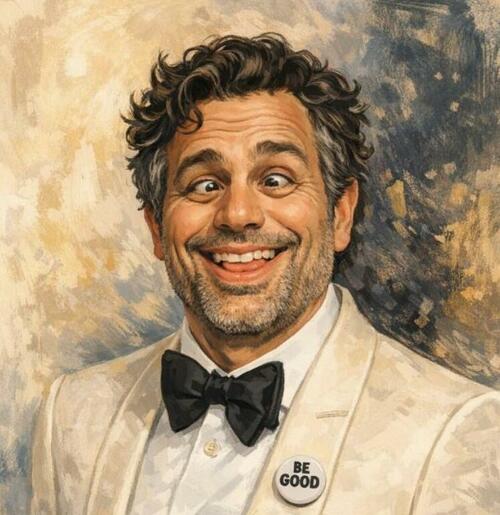
Celebrities wore coordinated pins reading “BE GOOD” and “ICE OUT,” signaling solidarity and moral urgency. The messaging was unified, emotional, and unmistakably political. The narrative was clear: this was a moment to resist, to rise up, to confront injustice.
But what was equally clear — and far more revealing — was what they chose not to say.
While the Golden Globes stage was filled with speeches about ICE, not a single celebrity mentioned the mass slaughter, imprisonment, and torture taking place in Iran at that very moment - Hundreds of protesters have been killed by the Iranian regime. Thousands have been dragged into prisons. Torture, rape, and forced confessions have been documented by human rights groups. The government has imposed sweeping internet blackouts to hide the brutality from the world. [ZH: regardless of whether this is yet more 'regime change paint by numbers' - it was completely ignored].
And yet, on one of the most visible cultural platforms in America, the silence was absolute.
- No speeches.
- No pins.
- No hashtags.
- No calls to “shut down” the Iranian government.
- Nothing.
The contrast is staggering. When the villain is a U.S. agency, outrage is immediate, coordinated, and emotionally charged. When the villain is a foreign authoritarian regime slaughtering its own people, the outrage evaporates. The issue is not the moral weight of the cause. The issue is whether the cause is useful to the narrative they want to tell.
But the hypocrisy runs even deeper. It extends to the way Hollywood reacts to domestic events that do not fit its preferred storyline. When Ashli Babbitt was shot and killed inside the Capitol, there were no celebrity tributes. No emotional speeches. No coordinated pins. No calls for accountability. Instead, the officer who shot her was widely described as a hero. The shooting was framed as necessary, justified, even praiseworthy.
Whether one agrees with either shooting is not the point. The difference in reaction reveals the deeper truth: Hollywood’s activism is not driven by universal moral principles. It is driven by selective outrage, selective empathy, and selective courage.
This brings us to the heart of the matter: the asymmetry of risk. Celebrities routinely encourage ordinary people to “stand up,” “fight back,” or “put your body on the line.” Sykes’s call to “shut this rogue government down” is a perfect example. These are not metaphorical suggestions. They imply confrontation, danger, and the possibility of violence.
Yet the people delivering these messages do so from behind layers of insulation that ordinary Americans do not have. They live in gated communities. They travel with private security. Their homes are protected by surveillance systems, controlled access, and armed guards. They are not wrong for wanting safety — everyone wants safety — but they are wrong for preaching danger for others while choosing safety for themselves.
A working‑class person who confronts ICE or police in the street faces real, immediate, physical danger. A celebrity who posts a hashtag or makes a speech faces none. Their activism is symbolic, not sacrificial. It costs them nothing. And yet they speak as though they are shoulder‑to‑shoulder with the people they are urging into the streets.
This is where the phrase “We’re in it together” collapses. When celebrities use it, they rarely mean shared sacrifice. They mean shared sentiment. They mean shared optics. But they do not mean shared risk. Their version of solidarity is digital, not physical.
The deeper civic insight is this: selective outrage and selective courage are symptoms of a broader cultural problem. We have built a society where moral authority is often claimed by those who bear none of the consequences of their own prescriptions. Hollywood’s activism is not dangerous to Hollywood. It is dangerous to the people they encourage to act on their behalf.
True solidarity requires more than a speech, a pin, or a social media post. It requires standing in the same place, facing the same risks, and sharing the same consequences. Anything less is performance.
And performance, no matter how passionate, is not courage.
Loading recommendations...