

Americans Overwhelmingly Support Science, but Some Think the U.S. Is Lagging Behind
A new report finds that a majority of Americans think the U.S. should be a world leader in science, but Democrats increasingly believe other countries are catching up
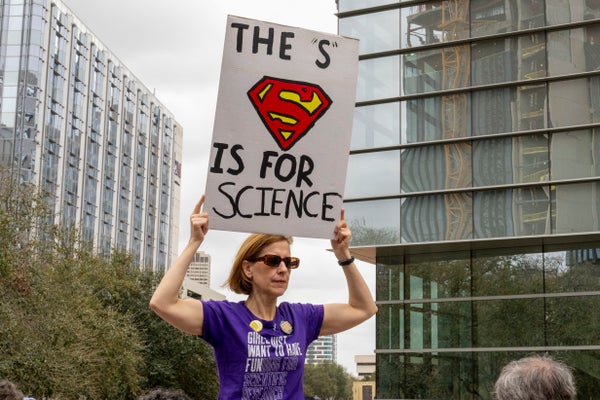
Houston Chronicle/Hearst Newspapers / Contributor via Getty Images
Americans are proud of their country’s science prowess: a majority believe it is important for the U.S. to be a world leader in science, according to the Pew Research Center’s latest report on trust in science.
The number of people who hold this view is five percentage points higher than it was in 2023, the last time Pew asked the same question, according to data from more than 5,000 people surveyed in October 2025.
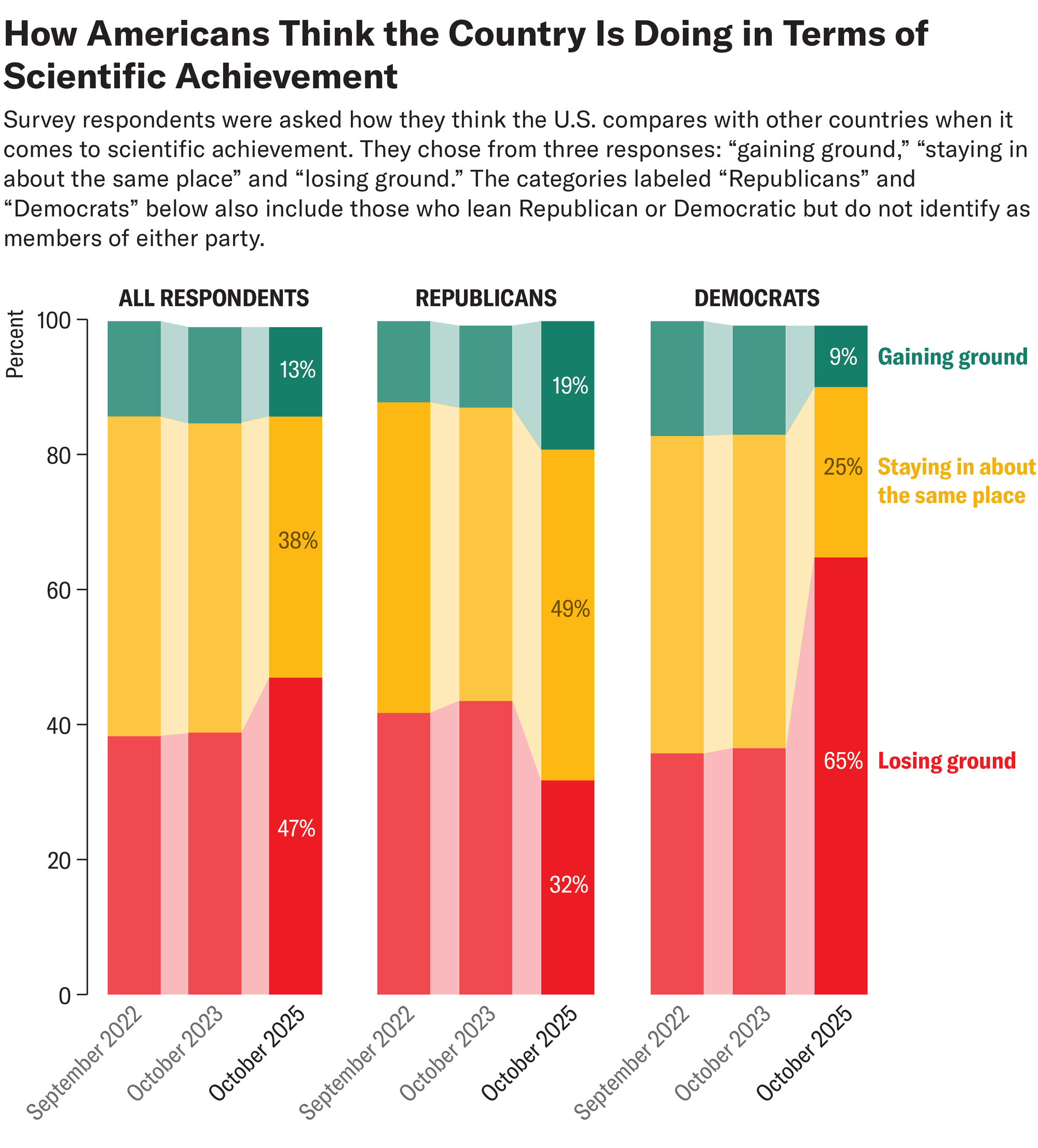
But people who voted Democratic in the 2024 presidential election tended to hold a very different view than Republican voters on whether the country is living up to its promise. Between 2023 and 2025, the proportion of Democrats who believe that the U.S. is losing ground in science compared with other countries jumped by 28 percentage points. About two thirds of Democrats now hold this view.
On supporting science journalism
If you're enjoying this article, consider supporting our award-winning journalism by subscribing. By purchasing a subscription you are helping to ensure the future of impactful stories about the discoveries and ideas shaping our world today.
Republicans are more positive about the country’s standing in science—a complete switch in sentiment since the last time Pew asked this question, says Brian Kennedy, one of the authors of the new report and a senior researcher at the Pew Research Center. And the split between both groups is far wider than it was at previous times when Pew asked the same question in the past five years, he says.
In 2022 and 2023 the difference between Democratic and Republican opinion was “far more modest,” Kennedy says, with both groups responses’ within 7 percentage points of each other. “Now we see this much bigger difference between Republicans and Democrats in our relative standing in science compared to other countries.”
Amanda Montañez; Source: Do Americans Think the Country Is Losing or Gaining Ground in Science? Pew Research Center, January 15, 2026 (data)
Last year the Trump administration cut federal funding for science. The administration slashed millions of dollars in grants for science across myriad disciplines and walked back its own research and regulations based on science, particularly in the areas of climate change and health and medicine. Meanwhile experts have warned of a “brain drain,” partly motivated by the administration’s strict immigration policies, with researchers choosing to study or live overseas instead of in the U.S.
Despite these cuts, the majority of Americans—84 percent—thought federal investments in science aimed at advancing knowledge were worthwhile. Republican voters, however, were more likely than their left-leaning peers to be open to private companies playing a key role in science, Kennedy says.
“One thing we’ve seen in our surveys over a number of years is that support for science funding is pretty widespread among both Republicans to Democrats,” he says. “This is a pretty consistent finding.”
Indeed, lawmakers on both sides of the aisle have advanced several legislative efforts to claw back some of the targeted federal funding for science agencies.
Ultimately, the report shows that Americans’ trust in science and scientists remains broadly strong—but not as strong as it was before the COVID pandemic. During 2020 and 2021, public trust cratered. And while it has recovered somewhat, it remains lower than it was before that period.
“There’s a broader context of trust and confidence going on in society,” Kennedy says. Still, he points out that Pew survey participants have consistently ranked scientists among the most trustworthy groups in society for the past 10 years. “Scientists have consistently ranked toward the top with the military, while elected officials generally were ranked toward the bottom,” he says.
It’s Time to Stand Up for Science
If you enjoyed this article, I’d like to ask for your support. Scientific American has served as an advocate for science and industry for 180 years, and right now may be the most critical moment in that two-century history.
I’ve been a Scientific American subscriber since I was 12 years old, and it helped shape the way I look at the world. SciAm always educates and delights me, and inspires a sense of awe for our vast, beautiful universe. I hope it does that for you, too.
If you subscribe to Scientific American, you help ensure that our coverage is centered on meaningful research and discovery; that we have the resources to report on the decisions that threaten labs across the U.S.; and that we support both budding and working scientists at a time when the value of science itself too often goes unrecognized.
In return, you get essential news, captivating podcasts, brilliant infographics, can't-miss newsletters, must-watch videos, challenging games, and the science world's best writing and reporting. You can even gift someone a subscription.
There has never been a more important time for us to stand up and show why science matters. I hope you’ll support us in that mission.