Authored by Armstrong Williams via The Epoch Times,
Let’s dispense with the convenient fiction: Immigration and Customs Enforcement (ICE) is not the primary threat to our communities. The real danger lies in the growing normalization of disorder, intimidation and lawlessness—often wrapped in the language of “justice” but driven by something far less noble.
What we are witnessing is not spontaneous civic unrest. It is a sustained strategy of division, enabled by progressive activism untethered from accountability and amplified by legacy and social media ecosystems that reward outrage over truth.

This is not how a nation is conquered by force. This is how it is hollowed out from within.
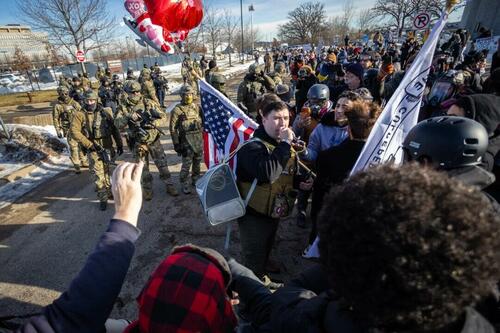
Over the past several years, protests have increasingly crossed the line from expression to coercion—blocking streets, vandalizing property, intimidating citizens, and provoking confrontations with law enforcement. Too often, progressive leaders and activists refuse to draw a firm line between protest and chaos. Silence becomes endorsement. Justification becomes fuel. The result is a culture where disruption is valorized, and restraint is treated as complicity.
When rare and tragic mistakes occur in law enforcement, they are not treated as moments for sober examination or reform. They are instantly weaponized. Context is stripped away. Facts are subordinated to narrative. Grief is transformed into political leverage. The objective is not justice but rather ignition sparking unrest, delegitimizing institutions, and exhausting public trust.
Here is an inconvenient truth: It remains exceedingly rare for law enforcement officers to fire their weapons in the line of duty. The overwhelming majority—well over 90 percent—never discharge a firearm at all. Most encounters are resolved through deescalation, judgment, and professionalism under immense pressure. That reality rarely survives the media cycle.
Legacy media outlets, once entrusted with informing the public, too often act as accelerants rather than moderators. Complex incidents are flattened into morality plays. Headlines are written to inflame rather than inform. Progressive narratives are echoed uncritically, while inconvenient facts are buried below the fold or ignored entirely. The result is a distorted public understanding that erodes confidence in law enforcement and emboldens those who seek confrontation.
Social media makes it worse. Algorithms do not reward nuance; they reward rage. Viral clips divorced from context travel faster than corrections ever could. Activists understand this and exploit it, baiting confrontations designed to produce images that inflame rather than illuminate. The platforms profit. The country pays the price.
We saw this pattern clearly on Ivy League campuses, where protests metastasized into intimidation and disorder. Administrators hesitated. Media outlets romanticized the unrest. Progressive leaders excused it. Only after chaos became undeniable did order return—at significant cost to institutional credibility. The lesson should have been obvious. Instead, it was ignored.
Today, those same forces have seized on immigration enforcement as their next flashpoint. The deployment of ICE agents under President Donald Trump has become a new rallying cry—not because it represents an unprecedented threat but because it offers another opportunity to provoke confrontation and amplify grievance. This is not about policy disagreement. It is about power: who controls the narrative, who dictates the terms of public debate, and who benefits when enforcement collapses under pressure.
That said, responsibility does not rest on one side alone.
Trump, for all his emphasis on law and order, bears a duty to temper his rhetoric. Words matter, especially from the highest office in the land. Enforcement must be firm, but it must also be wise. Precision, not provocation, strengthens institutions. A tone that encourages restraint, judgment, and professionalism does more to uphold the rule of law than bombast ever could.
Likewise, law enforcement leadership must continue emphasizing deescalation as the standard, not the exception. Officers already do this every day, often without recognition. In those vanishingly rare moments when lethal force is used, the expectation must be clarity, accountability, and transparency—not political scapegoating or reflexive condemnation.
The progressive movement, however, must confront its own complicity.
A philosophy that treats enforcement itself as oppression, that excuses disorder as activism, and that relies on media distortion to advance its aims is not reformist—it is corrosive. A society cannot function when laws are optional, authority is demonized, and chaos is reframed as conscience.
History is unforgiving to nations that mistake outrage for virtue and division for progress. Democracies do not collapse because laws are enforced. They collapse when enforcement is delegitimized, institutions are undermined, and truth becomes subordinate to narrative.
If we are serious about justice, reform, and social cohesion, then restraint must apply to everyone—activists, media, political leaders, and law enforcement alike. Anything less is not resistance. It is surrender to chaos.
And chaos, once normalized, never confines itself to the causes that first unleashed it.
Loading recommendations...