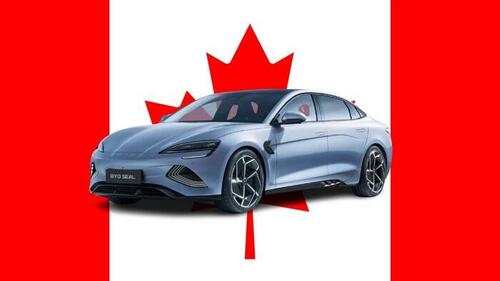
The invasion of Chinese electric vehicles into North America is set to accelerate after Canadian Prime Minister Mark Carney agreed to roll back the triple-digit tariffs previously imposed on Chinese EVs. The move sharply diverges from President Trump's America First policy, which aims to revitalize the North American auto industry. While Chinese EVs remain effectively blocked from US import, there has been a noticeable increase in BYD Motor vehicles on highways in Mexico.
Canadian Prime Minister Mark Carney, who appears to have deep ties with Beijing, was the first prime minister to visit China since 2017 and is seeking a major thaw in relations after years of tense diplomatic and trade ties.
Carney's move abandons the 100% tariffs on Chinese EVs imposed by former Prime Minister Justin Trudeau in 2024, replacing them with a 6.1% rate capped at 49,000 Chinese EVs. In 2023, China exported 41,678 EVs to Canada. The shift in trade policy will certainly capture the Trump administration's attention.
"In order for Canada to build our own competitive EV sector, we need to learn from innovative partners, access their supply chains and increase local demand," Carney told reporters after talks with President Xi Jinping.
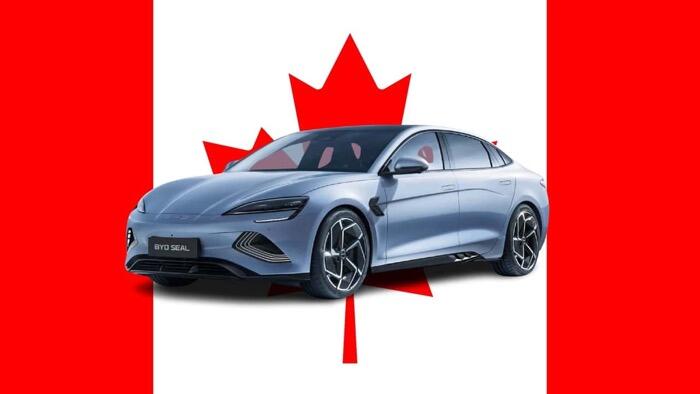
Carney may have given the wrong answer. Logically, if Canada wanted to build out an EV sector, it would turn to American expertise, such as Tesla, Rivian, Lucid, or even legacy Detroit automakers. Instead, that does not appear to be the case, raising questions about where Carney's allegiance truly lies, whether with the East or the West.
A recent report via The Bureau's Sam Cooper only suggests Carney's allegiance points towards Beijing...
And there it is.
He added that recent trade friction forced Beijing to slap 100% duties on Canadian canola oil - also known as rapeseed oil - as well as other ag products, with 25% on pork and seafood.
"China used to be the largest market for Canadian canola seed," Carney said. "We want to not just return to those levels, but to surpass them."
It appears Carney has not learned the lesson from Europe, where flooding the market with Chinese EVs helped decimate automakers across the continent.