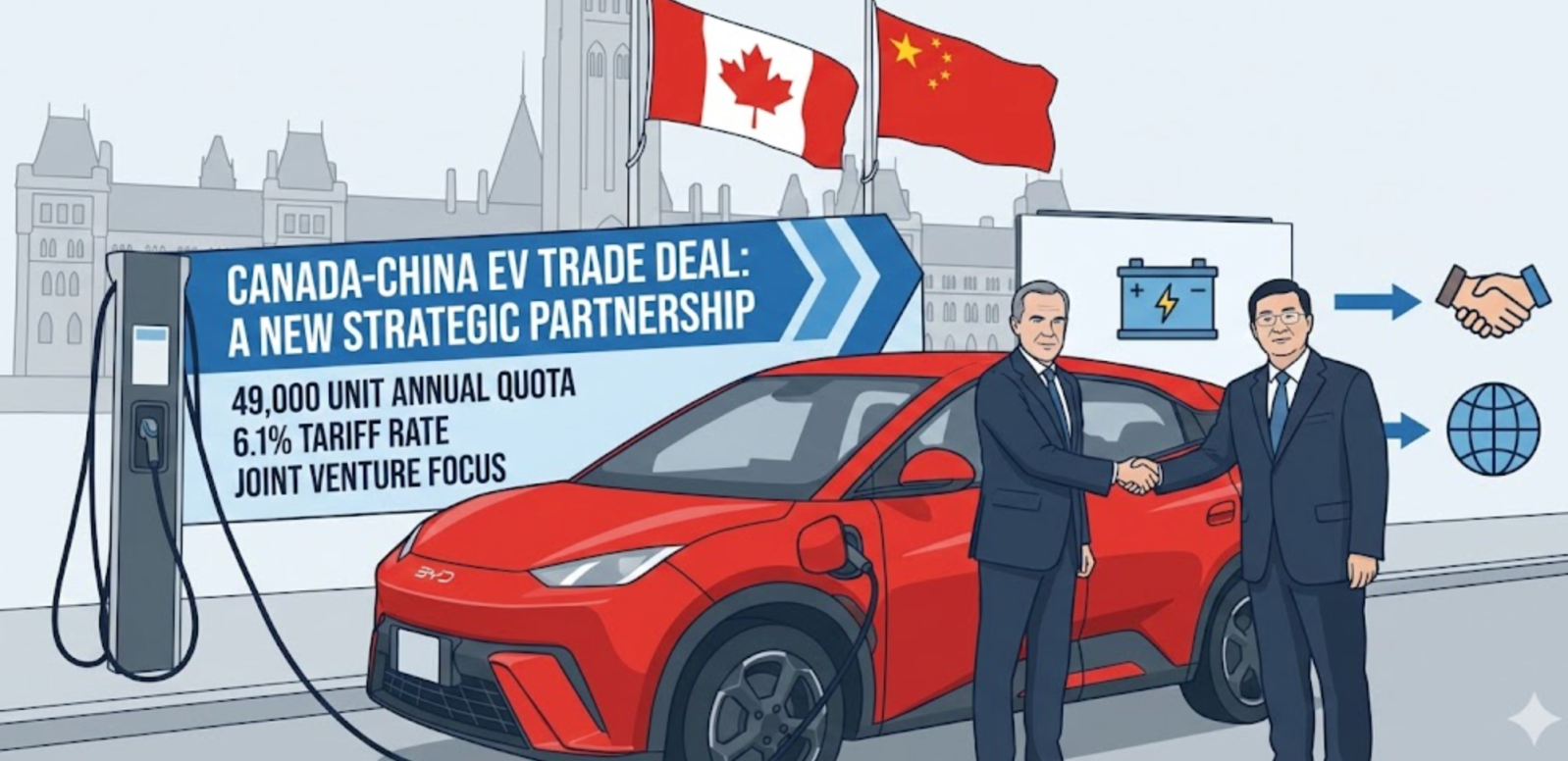
In a massive shift in North American trade policy, Prime Minister Mark Carney announced today a new “strategic partnership” with China that effectively reopens the Canadian border to Chinese electric vehicles.
The move marks a significant departure from the United States’ hardline protectionist stance and could bring affordable EV options like the BYD Seagull to Canadian roads as early as this year.
For the last two years, Canada has largely walked in lockstep with the US regarding Chinese EV tariffs. Following the Biden administration’s move to impose 100% tariffs on Chinese EVs, Canada implemented similar surtaxes, effectively freezing companies like BYD, Nio, and Zeekr out of the market.
Today, that ice is breaking.
As part of a broader trade agreement secured by Prime Minister Carney in Beijing this week, Canada has agreed to allow an annual quota of 49,000 Chinese electric vehicles into the country at the tariff rate of just 6.1%.
According to the Prime Minister’s office, this volume represents less than 3% of the Canadian new vehicle market. However, the deal explicitly targets the low end of the market, with the government anticipating that within five years, “more than 50% of these vehicles will be affordable EVs with an import price of less than $35,000.”
In exchange for opening the EV floodgates (or at least starting to break the dam), China has agreed to lower tariffs on Canadian canola seed from roughly 85% to 15% and to lift restrictions on Canadian lobster and crab.
The Canadian government claims this isn’t just about imports. The text of the agreement states that the deal is expected to “drive considerable new Chinese joint-venture investment in Canada” to build out the domestic EV supply chain.
While 49,000 vehicles might sound like a small number compared to the total market, it’s a specific, targeted wedge that changes the entire dynamic of the North American EV market.
For years, we at Electrek have argued that protectionism, while perhaps protecting legacy automaker jobs in the short term, ultimately hurts consumers and slows down the transition to sustainable transport.
Meanwhile, protecting domestic automakers from Chinese competition in their home market makes them less competitive on the global stage, virtually giving the global market to China.
The reality is that Chinese automakers are currently building some of the best, most affordable EVs in the world. Keeping them out entirely not only hurts consumers but also hurts innovation.
Of course, this is going to make Washington furious. The US has been trying to build a “Fortress North America” against Chinese EVs. By letting 49,000 units in tariff-free (or near tariff-free), Canada is effectively saying it values affordable climate solutions (and canola exports) more than complete alignment with US industrial policy, which is understandable since the US was the one to go hostile on trade with Canada.
The interesting detail here is the “Joint Venture” language. It looks like Carney is taking a page out of China’s own playbook. Canada seems to be using this quota as a carrot to get companies like BYD or CATL to set up shop in Canada and maybe help Canadian companies learn from those giants.
FTC: We use income earning auto affiliate links. More.