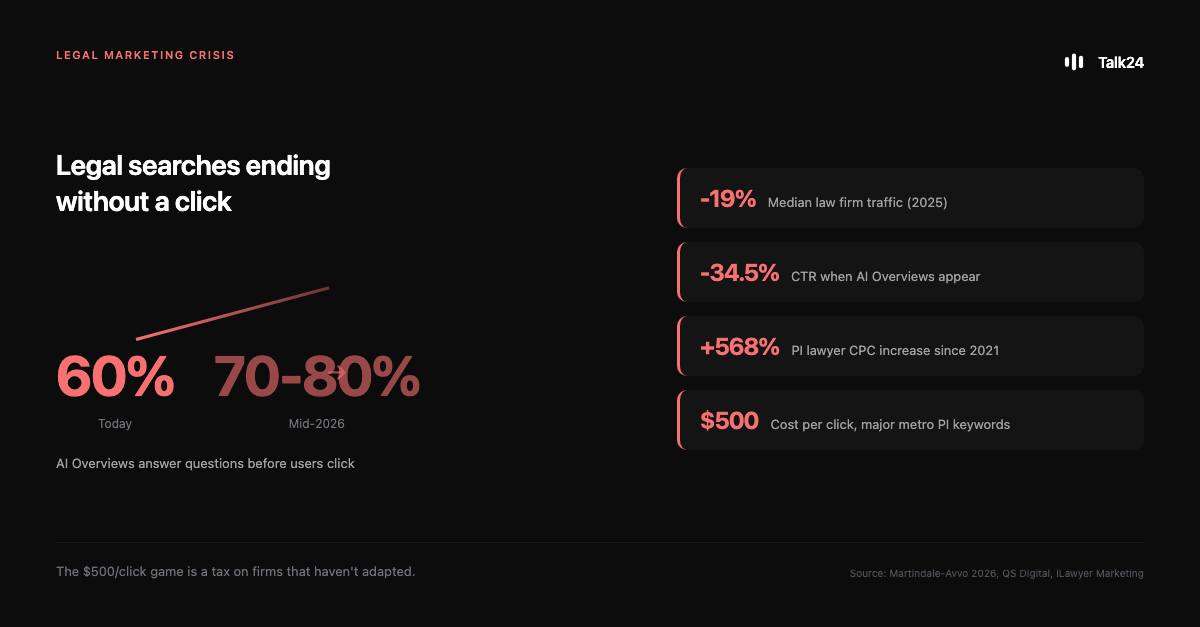
60% of legal searches now end without anyone clicking through to a website.
Google's AI Overviews answer questions like "what to do after a car accident" right there on the results page. No click needed. By mid-2026, that number is expected to hit 70-80%.
For law firms that built their entire client acquisition strategy on Google, this is an existential shift.
The data from 2025 tells the story clearly.

That's not a gradual decline. It's a collapse in progress.
The Traffic Numbers Are Brutal
According to QS Digital's analysis of the legal sector in 2025, the median law firm saw website traffic drop 19%. Some firms experienced declines of nearly 80%.
The strange part: impressions stayed flat. Firms were still appearing in search results. Users just weren't clicking through anymore.
Why? Because the answer was already on the page. AI Overviews provide summaries, suggest next steps, and even curate lists of attorneys. The user makes their decision before visiting a single website.
Surefire Local reports that when AI Overviews appear, top-ranking pages see a 34.5% drop in click-through rates. Being #1 on Google used to guarantee traffic. Not anymore.
Meanwhile, Costs Keep Climbing
Here's the painful irony: while traffic drops, the cost to compete for what's left keeps rising.
Personal injury lawyers are paying 568% more per click than they did in 2021. The keyword "Las Vegas personal injury attorneys" costs $500 per click. Some legal keywords have crossed $1,000.
iLawyer Marketing's 2025 analysis shows this isn't limited to a few high-competition terms. The entire legal advertising category is experiencing cost inflation while delivering diminishing returns.
The math is simple: higher costs, lower traffic, same conversion rates. ROI is collapsing.
Urban Firms Are Hit Hardest
The QS Digital data shows geographic patterns in the decline. Urban firms experienced larger drops and more volatility than rural practices.
This makes sense. Metropolitan markets have more competition, more sophisticated searchers, and more queries that AI can confidently answer. When someone in Los Angeles searches "what to do after a rideshare accident," the AI has plenty of training data to provide a direct answer.
Rural firms, with less competition and more unique local queries, saw more stability. But the trend is moving in one direction everywhere.
The Playbook Is Breaking
The model that built firms like Morgan & Morgan relied on a simple formula: spend more on advertising than competitors, dominate search results, capture the lion's share of leads.
That model assumed clicks would follow rankings. It assumed traffic would follow impressions. Neither assumption holds anymore.
Martindale-Avvo's State of the Legal Consumer 2026 report describes the shift: "The linear path of 'search, click, call' is being replaced by 'ask and chat.'"
Potential clients interact with AI that summarizes answers, curates attorney lists, and validates expertise. They might hire a lawyer without ever visiting that lawyer's website.
SEO Is Becoming GEO
The industry is coining a new term: Generative Engine Optimization (GEO).
Traditional SEO optimized for Google's algorithm. GEO optimizes for AI systems. The goal isn't ranking #1. It's getting cited by AI.
Different signals matter now. Structured data that AI can parse. Consistent NAP (name, address, phone) across directories. Reviews and reputation signals that LLMs can verify. Being mentioned in sources that AI models were trained on.
Firms that embraced accuracy, consistency, and community presence retained visibility in 2025. Those that relied purely on traditional SEO saw declines even when nothing changed about their websites.
What Actually Works Now
Three shifts that firms making the transition are prioritizing:
1. Diversify acquisition channels.
Firms that relied 100% on Google are getting crushed. Winners are building presence across video (YouTube, TikTok), community involvement, direct brand recognition, and AI-native discovery platforms.
2. Optimize for AI citation, not just ranking.
Ensure your firm's information is accurate and consistent everywhere. Claim and verify all directory listings. Build the kind of authoritative content that AI models reference when answering legal questions.
3. Capture demand that bypasses search entirely.
The fastest-growing intake channel is direct contact from people who already know your name. Brand building, referral systems, and community presence create demand that doesn't depend on Google at all.
The Bottom Line
The $500/click game is a tax on firms that haven't adapted.
Google search isn't going away. But its role as the dominant intake channel is diminishing. The firms that thrive in 2026 and beyond will be those that recognized this shift early and diversified before they had to.
The data is clear. The question is whether your firm will adapt proactively or wait until the numbers force a change.