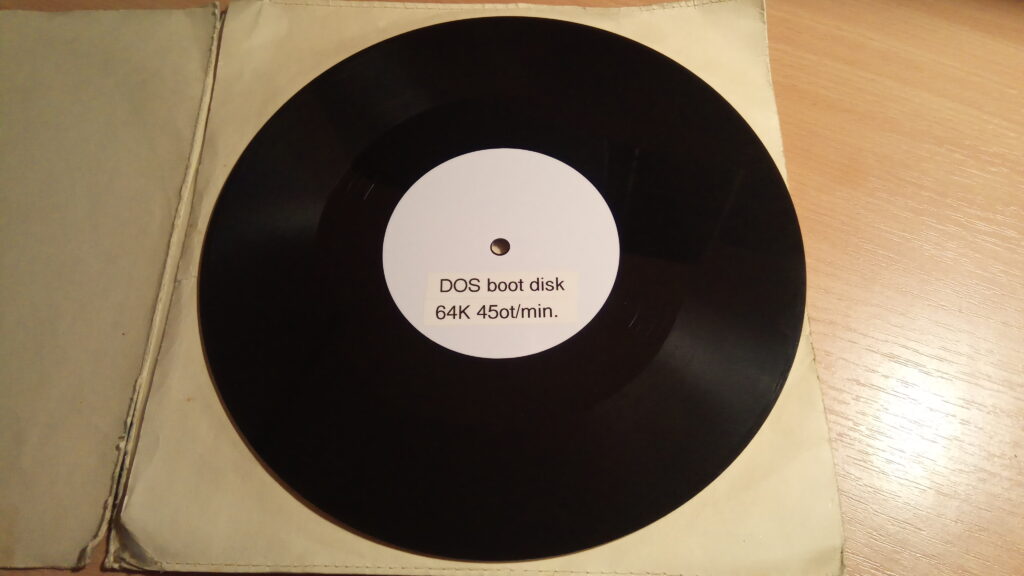
Most PCs tend to boot from a primary media storage, be it a hard disk drive, or a solid-state drive, perhaps from a network, or – if all else fails – the USB stick or the boot DVD comes to the rescue… Fun, eh? Boring! Why don’t we try to boot from a record player for a change?
 64 512 byte DOS boot disk on a 10″ record, total playing time 06:10 on 45 rpm
Update February 2022: Click here to observe the very same vinyl ramdisk booted on an IBM PCjr!
So this nutty little experiment connects a PC, or an IBM PC to be exact, directly onto a record player through an amplifier. I made a small ROM on-chip boot loader that operates the built-in “cassette interface” of the PC (that was hardly ever used), which will now be invoked by the BIOS if all the other boot options fail, i.e. floppy disk and the hard drive. The turntable spins an analog recording of a small bootable read-only RAM drive, which is 64K in size. This contains a FreeDOS kernel, modified by me to cram it into the memory constraint, a micro variant of COMMAND.COM and a patched version of INTERLNK, that allows file transfer through a printer cable, modified to be runnable on FreeDOS. The bootloader reads the disk image from the audio recording through the cassette modem, loads it to memory and boots the system on it. Simple huh?
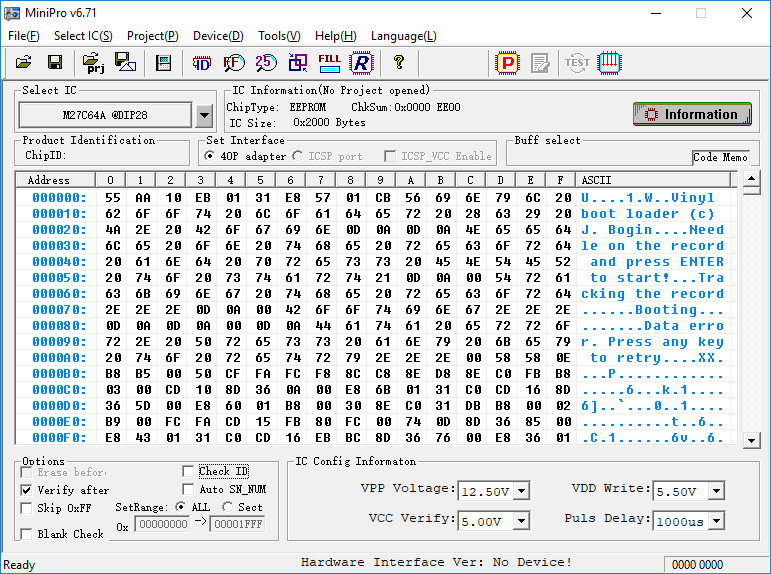 The vinyl loader code, in a ROM
(It can also reside on a hard drive or a floppy, but that’d be cheating)
And now to get more technical: this is basically a merge between BootLPT/86 and 5150CAXX, minus the printer port support. It also resides in a ROM, in the BIOS expansion socket, but it does not have to. The connecting cable between the PC and the record player amplifier is the same as with 5150CAXX, just without the line-in (PC data out) jack.
The “cassette interface” itself is just PC speaker timer channel 2 for the output, and 8255A-5 PPI port C channel 4 (PC4, I/O port 62h bit 4) for the input. BIOS INT 15h routines are used for software (de)modulation.
The boot image is the same 64K BOOTDISK.IMG “example” RAM drive that can be downloaded at the bottom of the BootLPT article. This has been turned into an “IBM cassette tape”-protocol compliant audio signal using 5150CAXX, and sent straight to a record cutting lathe.
Vinyls are cut with an RIAA equalization curve that a preamp usually reverses during playback, but not perfectly. So some signal correction had to be applied from the amplifier, as I couldn’t make it work right with the line output straight from the phono preamp. In my case, involving a vintage Harman&Kardon 6300 amplifier with an integrated MM phono preamp, I had to fade the treble all the way down to -10dB/10kHz, increase bass equalization to approx. +6dB/50Hz and reduce the volume level to approximately 0.7 volts peak, so it doesn’t distort. All this, naturally, with any phase and loudness correction turned off.
Of course, the cassette modem does not give a hoot in hell about where the signal is coming from. Notwithstanding, the recording needs to be pristine and contain no pops or loud crackles (vinyl) or modulation/frequency drop-outs (tape) that will break the data stream from continuing. However, some wow is tolerated, and the speed can be 2 or 3 percent higher or lower too.
 Bootloader in a ROM; being an EPROM for a good measure
And that’s it! For those interested, the bootloader binary designed for a 2364 chip (2764s can be used, through an adaptor), can be obtained here. It assumes an IBM 5150 with a monochrome screen and at least 512K of RAM, which kind of reminds me of my setup (what a coincidence). The boot disk image can be obtained at the bottom of the BootLPT/86 article, and here’s its analog variant, straight from the grooves 🙂