
Twitter is losing its mind over Ralph Wiggum loops.
Geoffrey Huntley’s pattern for keeping AI agents working autonomously went viral in early 2026. Developers are posting screenshots, sharing implementations, calling it a breakthrough in AI-assisted coding.
I watched this unfold with a strange feeling. Like seeing someone discover a trail you’ve been hiking for months.
My first thought: “People aren’t seeing this is basically like using Taskmaster.”
If the name doesn't ring a bell: it's a task management system for AI that's been on GitHub since March 2025, now sitting at 25k stars.
I've been shipping with this exact pattern since June 2025. Two production products. Up to three Cursor agents running in parallel on independent tasks. The loop part was never hard. Keeping separate agents from overwriting each other's work, that's where I kept hitting walls.
Ralph is an excellent teacher, though. Seven files, roughly 500 lines. You can read the whole thing in an afternoon and actually understand what’s happening. For learning how to let agents work independently, that clarity matters.
But when you need to actually ship with multiple agents and complex dependencies, you graduate to structured tooling. That’s where Taskmaster comes in.
The Ralph vs. Taskmaster debate treats them as alternatives when they’re actually stages. The core loop is the same. What differs is how much scaffolding you wrap around it.
The real question is which stage you’re at.
Both Ralph Wiggum and Taskmaster solve the same problem: keeping AI agents working on your codebase while you do something else.
The core loop works the same way. An AI agent reads the current state. It picks a task. It implements. It commits. It sleeps. Then it wakes up and does it again.
Ralph packages this in 7 files and roughly 500 lines of code. A bash script runs claude -p in a loop. Git commits provide persistence. A markdown file tracks what’s done. That’s it.
Taskmaster packages the same pattern with more machinery. 39 MCP tools. Task management with explicit dependencies. Docker sandbox security. A tool tier system that constrains what agents can access.
So when do you need 7 files versus 39 tools?
The answer depends on what you’re building. Solo experiments with straightforward tasks? Ralph’s simplicity wins. Multi-agent workflows with complex dependencies? You need the coordination layer.
I learned this the hard way after shipping two products with Taskmaster. Without proper task sequencing, agents kept stepping on each other. Which leads to the obvious question: what exactly does each tool give you?
Ralph Wiggum strips the persistent agent pattern to its essentials.
The implementation fits in your head. A bash script runs a while loop. Each iteration calls claude -p with a system prompt pointing to your implementation plan. The agent reads what needs doing, picks something, implements it, and commits. Then the loop sleeps and repeats.
Persistence comes from git. Every change gets committed, so if the process dies, you pick up where it left off. The task list lives in markdown files that update as work completes.
There’s no task orchestration. No dependency tracking. No tool permissions. The agent decides what to work on based on the current state of IMPLEMENTATION_PLAN.md.
The simplicity is the point. When you’re learning how agents think autonomously, you don’t want abstraction layers. You want to see the raw loop.
Ralph makes sense when you’re experimenting for the first time, or when the project is small enough for one agent to hold in context. If your tasks don’t have complex interdependencies and you just want to understand the pattern, start here.
For these cases, 7 files beats 39 tools. But at some point you outgrow it.
Taskmaster wraps the same loop in coordination tooling.
The difference shows up in how tasks get managed. Ralph tracks progress in freeform markdown, like keeping a todo list on a sticky note. Taskmaster uses JSON with explicit dependency arrays, more like a project management tool that won’t let you start task C until A and B are done.
A real task from one of my projects:
See subtask 6? It depends on both subtask 1 AND subtask 2. The agent can’t start it until both complete. Ralph’s markdown approach requires the agent to infer these relationships from prose. Taskmaster makes them explicit and machine-readable.
This matters when you run multiple agents.
Taskmaster’s MCP server exposes 39 tools organized into tiers. The core 7 tools handle basic task operations. You unlock more when you need project initialization, complexity analysis, or dependency validation.
The tool tier system is a guardrail. By default, agents only access the core 7 tools. You expand permissions when needed. Prevents runaway agents from doing things you didn’t intend.
The January 2026 loop command added Docker sandbox support. Ralph runs with your user permissions and direct shell access. Taskmaster asks: do you want that in a container?
The 8,645-line loop commit adds dependency tracking and status management. Also security boundaries if you want to run agents in containers.
That coordination layer is what lets you run more than one agent without them stepping on each other. And once you’ve felt agents collide, you start to see why the extra machinery exists.
Here’s the Taskmaster workflow:

Step 1: PRD → Tasks I write a PRD describing what I want to build. Taskmaster’s AI parses it and generates tasks.json with dependencies already mapped. It figures out that authentication comes before API endpoints, that Redis integration precedes rate limiting.
Step 2: Tasks → Complexity Report Taskmaster analyzes each task and scores complexity from 1-10. A simple config change scores low. Implementing a new authentication system scores high.
Step 3: Complexity Report → Subtasks The expand command uses those complexity scores to break tasks into subtasks. A complexity-8 task might get 6 subtasks. A complexity-3 task gets 2.
This is where it gets interesting. Each subtask has its own dependency array. Cursor agents can query which subtasks are safe to start based on what’s already completed:
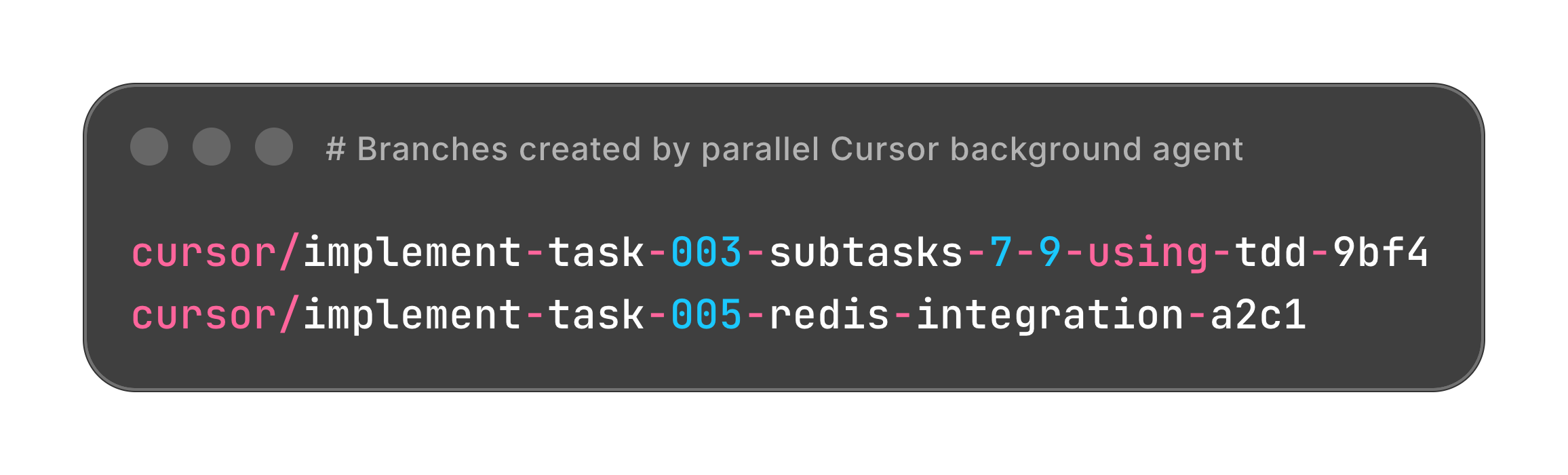
I ran up to three agents at once. I didn’t manually track which tasks depended on which. The AI did that when parsing the PRD, then refined it during complexity analysis.
Zero merge conflicts across 5+ months of development. That’s what coordination machinery buys you.
Ralph and Taskmaster aren’t competitors. They’re different points on the same learning curve.
Start with Ralph when you’re new to persistent AI agents. You can see the whole pattern. You learn what it means to let an agent work autonomously without your constant oversight.
The lesson Ralph teaches: agents can maintain context across sessions if you give them structure. Get comfortable with that before adding complexity.
Graduate to Taskmaster when you hit walls. When tasks have dependencies that matter, like authentication before API endpoints. When you want multiple agents working without conflicts. When your project gets complex enough that freeform markdown tracking breaks down.
Both tools run persistent agents. The difference is coordination overhead.
Small projects with straightforward task sequences don’t need much coordination. Ralph wins. Complex projects with interdependent components? Coordination overhead piles up fast. Taskmaster absorbs it.
I didn’t choose Taskmaster because it was better. I chose it because I needed dependency tracking for multi-agent workflows before Ralph even existed as a viral pattern. The tooling fit my problem.
If I were starting today with a simple solo project, I’d use Ralph to learn the loop. Then I’d migrate to Taskmaster when the project outgrew markdown-based coordination.
The primitives are the same. A loop. Task state in git. Agent autonomy. The tooling differs based on what you need.
Ralph going viral tells us something. Developers want persistent agents. They want to set something running and come back to progress.
I should be honest about what Taskmaster won’t do. It won’t spin up agent fleets automatically. No inter-agent messaging. You still need to understand your own codebase. I’ve watched people install it expecting magic and getting frustrated when they had to do actual work.
What you get is task management that actually enforces dependencies, and enough coordination to safely run a few agents without them colliding. That’s less exciting than “autonomous agent swarm” but it’s what I actually shipped two products with.
If you’ve never run a persistent agent loop, start with Ralph. If you need task coordination, try Taskmaster. Either way, build something you’ll actually use. Not a demo.
Arguing about which tool is better misses the point. Ship something with either one and you’ll learn what actually works.
What are you building with agents right now? I’m curious what problems people are solving with these patterns.
While I was writing this, Anthropic shipped Claude Code v2.1.16. The headline feature: task management with dependency tracking.
The same pattern. Persistent tasks as separate state. Dependencies between them. Built directly into the official tooling.
What started as a community experiment is becoming infrastructure. The developers behind Ralph and Taskmaster figured out something real. Now the platforms are catching up.
That’s usually how it goes. The practitioners find the patterns first. Then the patterns become features.
Resources:
