At what point do "you" end and the outside world begins?
It might feel like a weird question with an obvious answer, but your brain has to work surprisingly hard to judge that boundary. Now, scientists have linked a specific set of brain waves in a certain part of the brain to a sense of body ownership.
In a series of new experiments, researchers from Sweden and France put 106 participants through what's called the rubber hand illusion, monitoring and stimulating their brain activity to see what effect it had.
Related: Octopuses Fall For The Classic Fake Arm Trick – Just Like We Do
This classic illusion involves hiding one of a participant's hands from their view and replacing it with a rubber one instead. When both their real and fake hands are repeatedly touched at the same time, it can evoke the eerie sensation that the rubber hand is part of the person's body.
The tests, which in one experiment involved EEG (electroencephalography) readings of brain activity, revealed that a sense of body ownership seems to arise from the frequency of alpha waves in the parietal cortex, a brain region responsible for mapping the body, processing sensory input and building a sense of self.
"We have identified a fundamental brain process that shapes our continuous experience of being embodied," says lead author Mariano D'Angelo, a neuroscientist at Karolinska Institute in Sweden.
"The findings may provide new insights into psychiatric conditions such as schizophrenia, where the sense of self is disturbed."
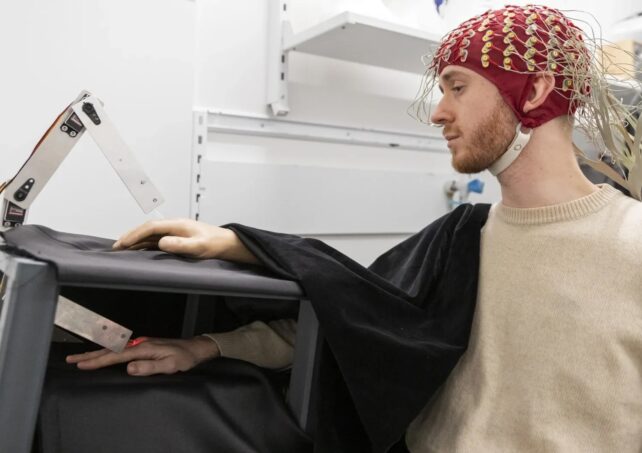
In the first batch of experiments, participants had a robotic arm tap the index finger of their real and fake hands, either at the exact same time or with a delay of up to 500 milliseconds between each tap.
As expected, participants reported feeling that the fake hand was part of their body more strongly if the taps were synchronized, and the feeling steadily weakened as the gap widened between what they felt and what they saw.
The EEG readings from the second experiment added more detail to the story. The frequency of alpha waves in the parietal cortex seemed to correlate with how well participants could detect the time delay between taps.
Those with faster alpha waves appeared to rule out fake hands even with a tiny gap in taps, while those with slower waves were more likely to feel the fake hand as their own, even if the taps were farther apart.

Finally, the researchers investigated whether the frequency of these brain waves actually controls the sensation of body ownership, or if they were perhaps both effects of some other factor.
With a third group of participants, they used a non-invasive technique called transcranial alternating current stimulation to speed up or slow down the frequency of a person's alpha waves. And sure enough, this seemed to correlate with how real a fake hand felt.
Speeding up someone's alpha waves gave them a tighter sense of body ownership, making them more sensitive to small timing discrepancies. Slowing down the waves had the opposite effect, making it harder for people to tell the difference between their own body and the outside world.
"Our findings help explain how the brain solves the challenge of integrating signals from the body to create a coherent sense of self," says Henrik Ehrsson, neuroscientist at Karolinska.
The researchers say that the findings could lead to new understanding of or treatments for conditions where the brain's body maps have gone askew, such as schizophrenia or the sensation of 'phantom limbs' experienced by amputees.
It could also help make for more realistic prosthetic limbs or even virtual reality tools.
The research was published in the journal Nature Communications.