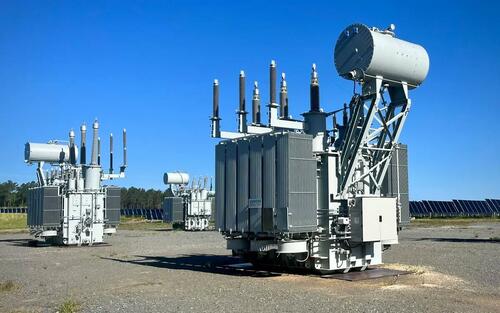
By Haley Zaremba of Oilprice.com
The global clean energy transition has passed a tipping point as renewable energies have simply become too cheap to fail. Worldwide, nations both rich and poor are rushing to install more and more wind and solar capacity to keep up with rising energy demand rates driven by global economic development and the age of AI. But while countries have been investing heavily into increased production capacity, investments in critical grid infrastructure have not kept pace, leading to a major energy transition bottleneck and a potential threat to energy security for an increasing number of countries.

The United States and Europe are both facing critical transformer shortages and aging and inadequate grid infrastructure, and the threat that this shortage poses to energy security is already being felt through historic blackouts such as last year’s cascading grid failure in Spain and Portugal. While these setbacks have raised the profile of infrastructure investing in European policy spheres, “ambition is not yet being matched by action from governments, policy-makers, investors and businesses,” according to a recent report from the World Economic Forum.
In the United States, specialists foresee a yearslong transformer crunch, with little to no relief forthcoming. While companies have rushed to ramp up production of power transformers and distribution transformers, keeping up with skyrocketing demand is an impossibly tall order. Wood Mackenzie estimates that, since 2019, U.S. demand for power transformers has jumped by 116 percent, while demand for distribution transformers has shot up 41 percent.
"This surging transformer demand has created a significant supply deficit, with domestic manufacturing capacity unable to keep pace," Wood Mackenzie Senior Analyst Ben Boucher. "Utilities are routinely turning to the import market to meet project timelines. In 2025, imports will account for an estimated 80% of US power transformer supply and 50% of the distribution transformer supply. This market imbalance is escalating costs and lead times and is delaying our ability to bring generating plants online in pace with the surging energy demand."
However, some experts disagree with this takeaway, arguing that the transformer “shortage” is overblown if not fabricated, and the issue lies in self-inflicted procurement problems. There’s room for debate because the issue is a complex one stretching over many different economic sectors and supply chains. Whether the problem is one of supply or one of procurement, however, the impact is the same – major bottlenecks for new electricity with potential pitfalls for national energy security.
“Over the past few years, what started as a squeeze has gradually morphed into a crisis,” Power Magazine recently reported. The Power article contends that this growing crisis has been “furnished by years of underinvestment in domestic manufacturing, a sudden surge in post-pandemic construction and electrification, and volatility in grain-oriented electrical steel (GOES) and copper markets, which steadily pushed lead times for large power and generator step-up (GSU) transformers beyond historical norms.”
And those driving factors are showing little signs of changing, indicating that delay times for transformer delivery are going to continue to stretch on. Even though demand for these products is now growing exponentially, this spike is coming in the wake of years of lackluster demand, and would-be investors are still warming up to the idea that they’ll get a return on their investment in the sector.
Hitachi, one major producer of such transformers, for example, has strategically only invested in transformer development when the purchase of those components is already guaranteed and buyer-backed. “Nobody wants to overinvest” in new production facilities, according to Hitachi Energy CEO Andreas Schierenbeck.
Through these kinds of up-front deals, Hitachi has planned $1 billion in new manufacturing capacity across the United States. However, Schierenbeck told news outlet Semafor this week that these deals are “probably not enough to close the gap between supply and demand… There are still customers who are just in the old world with transactional behavior, and they’ll have to be lucky to get a slot.”
Loading recommendations...