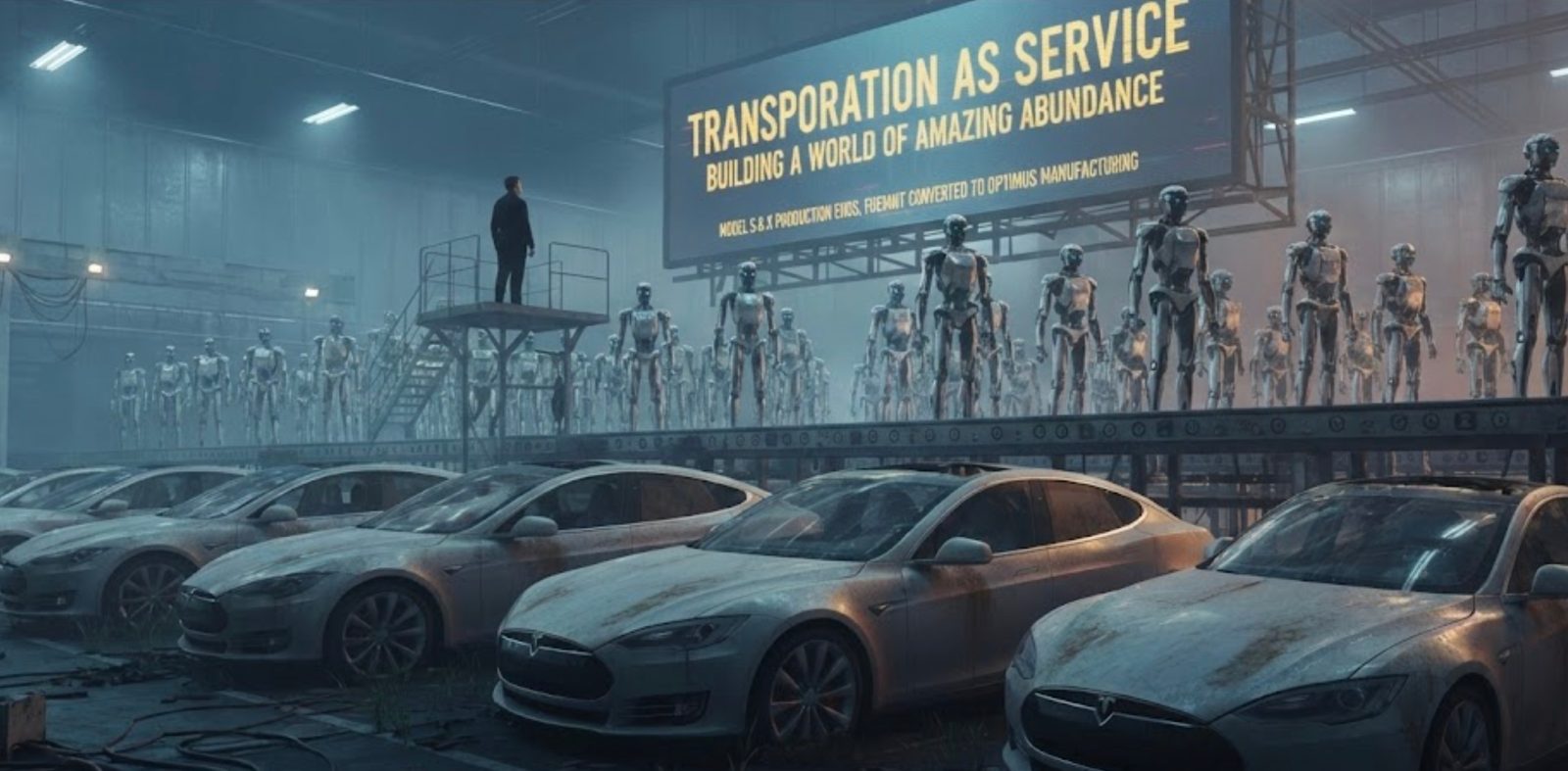
Tesla’s Q4 2025 earnings call made one thing painfully clear: the company is no longer interested in being an automaker.
In a single call, Tesla announced it’s killing the Model S and Model X, has no plans for new mass-market models, and is pivoting entirely to “transportation as a service.” The company that revolutionized the auto industry is walking away from it, not because it failed, but because Elon Musk got bored and found new toys.
What happened to Tesla today
When asked if Tesla has plans to launch new models to address different price segments, VP of Vehicle Engineering Lars Moravy gave a telling response:
“You have to start thinking about us as moving to providing transportation as a service more than the total addressable market for the purchased vehicles alone..”
Read that again. Tesla’s head of vehicle engineering is telling you to stop thinking of Tesla as a company that sells cars.
Musk doubled down:
“I really think long-term, the only vehicles that we’ll make will be autonomous vehicles.”
He predicted that “probably less than 5% of miles driven will be where somebody’s actually driving the car themselves in the future, maybe as low as 1%.”
And then came the killing blow: Model S and Model X production ends next quarter. The Fremont line will be converted to manufacture Optimus robots instead.
Finally, in its latest 10k SEC filing, Tesla officially updated its mission to “building a world of amazing abundance” – whatever that means.
What Tesla is left with
Let’s count Tesla’s current vehicle lineup:
- Model 3 — Successful (but in decline)
- Model Y — Successful (but in decline)
- Model S — Being killed
- Model X — Being killed
- Cybertruck — Commercial failure, selling ~20-25k/year against 250k capacity
- Tesla Semi — Still not in volume production after years of delays
That leaves Tesla with exactly two successful vehicle models. Two. And there are both in decline.
And instead of building on that success, expanding into new segments, addressing affordability, competing with the flood of new EVs from legacy automakers and Chinese competitors, Tesla is walking away.
The $25,000 Tesla that Musk promised for years? Scrapped.
New models to compete with the likes of the Hyundai, Lucid, Rivian, or the wave of affordable Chinese EVs? Not coming.
Tesla’s answer to everything is now the same: wait for robotaxis.
The false choice
Here’s what makes this so frustrating: Tesla didn’t have to choose.
The company could have spun off its AI and robotics efforts into a separate entity, call it Tesla AI or whatever, while keeping Tesla, the automaker, focused on what it does best: building and selling great electric vehicles and accelerating the industry’s transition to electric transport.
Or it could have done the reverse: spin off the automotive business and let Musk pursue his AI dreams with the parent company. Either way, there was no point in letting great EV programs die.
Tesla could have continued to invest in electric vehicles, leverage its expertise in batteries and power electronics, to accelerate EV adoption and stationary energy storage deployment, and could have licensed “Tesla AI’s” technology to integrate it into its vehicles.
Instead, Tesla is letting a highly successful automaker wither so it can chase autonomous robots and robotaxis that may or may not work, may or may not get regulatory approval, and may or may not find a market.
This is a company that delivered 1.6 million vehicles last year. That has a global Supercharger network. That has brand recognition any automaker would kill for (up until last year). And it’s being sacrificed on the altar of Musk’s next obsession.
The numbers don’t lie
Tesla’s automotive revenue declined 10% in 2025. Deliveries fell 9%. The company lost its crown as the world’s largest EV maker to BYD.
The response to these problems? Not to fix them by giving more love to its EV programs, but to abandon the business entirely.
Instead of killing Model S and Model X, Tesla could have brought the good things it did with the Cybertruck, such as drive-by-wire and its 800V powertrain, to its programs, but it didn’t bother.
Meanwhile, the “future” Tesla is betting on looks like this:
- Robotaxi fleet: About 30-60 vehicles actually operating in Austin, despite claims of “well over 500”
- Optimus robots: Zero doing useful work in factories, by Musk’s own admission
- CyberCab: About to go into production without a steering wheel while Tesla still hasn’t solved autonom
Tesla is abandoning a business that generated $80 billion in automotive revenue and almost $15 billion in profits at its peak for ventures that currently generate essentially nothing.
During the earnings call, the company announced it will spend a record $20 billion in capital expenditure in 2026, and most of it will go into its robotaxi and humanoid robots, as well as their supporting infrastructure, especially training compute.
Meanwhile, Tesla generated less than $6 billion in net income (non-GAAP) in 2025 – down 26% from last year and more than 50% from its peak a few years ago.
Electrek’s Take
I’ve covered Tesla for over a decade. I watched this company prove that electric vehicles could be desirable, that they could be profitable, that they could compete with and beat the best that legacy automakers had to offer.
And now I’m watching it commit suicide.
There’s a version of this story where Tesla remains the dominant EV maker while also pursuing AI and autonomy. Where the company launches affordable models to compete with Chinese EVs. Where it expands into new segments. Where it uses its manufacturing expertise and brand power to actually grow its automotive business, and push the industry forward in the process, especially in the US, where automakers are falling behind the rest of the world.
Instead, we get Lars Moravy telling us to think of Tesla as a “transportation as a service” company. We get Musk saying the only vehicles Tesla will make are autonomous ones. We get the Model S and X killed to make room for robots that don’t work yet.
Tesla could have had both. It chose to have one, and that could lead to neither.
This is Musk joining the popular “as a service” trend of the elite, who don’t want people to own anything and instead have them “subscribe” to as many things as possible. It’s a depressing future.
RIP Tesla the automaker. You didn’t have to die.
FTC: We use income earning auto affiliate links. More.