Heat pumps are becoming increasingly common in private homes. But storing the heat they produce has not been possible – until now. SINTEF and Swiss company COWA Thermal Solutions researchers are collaborating on the solution.
“Think of it as a thermal battery, which stores the heat from the heat pump and can be used later. In practice, this means that people get more energy out of the stored heat. It becomes easier and more comfortable to use, and the energy is also used in a smarter way,” says Galina Simonsen, a senior research scientist at SINTEF.
Simonsen is a member of the team that has developed the new thermal batteries.
“The batteries have high efficiency, and they charge and deliver heat quickly, making it easier to meet the need. Like when several people are taking showers one after the other, for example, or you need hot water early on a cold morning,” says Simonsen.
The solution will also benefit your wallet because it makes it possible to store excess heat when electricity is cheap or produced in an environmentally friendly way, and can be used when the need for more heat arises.

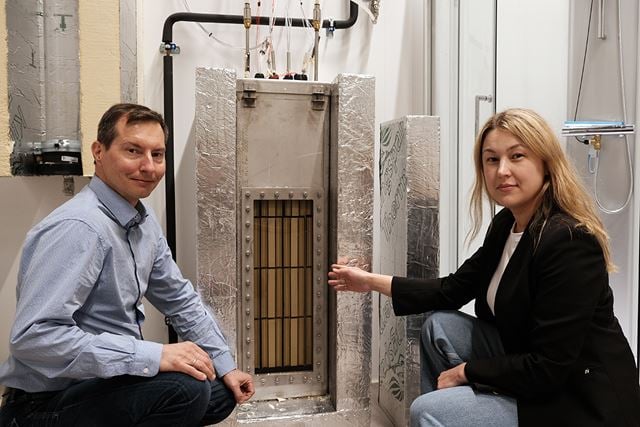
Research colleagues Martin Fossen and Galina Simonsen in front of the system that can store excess heat from heat pumps. Photo: Silje Grytli Tveten
Properties lie in salt hydrates
Heat pumps extract energy from the environment – air, soil or water – and transport the heat into the home.
However, in households and other buildings, the heat demand varies, depending on usage patterns, time of day, outdoor temperature and weather conditions. The researchers on this project have worked to meet these fluctuations in a smarter way.
“A heat pump that runs constantly is expensive, energy-consuming and can lead to overloading the power grid. With the new batteries, heat pumps combine storage and smart distribution of heat,” says Simonsen.
First out with a solution for private individuals
“The research team at SINTEF has collaborated closely with the Swiss company COWA Thermal Solutions to develop their solution. Although thermal energy storage already exists, the team is among the first to have managed to create a solution that is so effective that it is attractive for private homes.
The secret lies in a combination of technical solutions and materials called salt hydrates.

Studies of salt hydrates in the laboratory at COWA Thermal Solutions. Photo: COWA Thermal Solutions
“Unlike the salt we sprinkle on food, salt hydrates lock water into their structure and behave in a unique way when exposed to heat,” says Simonsen.
Substances that can undergo this physical transformation, from melting to solidification, belong to a broader group of materials known as “phase change materials.”
Here you can read about the company Cartesian, which has created a similar solution for both heating and cooling large buildings based on solar or wind power:
“Think of thermal batteries as sponges: When they’re heated to a certain temperature, they undergo a change from solid to liquid and can store heat. When they are cooled, they return to solid form and release heat again,” says Simonsen.
“They can store much more thermal energy than water, for example, and they retain heat longer, even if the temperature does not change that much.”
In other words: more heat and more stable temperatures.
Space-saving solution
Salt hydrates thus open up completely new possibilities for smart and more balanced heating systems because heating can be moved to times with low energy demand.
“Salt hydrates aren’t toxic, they’re not flammable and they are also relatively inexpensive. This makes them a safe and good choice for use in private homes. Heat storage with salt hydrates also takes up less space than a traditional hot water tank, often up to four times less,” says Simonsen.
About the Sure2Coat project:
The work is being carried out as part of the EU-funded project Sure2Coat and in close collaboration with the Swiss company COWA Thermal Solutions and research partners. COWA has worked to develop and improve the salt hydrates with new additives, so that the materials are stable and can function for decades without losing their special properties. SINTEF has worked to improve the efficiency of the batteries themselves.
Traditional systems often have low efficiency and can take a long time to charge and provide heat to the house. By using thin cooling fins, the researchers have managed to increase the efficiency of the new batteries from 65 to 85 percent. At the same time, charging time has been reduced by over 70 percent and the time it takes to release the heat has been cut by more than 80 percent.
The EU-funded Sure2Coat project is a collaboration between 14 partners in industry and research in 7 European countries. The project involves developing and implementing new or improved methods for surface treatment and coating of surfaces for different types of metals. The methods are demonstrated through three specific application areas: the gearbox, gas-water heater and latent heat storage.
Through the project, end users will effectively reduce their energy use, material consumption, CO2 emissions and pollution from production. The goal is to contribute positively to European industry and the EU's growth strategy by integrating surface treatment methods into the production line.
Recycled aluminium used
SINTEF’s task in the project has been to improve the efficiency itself. That is, how the heat is stored and released in the batteries.
“Specifically, we have designed and tested a type of heat sink that improves heat transfer in the thermal batteries,” says Simonsen.
The cooling fins are thin metal structures made of recycled aluminium that are effective heat conductors. This means that the heat is distributed quickly and evenly through the salt hydrate.

Researcher Galina Simonsen with the cooling fins used in the solution. Photo: SINTEF
“Aluminium is a light material, has good thermal conductivity and is easy to form. The use of recycled aluminium also reduces the environmental footprint and costs, and helps to promote a more circular use of materials.
At the same time, recycled aluminium poses a challenge: it can contain impurities that make it more vulnerable to corrosion.
“Corrosion is particularly critical because salt hydrates are tough on aluminium, especially when impurities are present. Without protection, the cooling fins can degrade over time, reducing performance and shortening the lifespan of the entire system,” Simonsen explains.
To solve this problem, the researchers have employed a type of coating called plasma electrolytic oxidation (PEO), which forms a thin, ceramic layer on the surface of the aluminium.
“This coating is similar to what is used on non-stick pans and provides a very durable and corrosion-resistant barrier,” says the researcher.

The researchers constructed a bathroom: the box in the middle stores heat during periods of low energy consumption and later releases it to deliver hot water to the shower. Photo: SINTEF