many traditional and modern card games. At only 120 cards, it supports a large number of existing game systems, such as:
The Everdeck is a card game system that can be adapted to play many traditional and modern games. It’s a portable travel companion, universal proxy deck, and game designer’s prototyping tool all in one.
This isn’t just a deck with extra ranks and suits. Its 120 cards can map to many distinct game systems:
The Everdeck is designed with a ruthless combinatorial efficiency. Beneath its minimalist pen-and-ink design lies layers of mathematical and linguistic patterns. This isn’t just a deck with haphazardly placed extra glyphs; rather, it aims to be both beautiful and practical.
This blog post is adapted from the Everdeck’s design document, found in this google docs link. Game systems are in blue bold text, and hyperlinks are formatted this way. A picture of all the cards is found at the end.
The Everdeck is now available, please buy it via DriveThruCards.com. Please subscribe to the BGG board game page!
Card Anatomy
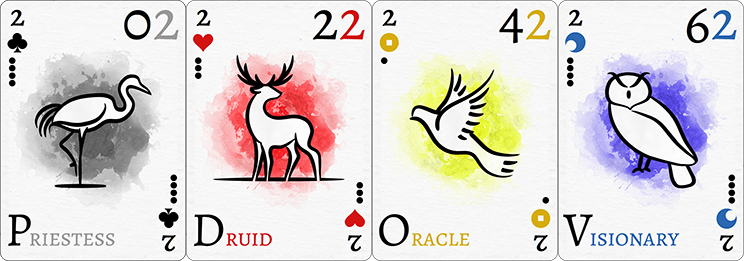
The Everdeck is an animal-themed deck. A card’s rank and suit is found at the top-left and bottom-right corners; underneath that is a point value of 1 to 5 dots. Every card is uniquely named and numbered, with a picture at its center.
Deck Structure
The Everdeck has 120 cards in eight suits. Suits are paired by color: black clubs/spades, red hearts/diamonds, yellow coins/crowns, and blue moons/stars.

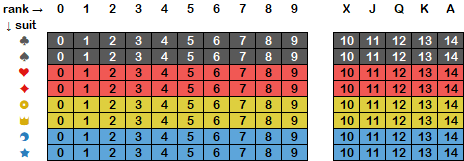
Each suit has ten number cards 0 to 9, and five black-bordered face cards X, J, Q, K, and A. 8 suits x 15 ranks can be achieved by mapping the face cards to the values 10-14.
Standard 52-Card Deck
The Everdeck can map to a 52-card standard deck by taking the traditional suits (red hearts and diamonds, black spades and clubs) and removing ranks 1 and 0. The remaining cards can form a second copy of the standard deck using non-traditional suits. 0 can be added back for Jokers.
Grouping by Color and Suit
The Everdeck may instead be treated as a four-color deck, giving two copies of (4 colors x 15 ranks). Two copies of a standard deck may also be combined to get a double standard deck for games like Canasta.
Sometimes, it helps to differentiate the two suits of the same color. This is done through suit groups: “soft suits” have icons with rounded tops, and “sharp suits” have pointed tops. The point values (dots) of soft suits are drawn with small circles, while sharp suits use diamond shapes.
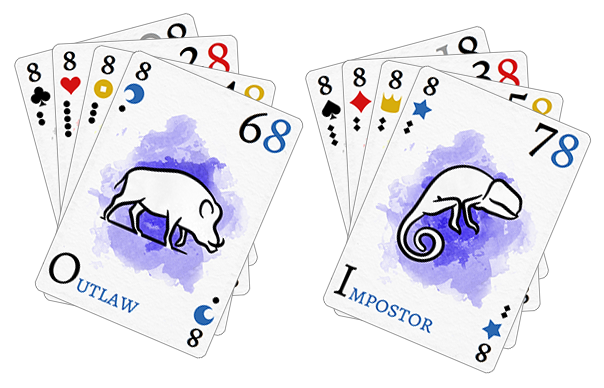
For 4 colors x 25 ranks, use the cards shown below and treat all sharp suits as having +10 value.

Letter Frequency
The first letters of each card’s name (bottom-left) have a frequency distribution compatible with English word games.

Here’s the distribution compared to Scrabble, Words With Friends, and standard English:

Letter Score
A card’s point value can be used for word game scoring mechanisms. Most letters have one or two possible point values, with rarer letters having higher average scores.

Point Value
Point values are also distributed equally across suits. Specifically, each suit has five 1’s, four 2’s, three 3’s, two 4’s, and one 5 (12345 • 54321). They can be used as an alternative rank value for games that require an uneven number of specific ranks, like Hanabi.

Naming Structure and Color Philosophy
All cards of the Everdeck follow a strict naming structure. Within a suit group, every four cards with the same rank are thematically related.
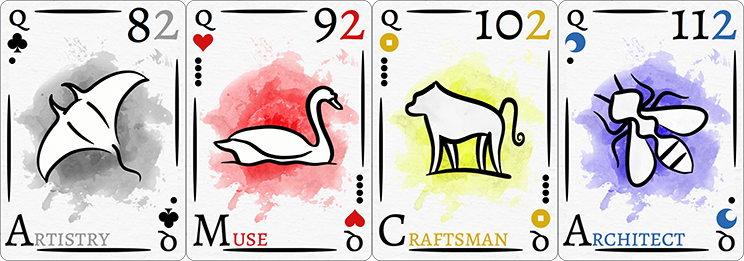
The thirty black cards represent 30 different archetypes. (Twenty-two of these correspond to the Major Arcana of the Tarot, while eight are unique to the Everdeck.) The three other cards are interpretations of the archetype, each filtered through a different color philosophy:
- Red Hearts/Diamonds is the SOUL, with themes of spirituality, emotion, art, and nature.
- Yellow Coins/Crowns is the BODY, representing civilization, physicality, and social or military power.
- Blue Moons/Stars is the MIND, with roles relating to intellect, cunning, and the sciences.
Another way to think about the primary colors is that they are biased viewpoints. These symbolic biases are only fixed when they’re mixed together, forming the universal color black.
Card Names
The symbolism of the Major Arcana is well-established. The Everdeck follows this symbolism to name all its cards, providing unique role cards for social games like Werewolf.

78-Card Tarot
A standard deck can easily be converted to a Tarot by using the X as a “Page” rank and adding the 22 black cards named after the Tarot Major Arcana.

Except for the last two aces, the Everdeck Tarot’s sequence number matches their Rider-Waite or Thoth number. More on sequence numbers below.
Sequence Number
Cards are uniquely numbered as well as named. Sequence numbers range from 0 to 119 and are used for games like No Thanks! or The Mind.
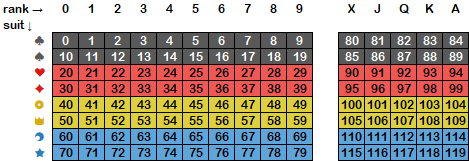
The number cards of each suit all start with the same digit. (For example, diamonds are all in the 30’s). This allows the suits to be ranked:

Colored Digits and Other Digits
The sequence can be split into two numbers. The rightmost number is the colored digit, which ranges from 0-9. The other digits are colored black and range from 0 to 11.
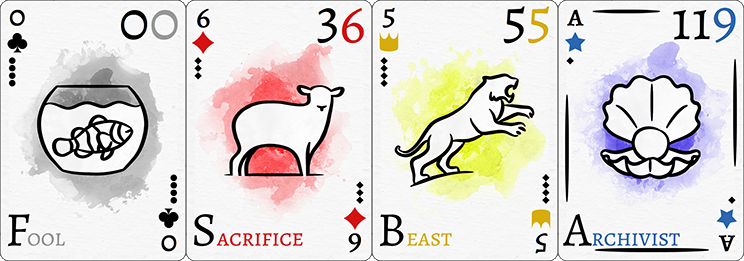
Colored digits and other digits can be used for 10 suits x 12 ranks or 12 suits x 10 ranks, depending on which one you treat as the “rank” and which one the “suit”.

When cards are fanned to the right, it’s easy to focus on the colored digit and ignore the others. This gives twelve copies each of the numbers 0 to 9 or three copies each of (4 colors x 10 colored digits).

Note that the colored digits match the card’s rank as well if it’s numeric.
Picture
The Everdeck is an animal-themed deck. Pictures and card names are thematically related, whether through symbolism, biology, or even just simple plays on words.

Each of the 60 unique animal pictures appear exactly twice, relevant for Memory variants. Paired pictures always have different ranks and different colors.
Here are the animals of the soft suits:

The animals of the sharp suits are the following:

Hanafuda
Hanafuda is a traditional flower-themed deck from Japan, Hawaii and Korea (where it’s called Hwatu). Its 48 cards are divided into 12 suits (“months”) of 4 cards each. Hanafuda has no numeric ranks or suits, instead using pictures to group cards into several categories, such as “Ribbons” and “Animals”.

Hanafuda’s asymmetric distribution of categories can be confusing, so the Everdeck requires a reference for the distribution. Cards of the same month are grouped by rank, and cards of the same category by suit:

Many cards are uniquely named for special scoring combinations. Pictures of these cards match or visually suggest their Hanafuda equivalent.

Summary
If you’ve made it this far, congratulations and thank you for reading about the deck! I hope you enjoy it as much as I enjoyed making it. A full spread of its pictures can be seen below (full size when opened in a new tab).
The system is available via DriveThruCards.com.

Credits
- Design: reddit (efofecks). Boardgamegeek thread here, with thanks going out to the many, many people who helped with the design.
- Images: Bat, boar, chameleon, clam, clownfish, crane, crow, duck, elephant, kangaroo, lamb, owl, rooster, swan by Contr4. All other animal art CC BY 3.0 also by Contr4 (Saeful Muslim at nounproject).
- Card Font: Alegreya SC, modified kerning. Google fonts open license.
- Watercolors: https://www.onlygfx.com/.
- Cover picture by Spencer Wharton (SpencerDub)